Bunco Score Calculator
Total target rolls, buncos, mini buncos, wins, losses, travel token status, and table team scoring in one sheet.
| Round | Target dice face | Single target | Double target | Triple target |
|---|---|---|---|---|
| Round 1 | Ones | 1 point | 2 points | Bunco, 21 points |
| Round 2 | Twos | 1 point | 2 points | Bunco, 21 points |
| Round 3 | Threes | 1 point | 2 points | Bunco, 21 points |
| Round 4 | Fours | 1 point | 2 points | Bunco, 21 points |
| Round 5 | Fives | 1 point | 2 points | Bunco, 21 points |
| Round 6 | Sixes | 1 point | 2 points | Bunco, 21 points |
| Event | Condition | Default value | Where it appears |
|---|---|---|---|
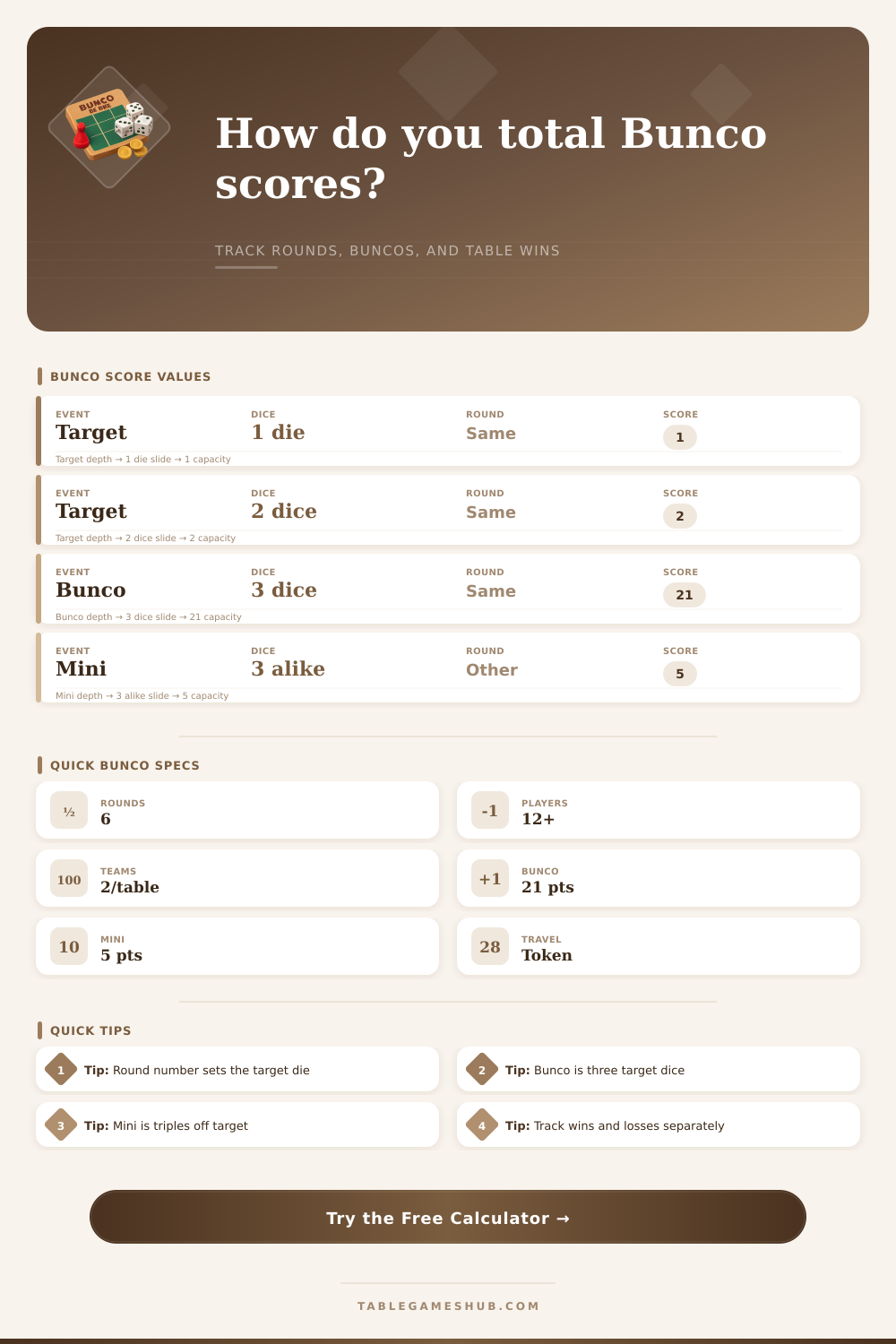
| One target die | Exactly one die matches the round number | 1 table point | Team table score |
| Two target dice | Exactly two dice match the round number | 2 table points | Team table score |
| Bunco | All three dice match the round number | 21 table points | Table score and Bunco tally |
| Mini bunco | Three matching dice off the round target | 5 table points | Table score and mini tally |
| Travel token | Player currently holds the travel marker | 0 points | Separate prize or note field |
| Table state | Team score check | Sheet mark | Rotation note |
|---|---|---|---|
| Team reaches target and leads | Team score at or above target | Win for the two teammates | Winners usually move up |
| Opponent reaches target first | Opponent score at or above target | Loss for the two teammates | Losing pair changes partners |
| Tied at target | Both teams at or above target | Table tie note | Use your host's tie rule |
| Neither team at target | Both scores below target | No final W/L yet | Keep rolling at table |
| Travel token active | Tracked beside table score | Travel mark only | Token passes by house rule |
| Sheet type | Primary ranking | Bonus counts | Best use |
|---|---|---|---|
| Classic party sheet | Most wins | Buncos and travel | Casual 12 player nights |
| Prize tally sheet | Buncos, wins, losses | Mini buncos optional | Multiple prize categories |
| Tournament sheet | Win points plus bonuses | Editable value fields | Larger groups or timed rounds |
| House rule sheet | Custom point total | Travel and mini values | Short games or themed nights |
Bunco scoring involve several different types of points and records. To play Bunco scoring corectly, there are three different aspect of Bunco scoring that you should be tracking. These include the dice point, the table outcome, and the session tally.
The dice points is the number of points that is earned from rolling the dice. Additionally, the table outcome indicate if the table win or lose that round. Finally, the session tally is the number of wins and loss that each person accumulate throughout the nights games of Bunco.
How to Use a Bunco Score Calculator
Because Bunco scoring involve these three separate aspect of Bunco, it is essential to ensure that these three separate aspect are tracked and not mixed up with each other. To produce an accurate Bunco score, several different field must be selected and filled out on the Bunco score calculator. First, you must select the current round since that will determine the target number for Bunco.
Additionally, you must also choose the table number since the head table, middle tables, and low tables can have different scoring. Furthermore, you must enter the scores for each team at the start of the round so that the calculator can determine whether or not the team have won the round yet. Buncos and minis must also be entered into the calculator since a Bunco occur when a player rolls three dice that match the target number for that round, while a mini occur when the three dice match a number other than the target number.
Because these scores has different values, it is important to enter these scores in the apropriate field for the calculator to work correctly. Another field on the calculator is for the travel token. While many travel token dont have a value assigned to them, some Bunco groups do give travel tokens a value.
In this case, the travel token field allow individuals to enter the player that have the travel token. This field is helpful to those who do not use travel tokens as a scoring for Bunco. Finally, the calculator also have fields for session wins and losses.
These scores keep track of the number of rounds that each table have won and lost throughout the night. While the outcome of each table will determine the result of that round, the wins and losses will determine the final ranking of each table throughout the night. These field will display on the calculator while players are still calculating the score of that round.
It is possible for a person to have many dice point during a round but to have very few session win for that nights games. Another use of the Bunco score calculator is to accommodate for the house rule of the Bunco game. Many groups will have different house rules for Bunco than others.
For example, some house rule will require that the target score be 15 point rather than 11 points. Additionally, another house rule could change the value of a mini. The value field of the Bunco score calculator can be adjusted to accommodate for these house rules of the Bunco game.
By changing the value of the fields, the calculator will produce the same result as the score sheet that was printed for the Bunco game. The status line on the Bunco score calculator is also helpful. This field will display whether the round was a win, loss, tie, or if the round was still open.
This allow for each person to know the outcome of that round without having to calculate the score again. Additionally, if someone were to win the round, the status line will display this so that no argument occur between player about who won the round. Overall, the Bunco score calculator allow individuals to keep track of the various category of Bunco scoring.
Each player can enter their dice point, table outcome, and session tally. By keeping these categories separate on the Bunco score calculator, the ranking for each player will be accurate. Furthermore, at the end of the nights games of Bunco, the Bunco score calculator will show the result of the game so that each player can accept the score for that nights games.