○ Go Handicap Stones Calculator
Balance a Go pairing by rank difference, board size, komi, reverse komi, game format, confidence level, and handicap placement pattern.
| Metric | Value | Formula note | Pairing read |
|---|
| Board size | Lines | Common handicap cap | Stone value proxy |
|---|---|---|---|
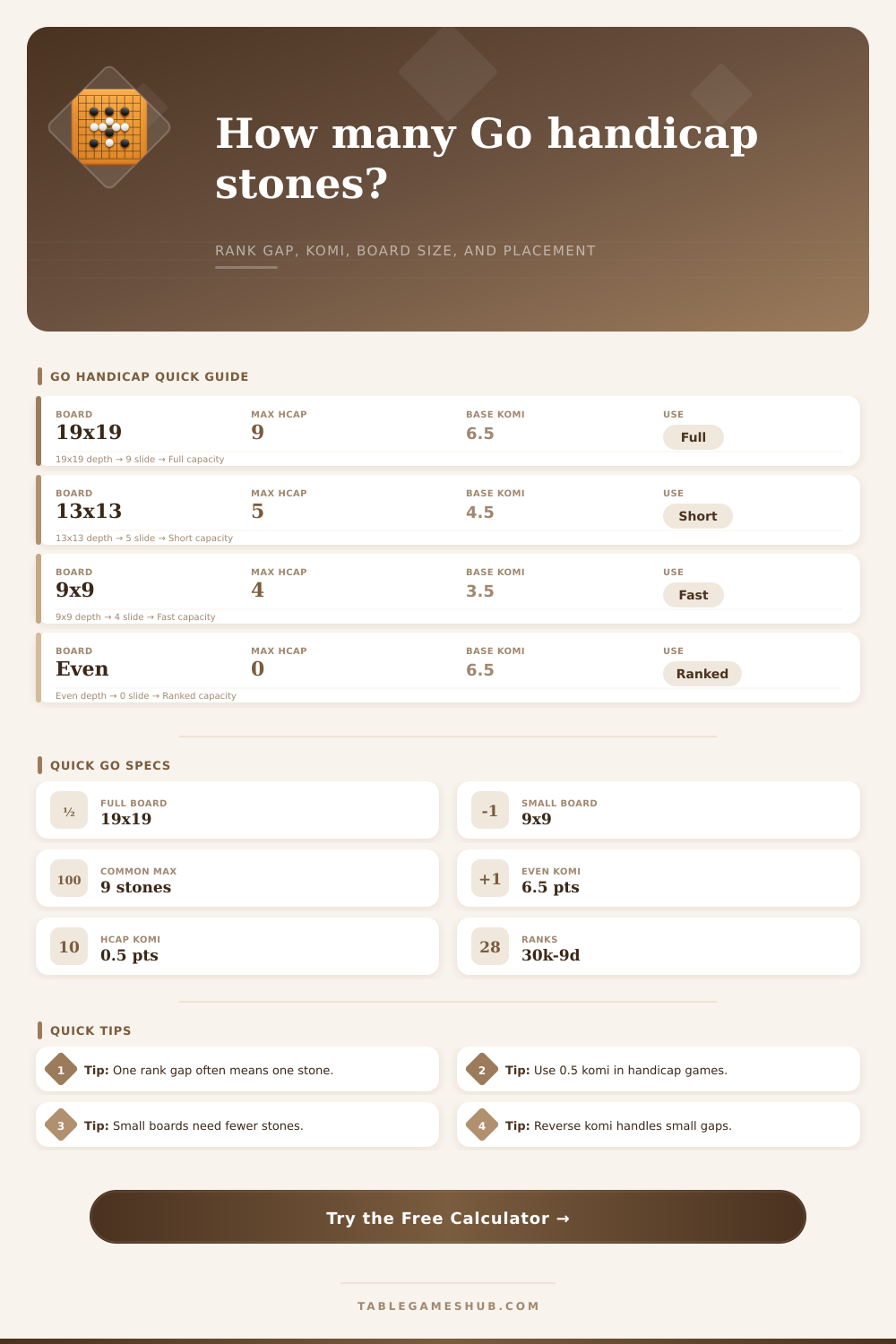
| 19x19 full board | 361 points | 9 stones | About 6.5 points per rank-step |
| 13x13 short board | 169 points | 5 stones | About 4.0 points per rank-step |
| 9x9 quick board | 81 points | 4 stones | About 2.5 points per rank-step |
| Even game | Any size | 0 stones | Komi carries the first-move balance |
| Rank gap | 19x19 recommendation | 13x13 recommendation | Reverse komi option |
|---|---|---|---|
| 0 to 0.5 ranks | Even game | Even game | 0 to 3 points to Black |
| 1 rank | Black plays first or 1 stone | Even or 1 stone | 3 to 6 points to Black |
| 2 ranks | 2 stones | 1 stone | Use if avoiding fixed stones |
| 3 to 5 ranks | 3 to 5 stones | 2 to 4 stones | Fine-tune by 2 to 4 points |
| 6 or more ranks | 6 to 9 stones | 4 to 5 stones | Teaching format recommended |
| Game format | Adjustment | Komi tendency | Best use |
|---|---|---|---|
| Club handicap game | Standard rank gap | 0.5 komi with stones | Regular pairing nights and casual rated games |
| Teaching game | Reduce about half a stone | Small reverse komi acceptable | Reviewing shape and direction without crushing pressure |
| Tournament pairing | Keep recommendation strict | Follow event rules | McMahon groups and official handicap rounds |
| Review or practice game | Prefer balance band | Flexible komi | Testing openings, joseki, and direction choices |
| Pair Go mixed table | Average team strength | Use simple half-point komi | Mixed teams with combined rank estimates |
| Stone count | Traditional full-board points | Opening shape | Calculator note |
|---|---|---|---|
| 2 stones | Upper right and lower left star points | Diagonal corners | Good for a clear two-rank gap |
| 3 stones | Three corner star points | One open corner | Leaves direction choice to White |
| 4 stones | Four corner star points | Stable corner framework | Classic beginner handicap shape |
| 5 to 7 stones | Four corners plus side and center stars | Large framework pressure | Usually a teaching or club gap |
| 8 to 9 stones | All side stars plus tengen at 9 | Maximum fixed pattern | Use careful komi and expectations |
| Balancing method | Best for | Strength gap handled | Practical tradeoff |
|---|---|---|---|
| Fixed handicap stones | Clear rank differences | About 2 to 9 ranks | Strong effect on opening shape |
| Reverse komi only | Small differences | Under 2 ranks | Keeps an even-board opening |
| Reduced stones plus komi | Teaching games | Medium gaps | Softer than full handicap |
| Even game komi | Similar players | 0 to 1 rank | Cleaner result comparison |
Rank Gap Tip
For full-board club play, start with one stone per rank difference, then adjust only when recent results show a consistent imbalance.
Komi Tip
If the players are close but not equal, reverse komi often gives a fairer test than placing one early handicap stone.
Handicap stones is used in the game of Go to ensure that a game is fair when played between two players of different experience levels. When two players of different experience levels play against each other, the more experienced player is usually stronger than the less experienced player. As a result, the stronger player will win most game against the weaker player, and the weaker player will experience little win against the stronger player if the stronger player should win all games played against the weaker player.
In order to ensure that games are competitive between players of different experience levels, handicap stones is used between the players. When two players of different experience levels are to play against each other, the less experienced player will place a number of handicap stone on the Go board prior to the stronger player making the first move on the board. These handicap stones is placed on the board in order to give the weaker player an advantage in the game.
How Handicap Stones Make Go Games Fair
The number of handicap stones that are used is determine by the difference in strength between each of the players. Such a difference in strength between the players can be determined by the number of rank each player holds. In general, one full rank between two players is equivalent to the value of one handicap stone on a full-size Go board.
Based off the ranks of the players, a calculator can determine the number of handicap stones to be placed on the game board by the less experienced player prior to the stronger player making the first move. The size of the Go board can impact the number of handicap stones that are to be use between the players. For example, on a standard Go board of nineteen by nineteen lines, the maximum number of handicap stones that can be placed on the game board is nine stones, which are placed on the star points of the board.
Should the game be played on a thirteen by thirteen lines Go board, the maximum number of handicap stones that are to be used is five handicap stones. For games played on a nine by nine lines Go board, the number of handicap stones decreases again. The smaller the Go board on which the game is to be played, the more powerful each handicap stone becomes.
Therefore, a handicap stone calculator that determines the number of handicap stones to be used between the players can account for the size of the Go board that is to be use, and each player can select the correct size for the calculator to calculate the number of handicap stones. Another method that can be used between players that have a difference in experience levels is the use of komi. In games that are even between the players in terms of experience, the stronger player will give the weaker player a komi advantage in order to ensure fairness between the players.
Such a komi advantage is typically six and a half points, as the weaker player does not have the advantage of making the first move in the game. If handicap stones are already on the game board prior to the game, then the komi stones may also be used between the players in order to avoid a draw between the players. The reverse komi is used between the players in place of the komi stones.
The reverse komi is typically used when the difference in rank between the two players is between zero and one full stone in strength. The placement of the handicap stones on the game board also has an impact upon the game that is to be played between the two players. For example, the handicap stones can be placed on the star points on the Go board, or the stones can be placed in a corner-first pattern on the game board.
Additionally, the stones can be placed in any position on the game board that the less experienced player desires. Each of these placement patterns will impact the experience of the less experienced player during the first twenty moves of the game. However, none of these placement patterns will impact the number of handicap stones that are to be used between the players.
A handicap stone calculator can provide a visual map of the placement pattern to the players to allow the players to review the placement of the handicap stones. The rank of the players is not always an accurate representation of the experience of each player with the game of Go. The rank that is provided to each player may be relatively high based upon the experience of each player in previous years, but the stronger player may have gain experience in the game in the years since the rank was provided to them.
Additionally, the rank that is provided to each player may be high, but the player may have become less experienced in the game since taking a break from playing games of GO. To account for these factors, a handicap stone calculator allows for the players to provide a confidence setting as to the accuracy of the rank of each player. The higher the confidence level of the players, the more accurately the ranks will be reflected in the calculation of the number of handicap stones.
A lower confidence setting indicates that the rank of each player may not accurately reflect their experience with the game of GO. An alternative method of using handicap stones is in the teaching of games of GO to a less experienced player. In these instances, the stronger player will typically accept a lighter handicap in order to enable the teacher to show the student the types of mistakes that can be made during the game.
A handicap stone calculator can provide a teaching format for the teachers of GO that will reduce the number of handicap stones to be placed on the game board by about half a rank. Using half a rank in handicap stones will allow the students to experience some of the challenges that can result from making mistakes in games of GO. In the game of Pair Go, in which two players are to be teamed up against two other players, an additional variable must be accounted for in the calculation of the number of handicap stones.
In this instance, the ranks of each of the players on a team must be combined to calculate the strength of each team. This resulting handicap will apply to each team rather than to the individual players. This ensures that a stronger player who is a member of a team will not be overcome by a weaker player who is on the opposing team.
The number of handicap stones can also be taught to players who wish to increase their experience with the game. For example, players may make mistakes with the number of handicap stones that are to be used between the players. With a handicap stones of two, for instance, a player may feel as if they will win the game against their opponent.
However, this does not ensure that they will win the game; the purpose of using handicap stones is to ensure that the game is competitive between the players. If one team wins too often, an adjustment to the number of handicap stones will have to be made for that player in the subsequent games; either half a stone will be added to the handicap for the stronger player, or half a stone will be removed from their handicap stones. Thus, while handicap stones may be calculated for the players, the players will make the final decision regarding the number of handicap stones that will be used during each game of GO.
Many clubs that play Go have their own local rules regarding the game of GO. For example, some clubs will round the measurement of the rank of the players up to the next rank to ensure that the games are interesting for the players. Additionally, some clubs will use the reverse komi pool instead of calculating the number of handicap stones between the players.
These rules are created by the clubs to ensure that each player feels as if they had a chance to win the game of GO against their opponent. While the handicap stone calculator can determine the number of handicap stones that should be used between the players, the players will need to make the final decision on the number of handicap stones to use in their games of GO.