Jaipur Goods Token Calculator
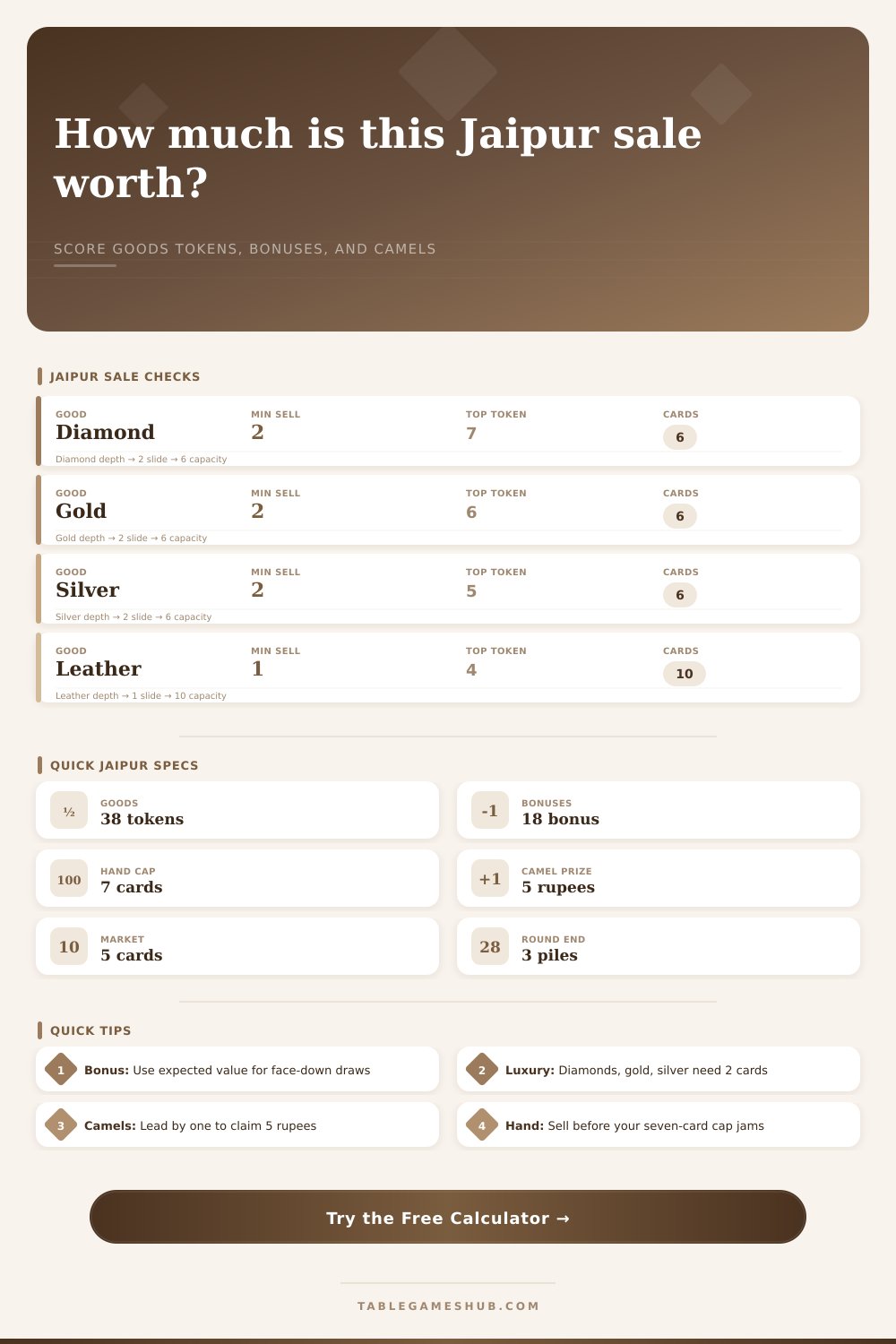
Score a single Jaipur sale from the remaining goods pile, sale-size bonus, camel token race, hand space, and projected round total.
| Goods pile | Token values in claim order | Cards in deck | Minimum sale | Calculator use |
|---|---|---|---|---|
| Diamonds | 7, 7, 5, 5, 5 | 6 cards | 2 cards | Highest burst pile; punishes late timing. |
| Gold | 6, 6, 5, 5, 5 | 6 cards | 2 cards | Strong pair sale, especially before second token disappears. |
| Silver | 5, 5, 5, 5, 5 | 6 cards | 2 cards | Flat pile; timing is more about denial and bonuses. |
| Cloth | 5, 3, 3, 2, 2, 1, 1 | 8 cards | 1 card | Good 4-card bundle candidate if top tokens remain. |
| Spice | 5, 3, 3, 2, 2, 1, 1 | 8 cards | 1 card | Mirrors cloth; the 5 token is the tempo prize. |
| Leather | 4, 3, 2, 1, 1, 1, 1, 1, 1 | 10 cards | 1 card | Low token values, but excellent for big-sale bonuses. |
| Cards sold in one sale | Bonus token pile | Hidden values | Expected value | Planning note |
|---|---|---|---|---|
| 1 card | No bonus | None | 0 | Legal only for cloth, spice, and leather. |
| 2 cards | No bonus | None | 0 | Legal minimum for diamonds, gold, and silver. |
| 3 cards | 3-card bonus | 1, 1, 2, 2, 2, 3, 3 | 2 | Useful when top goods tokens are still above 2. |
| 4 cards | 4-card bonus | 4, 4, 5, 5, 6, 6 | 5 | Often the sweet spot for cloth and spice. |
| 5 or more cards | 5-card bonus | 8, 8, 9, 10, 10 | 9 | Can make leather competitive despite low tokens. |
| Logistics rule | Calculator field | Scoring effect | Round planning implication |
|---|---|---|---|
| Camels are held in a herd, not in hand | Your camel herd | May secure the 5-rupee camel token | A camel lead can offset a small sale gap. |
| Hand limit is 7 goods cards | Goods cards left after sale | Open slots show future market flexibility | Selling before taking can unlock a better exchange. |
| Market row refills to 5 after taking cards | Hand slots and camel lead | No direct sale points this turn | Sale turns do not reveal replacement cards. |
| Exchange can return goods, camels, or both | Hand slots after sale | Improves next-turn set building | Two or more open slots make larger exchanges safer. |
| Round scoring item | Value source | Calculator treatment | Tie or end note |
|---|---|---|---|
| Goods tokens | Visible pile values | Summed from current pile position | Three depleted goods piles end the round. |
| Sale bonuses | Hidden bonus backs | Minimum, expected, maximum, or ignored | More bonus tokens wins the first tie-break. |
| Camel token | Largest camel herd | Adds 5 to projected total only when ahead | A camel tie gives neither player that advantage. |
| Deck refill failure | Market cannot refill to 5 | Handled as a planning note, not a point source | May end the round before a stored set sells. |
Jaipur: You have a hand of good cards and you’re standing in market of Jaipur. Do you sell them now? Or wait until there is a better time? That’s the tension of a fast-paced turn. Sell something that’s in-hand or pick up some new cards from the market. You cannot do both.
Players often fumble on this one by thinking too hard about how much each token are worth. They forget it’s just about time and space. If you don’t know what those numbers do, take a look at calculator up top. The calculator will do all of math for you. Now here’s what they mean.
How to Decide When to Sell Your Cards
Your statement of risk is based off the products you’re selling. Luxurius item goods like diamonds, gold, and silver have large point bursts but they also needs to be sold in sets. You need at least two cards to sell them. That means they are rigid. Having one diamond card in your hand is dead weight until you get another diamond card. Their rigidity changes how you manage hand size.
You play with a seven-card limit. Any card you hold can becomes a liability if it doesn’t fit into a sellable set. This brings us back to Hand Room. Why? Because this isn’t all about your current points. This is about your future opportunities.
How many slot does a sale leave you with next turn? With two open spots from selling three spice cards, you’ve got flexibility. You can dive into the market and pluck out four new cards without busting your hand cap. But with seven cards left after that sale, you’re jammed. You’ve gotta sell or pass, and neither’s good if market dried up.
So how do you know? That’s where the logistics check comes in. And that’s how the tool calculates it for you. Consider it more of a forward-looking move than a backward-looking score.
That’s not all: there’s also some hidden variance in those bonus tokens. This one most players undervalue. You recieve a bonus token with an unknown value on its back whenever you sell at least four cards. The calculator smoothes that out using expected values. So it averages the possible points and helps you make a rational decision.
For instance, a four-card sale average five bonus points. That’s pretty good. That’s a decent buffer. If the bonus carries you, then you don’t necessarily has to use the highest-value goods token. But if the game is tight, you’re putting yourself in danger by relying on the bonus. The calculator allows you to toggle between conservative and optimistic estimates. That’s handy when you’re trying to catch up to a leader or hold off a chaser.
And then there are the camels. These guys are the wildcards of the game. The player who has gathered the greatest number of camel during the round wins 5 rupees. And camels don’t apply towards your hand limit. This is so insanely efficient. You could keep your collection of goods cards really low and just hoard those bad boys.
The calculator takes into account how many of these dudes you’ve got, and how many it thinks your rival have. It allows you to make more conservative, safe sales if you’re ahead in the camel race. You’ve got insurance. If you’re behind, well, maybe you’ll should of take some more aggressive chances with your goods in order to catch up.
This is detailed in the reference table found on that page. This chart depicts the value of tokens (e.g., a diamond token with a point value of seven at full pile will have a point value of five by the end). As they diminish, so does their value. So the first diamond token is worth seven points. Maybe the very last one will only get five. That’s going to punish those who wait around. But you don’t want to be the one to sell too soon either. You don’t want to be holding an empty hand when all of big bonus opportunities come along.
It’s a balancing act between security and greed. To play Jaipur well, you have to manage this flow. It’s not just about getting more points. It’s about managing a pipeline of goods into a hand with limited space. You try to hit the sweet spot between token value and sale size. These tools on this page help you quantify that split-second decision. But the real skill is the gut feeling built from seeing how these inputs shift the balance of power. You don’t sell just for the points; you sell for the position. And finally, position is everything.