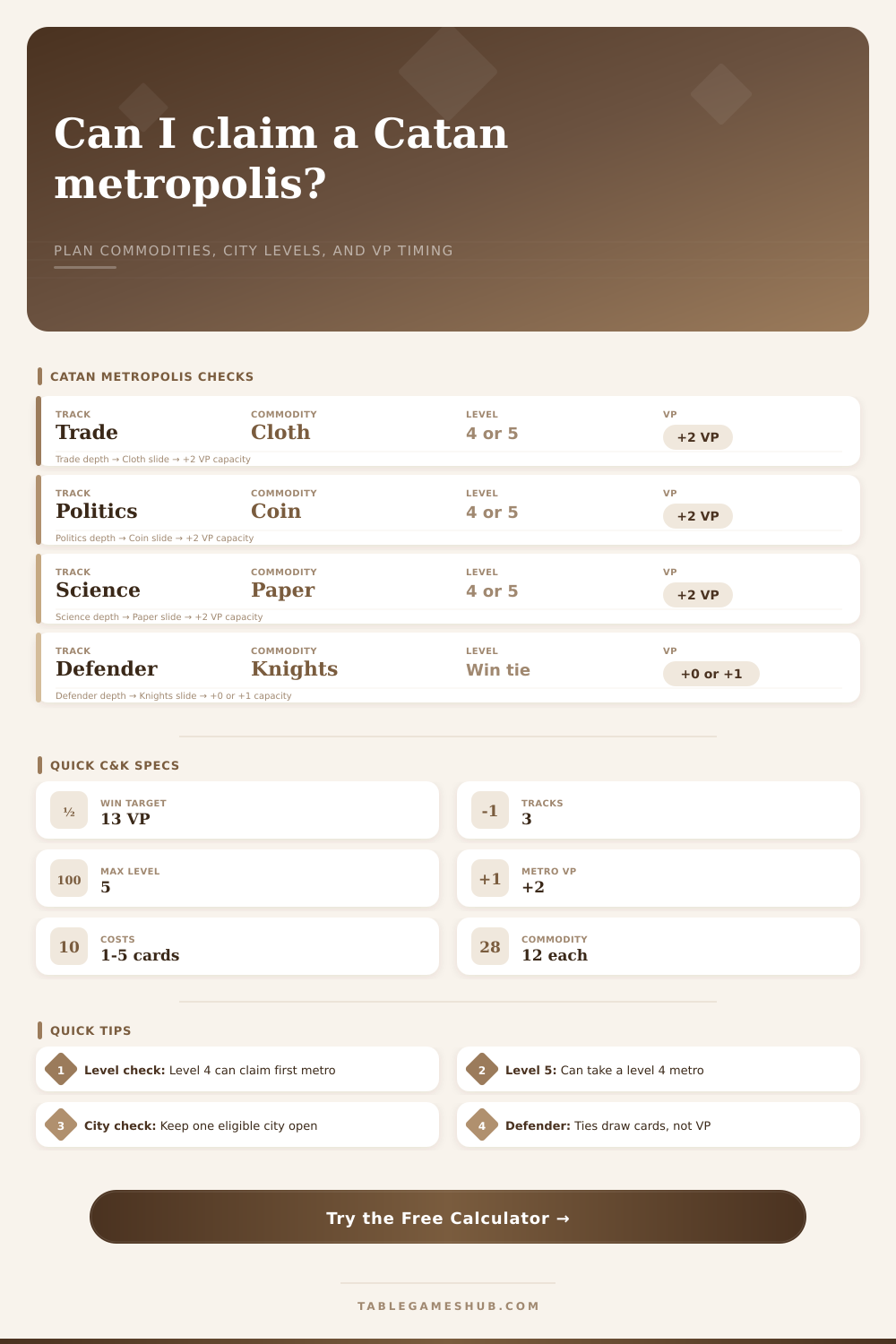
Catan Metropolis Calculator
Plan Cities & Knights commodity requirements, city improvement levels, metropolis eligibility, Defender timing, and the 13 VP finish.
| Level reached | Single flip cost | Cumulative cost | Planning note |
|---|---|---|---|
| Level 1 | 1 matching commodity | 1 card | Starts the calendar track. |
| Level 2 | 2 matching commodities | 3 cards | Often sets up progress card rolls. |
| Level 3 | 3 matching commodities | 6 cards | Unlocks the track ability. |
| Level 4 | 4 matching commodities | 10 cards | Can claim the matching metropolis. |
| Level 5 | 5 matching commodities | 15 cards | Can take or protect a contested marker. |
| Track | Commodity source | Metropolis trigger | VP logistics |
|---|---|---|---|
| Trade | Cloth from pasture cities | First level 4, or level 5 takeover | Marker adds 2 VP to a city. |
| Politics | Coin from mountain cities | First level 4, or level 5 takeover | Do not place on a city with another marker. |
| Science | Paper from forest cities | First level 4, or level 5 takeover | Level 3 ability remains after later flips. |
| Any track | Matching commodity only | Requires at least one city to improve | Losing the marker loses its 2 VP. |
| City terrain | Commodity produced | Resource paired | Calculator use |
|---|---|---|---|
| Pasture city | Cloth | Wool | Feeds the Trade calendar. |
| Mountain city | Coin | Ore | Feeds the Politics calendar. |
| Forest city | Paper | Lumber | Feeds the Science calendar. |
| Field or hill city | No commodity | Two resources | Good for trades, not direct flips. |
| Barbarian result | What is compared | Reward or loss | Metropolis angle |
|---|---|---|---|
| Catan defended | Active knight strength beats barbarians | Top contributor gains Defender VP | May combine with +2 metropolis VP. |
| Top contribution tied | Two or more players tie for highest aid | Tied players draw progress cards | Useful, but no immediate VP card. |
| Catan defeated | Barbarians exceed active knights | Lowest contributor loses a city | A metropolis is protected from downgrade. |
| No eligible city | All cities are gone or already marked | Improvement timing may be blocked | Upgrade or free a city slot first. |
Cities and Knights has a tendency to come down to an abrupt end. For two hours, you’ve played a slow-paced resource management game; waiting for rain, saving up wool. And then somebody slaps down their third city marker, gets three victory points and suddenly, they win the game. It is unsettling because most of the time, it realy is that unsettling. Did you track how much coin or cloth you spent? Or did you guess?
That’s what makes this kind of game so tricky: Victory can hinge on a single decision, and sometimes that decision is knowing when you’re out of money before putting your cards on the table. That’s where a good look at your paper, cloth, or coins goes a long way. This tool will help you get that look, so you know exactly how close you are when you put your cards down on the table.
How to Win Cities and Knights
Three tracks is the key mechanic here, one for each commodity and corresponding type of city. If you want to use Science to get the special power (and thus the metropolis marker), your city must be in a forest, produce paper as its primary good, and you have to be at level four. For Politics, it’s a mountain city with coin as its primary good; for Trade, it’s a pasture city with cloth as its primary good.
Getting to level three provides a helpful ability, but getting to level four is when you actualy gain the ability to put down the metropolis marker. Many players falls into this trap, thinking that obtaining the special power at level three means they already own the ability to place the metropolis marker. Not so! Level four is required to stake your claim, and there has to be an open spot on the board for you to drop it down.
Input your hand count and where you currently stand in terms of improvements to see how many more cards you need. The calculator will tell you how far off you are from achieving what you’re after. And it’ll let you know if you can or should convert any excess resources as well. Trading two for one at a matching harbor is nothing compared to having to trade four for one at the bank. Add in whatever surplus goods you possess and the math gets real fast.
Maybe you’ve got a warehouse overflowing with grain and don’t know what to do with it. Converting it into paper could be the difference between winning and watching someone else win the crown.
What matters isn’t so much what cards are in play but where those cards is placed. That requires some strategy. You’re looking for a city marker; each city gets exactly one. Once that marker goes down, it can be taken by someone else if they reach level five. So if all your cities is full of markers, no matter how far up you get, you won’t win any victory points.
That’s another pitfall: people run around trying to max out every city to score some victory points and then suddenly find themselves blocked from getting into the metropolis game. Leaving a city or two unclaimed at a lower level is more than a mistake. It’s part of your plan. It keeps your back door open.
And that’s where the Defender card comes into play. It’s another wrinkle. When you defeat the barbarians, you recieve one of these victory point cards, though with ties you’ll typically gain some combination of progress cards rather than points. That could mean missing out on an instant payoff required for the finishing line (thirteen points). You must then decide: should you focus on defending? Or should you go after the city?
It depends on how many points you’ve scored so far. It might be the former: if you’re down by three, you may need that metropolis to get over the hump. Or it might be the latter: if you’re already up five, you can probably afford to give away those two points.
Everyone concentrates too hard about amassing cards and not enough about spending those cards. It looks like it’s clever to wait as long as possible for the cloth but then you’re leaving yourself open to other people going first. The idea is to get to level four one turn ahead of your opponent (and ideally even further ahead if they’ve already taken the marker). At that point, you can swipe their city away. That adds a bit of drama to the end of the game.
Suddenly what was a basic “collecting contest” has become something more like a time-based puzzle. The cumulative cost is tracked on the page with reference tables. You need ten matching commodity cards to get from level zero to level four. There are only twelve copies of each commodity card in the game. That is a large part of the deck. Assuming that two players race for the same track, somebody’s going to be out of cards.
The calculator lets you see just how scarce those cards are. It visualizes your position in the race relative to the finish line.
Cities and Knights is a game of precision and patience. There’s no way to stumble into victory here. You have a plan, considering your hand, your city slots, and what your opponents are doing. While the calculator doesn’t decide for you, it takes away all the guesswork and lets you know how far away from victory you are. How many cards do you still need? How much closer are you to those two extra victory points?
Once you know how close (or far) you are, you’ll be able to put down the calculator, forget about the numbers, and play the game. And that’s where people go wrong. They worry about their cards rather than look around at the board. Look around the board, see how close you are, then make your move.