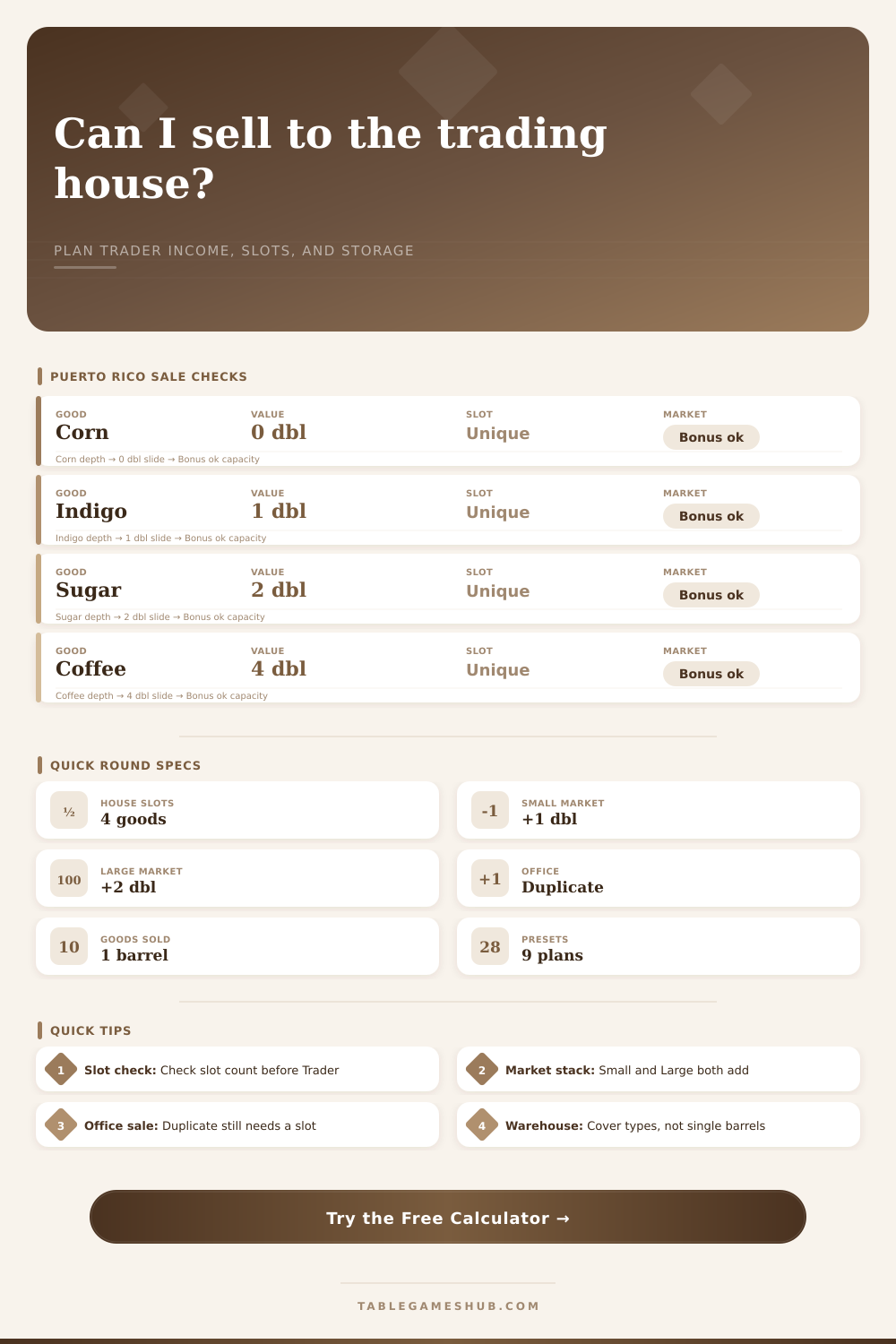
Puerto Rico Trading House Calculator
Check a Trader sale, apply Small and Large Market bonuses, track occupied trading-house slots, and balance warehouse exposure after Captain shipping.
| Good type | Base sale value | Common timing | Logistics note |
|---|---|---|---|
| Corn | 0 doubloons before market effects | Emergency market trigger | Only attractive when markets or slot timing matter |
| Indigo | 1 doubloon before market effects | Early production sale | Watch duplicate indigo in a partially occupied house |
| Sugar | 2 doubloons before market effects | Midgame flexible sale | Often competes with Captain shipping for barrel use |
| Tobacco | 3 doubloons before market effects | High-value Trader role | Strong target when Large Market is active |
| Coffee | 4 doubloons before market effects | Premium sale window | Plan around trading-house uniqueness and open slots |
| Component | Effect in calculator | Input field | Practical read |
|---|---|---|---|
| Trading house slot | Sale requires one open slot | Occupied trading-house slots now | Four occupied slots blocks the sale and clears after resolution |
| Good uniqueness | Duplicate goods normally cannot be sold | Duplicate-good trading house state | Check the goods already sitting in the house before choosing Trader |
| Office | Allows selling a duplicate good if a slot remains | Same good in house, Office available | Office solves uniqueness, not capacity |
| Small Market | Adds 1 doubloon to a successful sale | Market building effects | Can make low-value goods worth the Trader action |
| Large Market | Adds 2 doubloons to a successful sale | Market building effects | Pairs especially well with tobacco and coffee timing |
| Storage plan | What it protects | Calculator estimate | Round planning note |
|---|---|---|---|
| No Warehouse or Wharf cover | No chosen types after Captain | 0 protected barrels | Loose barrels are exposed to spoilage checks |
| Small Warehouse covers sale-good stack | All remaining barrels of one selected type | Sale stack plus matching extras | Best when one type remains after selling a single barrel |
| Large Warehouse covers one key type | One chosen good type for a conservative plan | About half of loose barrels | Use when the loose mix is uncertain |
| Large Warehouse covers two key types | Two chosen good types | About three quarters of loose barrels | Strong when two produced goods miss the ships |
| Wharf already handled one stack | One extra shipment outside ship holds | Reduces storage demand before warehouse math | Enter only barrels still left after Wharf use |
| Preset | Trader target | Market shape | Use when |
|---|---|---|---|
| Coffee With Both Markets | Coffee for 7 doubloons | Small and Large Market | You need maximum Trader income with an open unique slot |
| Sugar Crowded House | Sugar with three slots occupied | No market help | You are testing whether the fourth slot is worth filling |
| Indigo Office Duplicate | Indigo despite duplicate | Small Market | Office changes a blocked sale into a legal one |
| Sugar Shipping Round | Sugar after Captain pressure | Large Market | You want VP shipment totals beside Trader cash |
| Endgame Full Trading House | Coffee in a full house | Both markets | You need to confirm that no slot remains this role |
Add in the Trader role and things becomes different around the table. While five players attempt to play it cool, they’re also doing some mental math. What do you have? What’s in the trading house? Should I sell something yet?
For most player, this role becomes an income button. You pick a good. You receive coins. Simple enough, right? On the surface, yes, but that’s far from the truth. There are hard capacity limits and special constraints on the trading house, which makes each sale a huge gamble. The guts of this all come down to the four empty spot. There’s room for four different goods in the trading house before it will clear out. That means if you’re selling coffee, that goes in one of those empty spots, or replaces another good inside.
Understanding the Trader Role
That is unless you have built an Office. Here’s where folks mess up. They think that if they have the Office, they can duplicate-sell willy-nilly. Building the Office doesn’t solve capacity; it solves uniqueness. Having a spot available isn’t enough, you also need a physical barrel to put in that spot. If every slot are full, then the Office is useless.
Once you know how many slots you have and whether your goods is duplicated or not, the calculator runs the numbers for you. No more guessing if sale will meet legal standards. The Large Market and Small Market give you more doubloons on your sale, but you only get the bonus if it’s a successful sale. Nothing feels worse then spending your action selling a bunch of corn that nets you zero doubloons. Then you realize you weren’t eligible for the Large Market bonus because a blocked transaction does not count. Success means the bonus counts. If you can stack the Small Market and Large Market, you’ll increase the value from one barrel of tobacco up to six doubloons. That’s a huge swing in value. Only if there is an open slot and nothing else blocking your way.
These bonuses are time-sensitive, which means you need to look at board state three turns out. Not just what is happening on this turn.
And then there’s warehouse management. In order to sell that one barrel to the Trader, you’re likely left with a pile of the same stuff that’s at risk in the Captain phase of spoiling. And what do you do about it? Store it. Except warehouses don’t protect individual barrels, they protect certain types of good. Got a Coffee Warehouse? Every coffee barrel is protected. Don’t got any? Any loose barrels are fair game for points.
So now you have this odd situation where selling might actualy make things more risky. Sure, you made money. You opened up a spot. But maybe you didn’t get a chance to buy storage space, so now you’ve got a pile of indigo out in the open. This is laid out nicely in the reference table on the page which shows how each storage plan interacts with your remaining goods. Think of it as a trade-off between short-term money and protection over time.
For example, maybe your corn is worth less than everything else so you want to sell it off to make room for something more profitable down the line. Maybe you don’t sell anything at all because you’re saving space in your warehouse. Who knows? Depends on what your competition does. Your one corn slot could be the most valuable piece of real estate on the board if everybody’s dumping all their sugar into the trading house.
If you want to do well in Puerto Rico, then know this: everything costs something, even when it doesn’t. That’s true for trading, too. The Trader role is not all about collecting coins. It’s also about timing your market bonuses, controlling the flow of goods into and out of your house, and guarding what little stock remains for the Captain.
Should you sell now or keep stock safe? How much does each barrel count for? The calculator shows that trade off ahead of time. What’s the risk? Before you take action, you can see that risk as concrete numbers instead of an abstract gamble. How many barrels are going to get exposed? Will my second sale be legal? With that kind of clarity, you’re able to play confidently without hoping.
This game rewards thinking two steps ahead. You should know what’s going on in the trading house before you even have a chance to pick your role. Who’s going to get the slot? Should I keep my stuff there? You should of known all that by the time you make your decision. These tools help you run through those scenarios. They help you try out strategies without anyone looking over your shoulder or hearing the tick-tick-tick of the clock.
Use these tools to plot your move. To figure out how the trading house works. And when the moment comes, when you’re alone and picking the Trader, you’ll know precisely why you’re doing it. It won’t be a guessing game anymore. It will be a calculated strike.