♟ Elo K-Factor Calculator
Estimate Elo rating movement from K-factor choice, rating gap, game result, rating-period caps, provisional status, and league sensitivity settings.
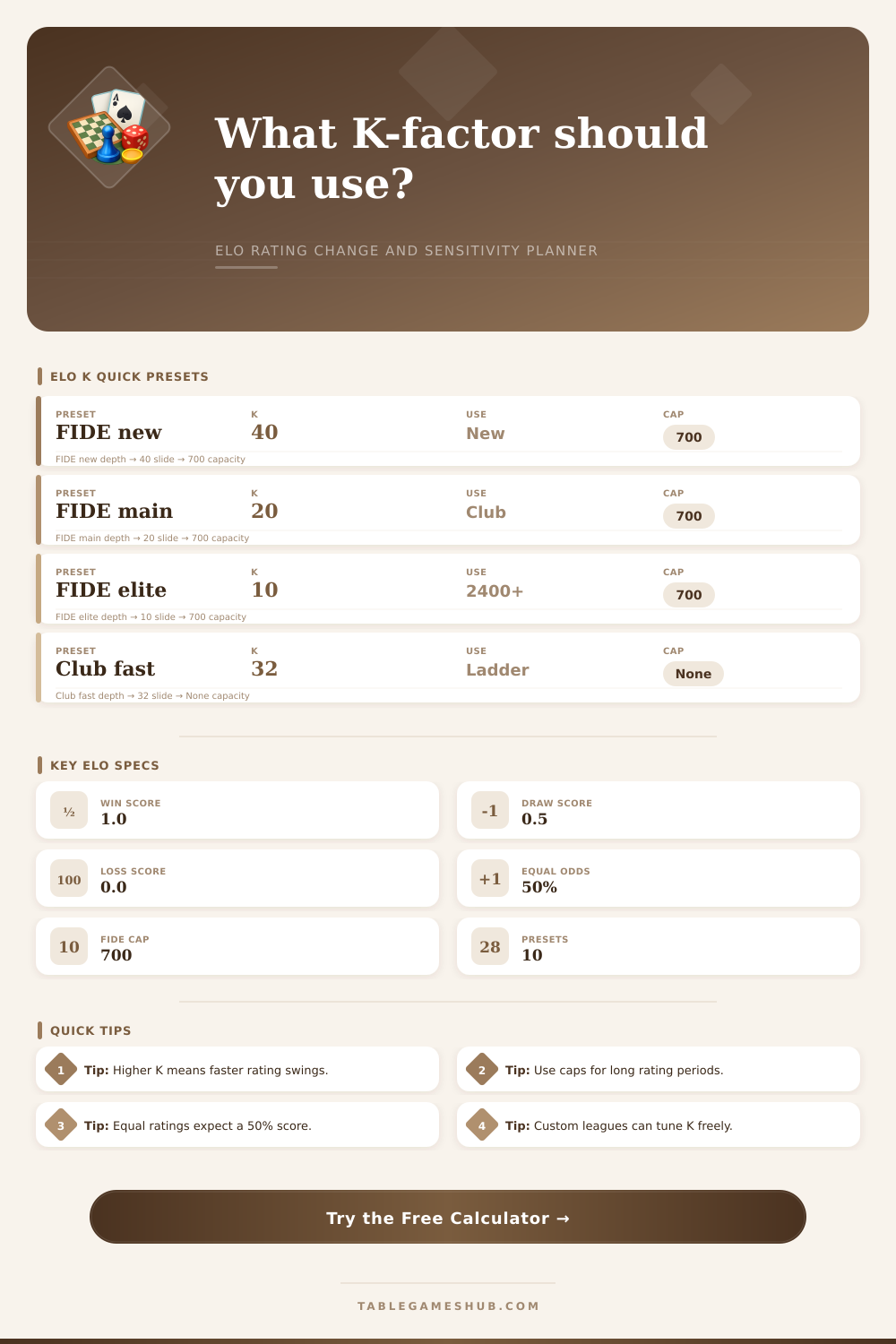
1K-Factor Presets
Load a common rating environment, then tune every field for your tournament, club ladder, chess server, or tabletop ranking sheet.
2Rating and Rule Inputs
3Live Rating Specs
4Formula Cards
Expected Score
E = 1 / (1 + 10^((Rb - Ra) / 400))
Converts the rating gap into the score the player is expected to earn before the game.
Rating Change
Delta = K x (S - E)
Compares actual score to expected score. Win is 1, draw is 0.5, loss is 0.
Period Cap
Kcap = floor(cap / games)
If a league caps K multiplied by games, the calculator lowers K for long periods.
Custom Sensitivity
Keff = min(K x V, Kcap)
Use a multiplier for club or online ladders while keeping a cap when desired.
5K-Factor Reference Grid
6Reference Tables
| Preset | Base K | Typical Use | Key Condition | Calculator Note |
|---|---|---|---|---|
| FIDE new player | 40 | Initial rated games | Under 30 completed rated games | High movement while the rating settles. |
| FIDE established | 20 | Main tournament pool | Always below 2400 published rating | Balanced sensitivity for regular events. |
| FIDE 2400+ reached | 10 | Elite published rating | Peak rating has reached 2400 | Stable K, even if current rating later drops. |
| FIDE junior style | 40 | Younger developing player | Until end of 18th birthday year if under 2300 | Use age and peak rating checks together. |
| Legacy class tier | 32 | Club or historical class pool | Lower rated active players | Useful for fast local ladders. |
| Custom provisional | 50 | New league seeding | Small sample, private ranking list | Use carefully; swings are intentionally large. |
| Player vs Opponent | Rating Gap | Expected Score | Win Change at K20 | Loss Change at K20 |
|---|---|---|---|---|
| Equal ratings | 0 | 50.0% | +10.0 | -10.0 |
| Player 100 higher | -100 | 64.0% | +7.2 | -12.8 |
| Player 200 higher | -200 | 76.0% | +4.8 | -15.2 |
| Player 100 lower | +100 | 36.0% | +12.8 | -7.2 |
| Player 200 lower | +200 | 24.0% | +15.2 | -4.8 |
| Player 400 lower | +400 | 9.1% | +18.2 | -1.8 |
| K-Factor | Max Single Gain | Max Single Loss | Approx Response Window | Best Fit |
|---|---|---|---|---|
| 10 | 10 points | 10 points | About 70 games | Very stable pools and top ratings. |
| 16 | 16 points | 16 points | About 44 games | Master-level legacy pools. |
| 20 | 20 points | 20 points | About 35 games | Established tournament pools. |
| 24 | 24 points | 24 points | About 29 games | Expert or active club pools. |
| 32 | 32 points | 32 points | About 22 games | Fast ladders and local rankings. |
| 40 | 40 points | 40 points | About 18 games | New, junior, or rapidly changing ratings. |
| Base K | Games in Period | K x Games | 700 Cap Result | Effect |
|---|---|---|---|---|
| 40 | 10 | 400 | K stays 40 | No cap pressure. |
| 40 | 18 | 720 | K becomes 38 | Long event slightly reduces K. |
| 32 | 25 | 800 | K becomes 28 | Ladder month is smoothed. |
| 20 | 35 | 700 | K stays 20 | Exactly at the cap. |
| 24 | 40 | 960 | K becomes 17 | Large batch needs stronger cap. |
| 10 | 60 | 600 | K stays 10 | Stable K rarely hits this cap. |
7Rating Tips
Choose K from the pool, not the mood. A higher K-factor is useful when ratings are uncertain, but it can overreact in a stable club ladder.
Watch long periods. If many games are submitted together, a K x games cap prevents one busy event from moving ratings too sharply.
It’s an immediate thing that you can’t see. You sit down at a game, the board is set, the clock runs, and then waiting somewhere behind you is a mathematical engine measuring what you do. Endgame technique or opening theory: these will decides this match right now, so most players spend their time thinking about them exclusivey.
But there’s another level to strategy that decides just how quickly you get on the leaderboard with your real strength revealed. It’s called K-factor, a sort of sensitivity knob that controls how important each individual game is to your cumulative rating. Once you understand that number, everything shifts for you; each tournament becomes more comprehensible.
What Is the K-Factor?
Plug in your own ratings and your desired results and let the calculator do its thing (above), then you’ll see, no guesswork about whether a bad performance will sink you or barely matter at all. You won’t have to stress wondering what is happening behind the scene when you post scores. “Oh no,” you might say, “I just blew it. Now I’ve dropped 10 points. That stinks.” Well, if you’d had a slightly different sensitivity setting, that same drop would of been four points instead of ten. And that’s nothing to do with your level of play at all. It’s simply admin.
Two opposing forces is at play here; accuracy versus stability, and the system attempts to strike a balance between them. A K-factor that is too high lead to wild swings in your rating depending on how well (or poorly) you played on any given day. Bad luck can causes huge fluctuations. Your rating ends up seeming less like a reflection of your skill and more like a mood ring. But set it too low and your rating slows to a crawl. Your improvement won’t be reflected for ages as the system doesn’t want to believe all these new wins you’re getting.
So where’s that sweet spot? That’s the difference between a ranking that works and one that simply frustrates. New players usually benefit from higher K-factor. Initially, they will be rated based off guesswork because the system requires fast feedback to find where their true skill level lie. That’s also why some federations begin everyone with a steep learning curve or high sensitivity factors for their first several dozen matches.
Then as time goes by and your history grows, the multiplier decrease. The system believes you’ve demonstrated what you’re about and begins protecting your rating from chance fluctuations. Crossing this threshold can feel disorienting as it suddenly becomes harder to gain points even if you improve. In addition, ratings can only increase so much per time frame. So it’s impossible for you to grind out 50 quick wins against new players and skyrocket your rank that way too quickly.
It’s explained nicely in the reference table at the bottom of the page. You can see it smoothes out tournament times and ladder months over a longer period of time to keep rankings honest. Your games aren’t just scored individually; they are also considered in context of the event. The top of the list tends to stay put with an elite player because their K-factors is typically very low (sometimes as low as ten). That makes for some stability in rankings and prevents world no.1 from flipping on a whim following an upset. It builds a wall around their rating that’s hard to break through, which may dissuade anyone who want to challenge them, but it helps keep things credible over time.
The mid-range is where you find the greatest feedback loop if you’re playing online ladders or casually at clubs. You’ll see enough movement when beating someone rated above you, but not get clobbered every time you lose to somebody rated below you. It’s not about chasing points; it’s about creating an environment which best reflects the world around you.
Once you understand those levers, you no longer complain about the system but use it for your gain. You know that sometimes winning isn’t great and losing isn’t terrible, it depends on the situation. Eventually the numbers quiet down. You see who’s really out there grinding. You see how quickly or slow the calculator choose to change the score.