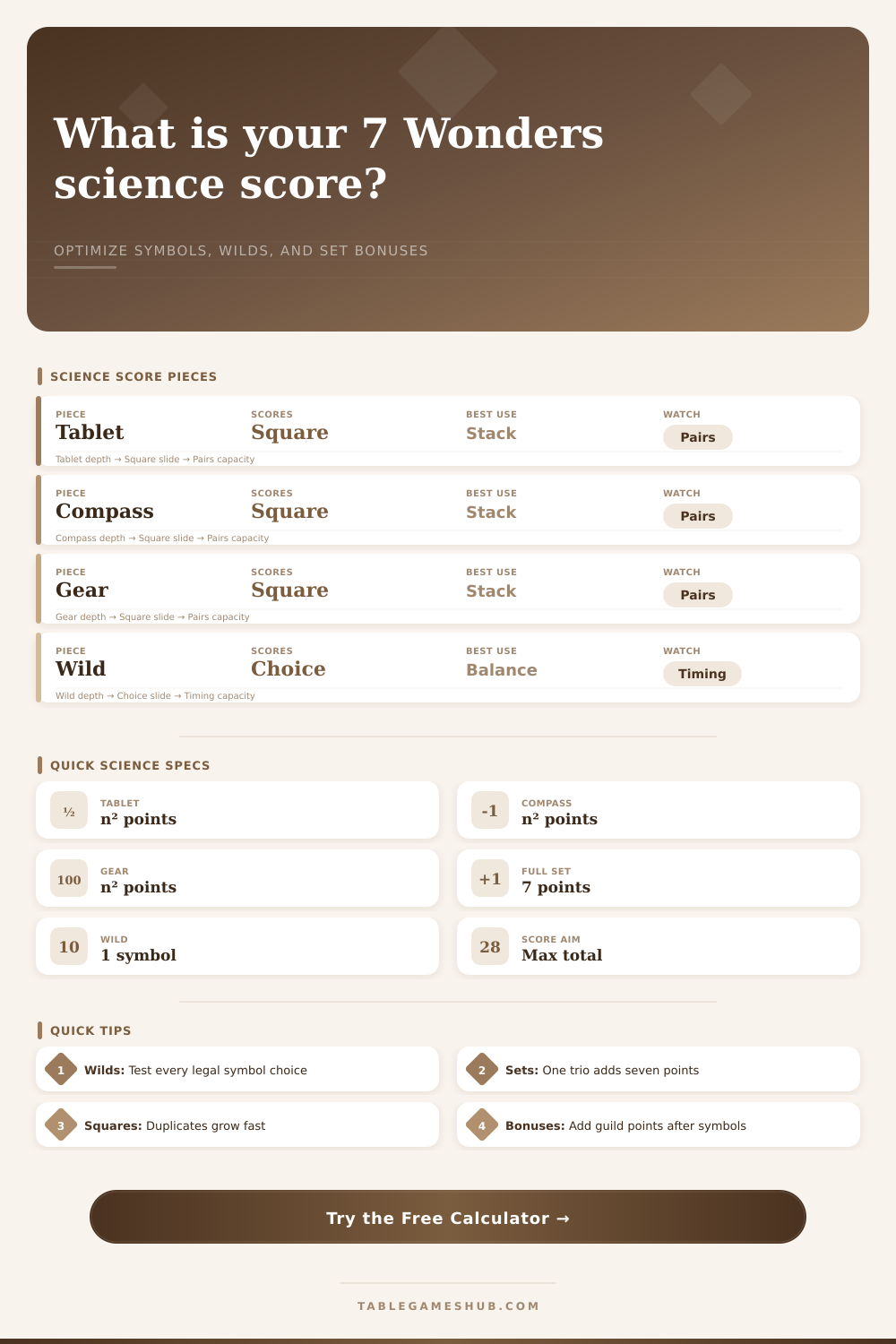
Seven Wonders Scientific Set Calculator
Total tablet, compass, and gear scoring with duplicate symbol squares, complete scientific sets, wild symbols, and guild or expansion science bonuses.
| Scoring Part | Formula | What To Count | Common Mistake |
|---|---|---|---|
| Tablet square | tablets² | All final tablet symbols | Counting only unique tablets |
| Compass square | compasses² | All final compass symbols | Forgetting duplicate growth |
| Gear square | gears² | All final gear symbols | Ignoring a copied symbol |
| Complete set | min symbols × 7 | Tablet, compass, and gear trios | Adding 7 only once |
| Wild symbol | best legal choice | Each choice icon separately | Locking a wild too early |
| Board Shape | Likely Best Wild | Why It Scores | Check Before Final |
|---|---|---|---|
| 2 / 2 / 2 | Any symbol | Each reaches 3 and keeps two sets | Compare square growth |
| 4 / 1 / 1 | Tablet often | A fifth duplicate adds 9 square points | Set loss may matter |
| 3 / 3 / 0 | Missing gear | Creates the first complete trio | Second wild may stack |
| 5 / 2 / 2 | Stack or balance | Both square and set gains compete | Use maximize mode |
| Component Source | Calculator Input | Score Timing | Use This Field |
|---|---|---|---|
| Green science cards | Fixed symbols | End game scoring | Tablet, compass, gear |
| Scientists Guild | One chosen symbol | Final choice | Wild science symbols |
| Wonder science stage | Chosen or printed symbol | When stage is built | Wild or fixed symbol |
| Leader or city bonus | Flat VP or copied icon | Card-specific scoring | Bonus points or wild |
| House reference sheet | Extra set award | Table agreement | Extra set awards |
| Final Symbols | Square Points | Set Points | Total Before Bonuses |
|---|---|---|---|
| 1 tablet, 1 compass, 1 gear | 1 + 1 + 1 = 3 | 7 | 10 |
| 2 tablets, 2 compasses, 2 gears | 4 + 4 + 4 = 12 | 14 | 26 |
| 4 tablets, 1 compass, 1 gear | 16 + 1 + 1 = 18 | 7 | 25 |
| 3 tablets, 3 compasses, 2 gears | 9 + 9 + 4 = 22 | 14 | 36 |
But Seven Wonders seems easy to score in science: pick green cards for three ages; watch as your pile of gear and compasses and tablets accumulates. Looks good! Then comes the scoring and you realize that another player has less organized-looking hand but still gets more points. That’s a mistake many people make (duplicate cards counts higher then balanced piles of singletons). Fortunately, there’s an app for that (well, a calculator on this page that does math for you), and it turns fuzzy worry into a clear number.
Its main mechanic punishes being average. Its formula reward stacking by squaring the count of any given symbol type. Nine points for three tablets, not three points for three tablets. Four points for two compasses, not two points for two compasses. It’s a rapid increase that encourages hoarding single symbols.
How to Score Points in Science
Or maybe two symbols at most, because you never feel like you’ve reached that dangerous zone where you have too many to be mediocre but not quite enough to fill out a set. That’s where the game gets heavy, and most people will miss it. You can amass a trio of symbols, and they’re only worth seven points (the set bonus), and think “Oh! I got the big score!” But usually, the set bonus is just the consolation prize from falling short of stacking your symbols so high as to completely dominate that square’s point value.
Now you consider: does it make more sense to put up one of these squares, or use an existing set? Suppose I have two tablets and one of everything else. Putting up another gets me four points (from the jump on the square). Finishing off a set nets me seven. Huh! The set is better. Except that now putting up that final tablet will bring me to five, worth a whopping twenty-five points. Suddenly the answer shifts.
That’s where wild cards are so important. Wild cards are flexible tokens; often created through wonder stages and guild buildings. They allow you to go back and change your hand after the fact. At the time you create them, you don’t know what they’re going to be worth. You know what they’re worth at the end. You don’t get to use these tools, and then win with those numbers. But you can test what they suggest by plugging in all combinations of wild placements and seeing which one scores highest.
For instance, maybe you have one weak pile and you are thinking “I’d better throw a wild at my weakest pile so I can fill it out.” And the calculator says no. Adding that wild to your best pile result in a bigger gain because now you get a square jump which outweighs the benefit of completing the set. And for most of us, we make our wild decisions too early. We think of them as hard limits instead of soft boosters. That is laid out nicely in reference table on the page. It explains which board shape values which wild strategy.
Scoring mistakes are made by people too. In a full group game, it is hard to keep track of squaring the cards for six different player. Someone forgot their set bonus. Someone forgot to square. Someone double counted their wilds. Having a central place that calculates it makes those arguments dissapear. It makes that part of the process a simple verification step and lets you argue about military dominance or trade deals rather than arithmetic.
In short, learning how to play science in Seven Wonders is about knowing when not having balance matters. Specialization matters. It matters more then chasing a second set while some other guy is sitting on a heap of five gears. That’s a counter intuitive route which feels wrong until you watch the points accumulate. Knowing the power of the square opens the door to scientific success. This applies whether you are planning your next round of moves in Age II or simply double checking the endgame tally. Once you understand how to stop forcing symbols to be equal and instead force them to be unequal, the math would of worked out in your favor.