Azul Stained Glass Calculator
Score a Sintra round with completed panes, palace strip chains, color bonuses, glazier movement, broken glass, and endgame color totals.
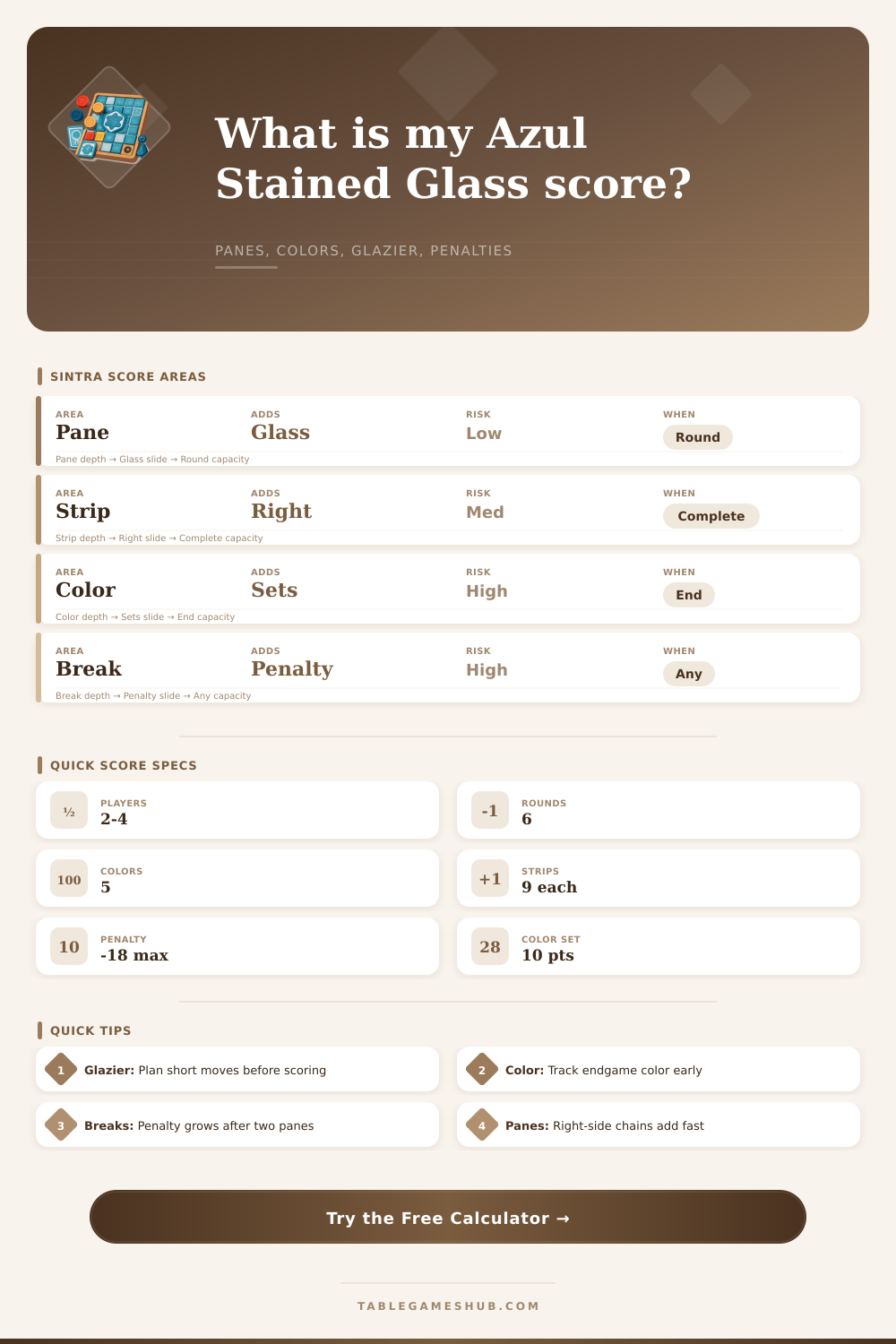
Use this worksheet for Azul: Stained Glass of Sintra scoring checks. It totals the current round, estimates endgame color value, and flags when broken glass is erasing pane gains.
| Scoring Area | Calculator Input | Formula Used | Best Use |
|---|---|---|---|
| Completed strip score | Base Glass Points | Direct pane score | Finished palace strip |
| Right-side chain | Scoring Panes To The Right | Panes x avg value | Developed board side |
| Round color bonus | Color Bonus Points | Bonus entered | Matched color burst |
| Broken glass | Broken Glass Pieces | -1, -1, -2, -2, -3... | Penalty audit |
| Endgame color | Color Sets and Plan | Sets x plan value | Final scoring projection |
| Broken Pieces | Penalty Total | Score Warning | Calculator Note |
|---|---|---|---|
| 0 | 0 | Clean round | Preserve tempo |
| 1-2 | -1 to -2 | Small leak | Often acceptable |
| 3-4 | -4 to -6 | Score drag | Needs pane gain |
| 5-7 | -9 to -15 | Major loss | Reset priority |
| 8+ | -18 cap area | Severe loss | Protect next round |
| Glazier Shift | Distance | Efficiency Effect | Board Reading |
|---|---|---|---|
| Same strip | 0 | Full efficiency | Ideal scoring lane |
| Near shift | 1-2 | Minor drag | Normal palace move |
| Middle shift | 3-4 | Moderate drag | Check right-side chain |
| Long shift | 5+ | High drag | Only if score spikes |
| Endgame Color Plan | Value Per Set | Good Target | Use When |
|---|---|---|---|
| Partial color | 6 points | 1-2 sets | Mixed board |
| Complete color | 10 points | 2-3 sets | Stable final row |
| Dominant color | 14 points | 3-4 sets | Focused color draft |
| Table-leading color | 18 points | 4-5 sets | Final sweep push |
| Mode | Players | Draft Pressure | Scoring Priority | Calculator Focus |
|---|---|---|---|---|
| Duel board | 2 | High color control | Endgame color | Color sets |
| Standard table | 3 | Balanced offers | Pane chains | Round total |
| Full table | 4 | Fast depletion | Penalty control | Broken glass |
| Final round | 2-4 | Targeted colors | Color multiplier | Projected total |
This worksheet is a scoring aid for Azul: Stained Glass of Sintra. Enter the visible scoring pieces from the board and compare the round gain against final color value.
Scoring a round of Azul: Stained Glass of Sintra involve managing two different objective: completing palace strips and color sets. While completing palace strips earn you points during the game, color sets earns you points at the end of the game. The difficulty with these scoring objectives involves the cost of broken glass for penalties and the decrease value of palace strips due to glazier movement.
Scoring can be rewarding in Azul: Stained Glass of Sintra if you earn bonus points for completing strip in a row. However, due to the cost of broken glass, scoring can also be a losing game for players who must pay the penalty for broken glass. For example, adding to the right-side panes for a potential bonus score can also decrease your score if the cost for broken glass are high.
How to Score and Plan in Azul: Stained Glass of Sintra
Using the provided calculator will handle the mathematical calculation for scoring. To use the calculator, all that you must enter is the number of completed strips, the number of panes completed on the right side of the board, and the number of broken piece of glass. Using the calculator will allow you to focus on your move rather than the mathematical calculation.
Many player will make a mistake with the movement of the glazier in the first few games of Azul: Stained Glass of Sintra. Part of the reason that players make these mistake is that they will often focus on one strip to complete as opposed to the efficiency with which the glazier can move between strips to complete them. A long shift of the glazier to complete one strip may provide the point to earn a strip but may cost more in efficiency points than the strip earned.
The distance that the glazier moves away from the player’s current strip or position cost the player efficiency points. The reference table include on the page explains how shifts of short, medium, and long distances between strips impact a player’s efficiency with the glazier. By referring to this table while playing the game, players can make more better movement decisions for the glazier.
Color planning is the second major component of scoring in Azul: Stained Glass of Sintra. Color planning involves determining how many color are left in each factory and drafting colors that are most convenienty for the early part of the game. As the game continues, players draft colors in specific factories so that the cost of ignoring that color in the last few turns is not too greatly.
By using the game calculator, players can change the value of each color set at the end of the game. By changing the value of each color set, players can determine if they have a good chance of drafting the colors at the end of the game. Many people do not consider the value of the last color set that players can earn which can substantialy increase the total number of point scored by a player.
Another game element that impact scoring is the number of pieces of broken glass. For the first two piece of broken glass, the penalty is low. Beyond two pieces of broken glass, however, the penalty for broken glass is high.
A risk that is acceptable for earning a few point on turn three can easily become a penalty that decreases your score by turn five if you continue to draft from the same group of factories. The penalty for broken glass rewards players who understand that the first few piece of broken glass are a warning to players not to draft from those factories any further. The factory pressure that a player feels impact the player’s color drafting and their overall strategy.
The level of factory pressure that a game feature changes depending on the number of players at the table. For example, in a game between two player, players can generally draft all of the colors that they need for their color sets. However, in a four-player game, factory pressure make it difficult for any player to take the time to draft their colors and leaves the pressure on the players to make their color decisions quick.
The calculator can adjust the efficiency value for different level of draft pressure between players. This helps to provide a better understanding of whether or not the color sets that a player drafts are still within reach at the end of the game. The primary value of calculating these values is for players to compare their scoring this round to their projected score at the end of the game with these calculations.
For instance, if the player has a high scoring value for this round but a low calculated value for the end of the game, the numbers is indicating that the current strategy that the player is using for the game may be incorrect. If the player has a high value for their score this round but has a weak color coverage, they should adjust their strategy to more heavy focus on protecting the colors that they need to score the most points. The opposite is true for a weak round value but high color coverage.
The worksheet makes it easy for players to determine the best focus for their Azul: Stained Glass of Sintra strategy for the remainder of the game.