✨ D&D Level Up Calculator
Track XP progression, proficiency bonuses, and level milestones for D&D 5e
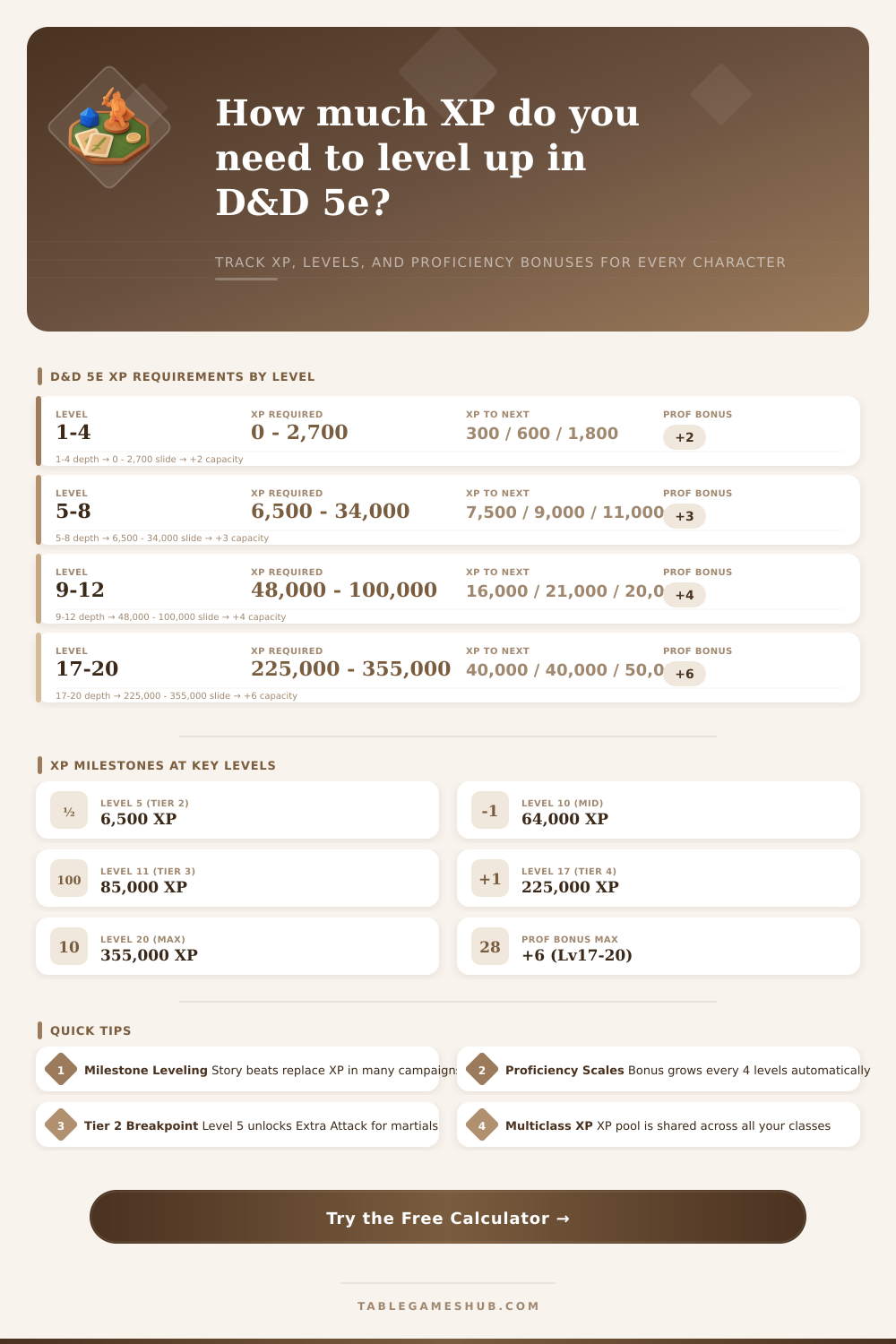
| Level | XP Threshold | XP from Prev | Prof Bonus | Key Features |
|---|
Local Heroes (Lv 1-4)
Characters are learning their abilities. Threats are local, survival is a real concern, and every level brings dramatic new powers like spellcasting and class features.
Heroes of the Realm (Lv 5-10)
Extra Attack, 3rd-level spells, and proficiency +3 arrive. Characters become true heroes capable of shaping regional events and facing powerful monsters.
Masters of the Realm (Lv 11-16)
Characters gain 6th-level spells, legendary resistance becomes common. Threats are national or world-level, and characters can shape the fate of kingdoms.
Masters of the World (Lv 17-20)
9th-level spells, proficiency +6, and near-mythic power. Characters rival demigods, clash with ancient dragons, and decide the fate of entire planes of existence.
Many modern campaigns use milestone leveling, where the DM decides when characters level up based on story beats rather than accumulated XP. This can create more satisfying narrative pacing and removes the need to track monster XP individually.
Your proficiency bonus applies to attack rolls, saving throws, skills, and spellcasting. It scales from +2 at level 1 to +6 at level 17, doubling its value. Multiclassing does not give extra proficiency bonuses — it is based on total character level.
Leveling up in DnD is basically a reward for the character because of killing enough monsters or completing big quests. When a character experiences adventures and beats challenges, they win experience points. Reaching a set amount of experience means improvement of skills.
This progress you call gaining a level. Every new level gives new class abilities, spells or changes of the basic stats
How Leveling Up Works in DnD
There are two main ways to handle the progress. The first is by experience won, which is the standard rulebook method. The amount of experience for every level is in the Player’s Handbook.
The DM decides the source and the amount of experience. He can give more experience for faster progress, or less for slow. The other popular way is milestone leveling, where after some encounters or challenges you receive a milestone, usually every four sessions for a new level.
This system works better for some groups, because experience play sometimes feels like tediious work.
For standard pacing, players usually level up every two or three sessions, although that depends on the style of the campaign and the preferences of the DM. The first levels are designed to be very fast, but the higher your level, the longer the progress takes. For expert players, level three is almost same as level one.
Actually, the levels one and two are only as an introduction.
Every time a character reaches a new level, they receive an additional Hit Die. You roll the Hit Die, add the Constitution modifier and add the total to the maximum of hit points. Instead, you can use the fixed value described in the class.
For instance, if a fighter of seventh level has Constitution of seventeen, reaching the eighth level he can increase that value to eighteen, which alters the modifier from three to four. Then the maximum of hit points grows by eight.
While you progress, stat points can be spent on any attributes. Every attribute has a different goal. Moreover, with every level usually comes something new: a new spell slot, special force, more gear or more HP.
Leading new players through the progress can be a difficult task. If players are entirely new and require help, that can take a lot of time. Trying to do that during the session can create chaos, because some progress quickly while others still decide on their choices.
So, it is better to do that at the end of the session. You can discuss the plans of the character and even describe a story about how he reached that new force or spell. Although there is a maximum of twenty levels, characters become truly mighty before they reach that cap.
If the campaign is short, the leveling occasionally feels like a rush.