Hand and Foot Score Calculator
Total a Hand and Foot round from books, melded card points, red threes, going-out bonuses, leftover cards, unopened feet, and house-rule scoring values.
1Preset Round States
Choose a named scenario, then adjust any score line to match your table sheet.
2Round Rules and Score Sheet Setup
3Books, Red Threes, and Round Bonuses
4Melded Card Points
Count all cards already in melds and books. Book bonuses are handled above, so this section counts the card faces themselves.
5Cards Left in Hand or Foot
Enter cards still held by this side at the end of the round. The calculator subtracts the same face values used for melded cards.
6Component and Score-Sheet Grid
7Reference Tables
| Card or Item | Common Value | Counts Where | Calculator Input |
|---|---|---|---|
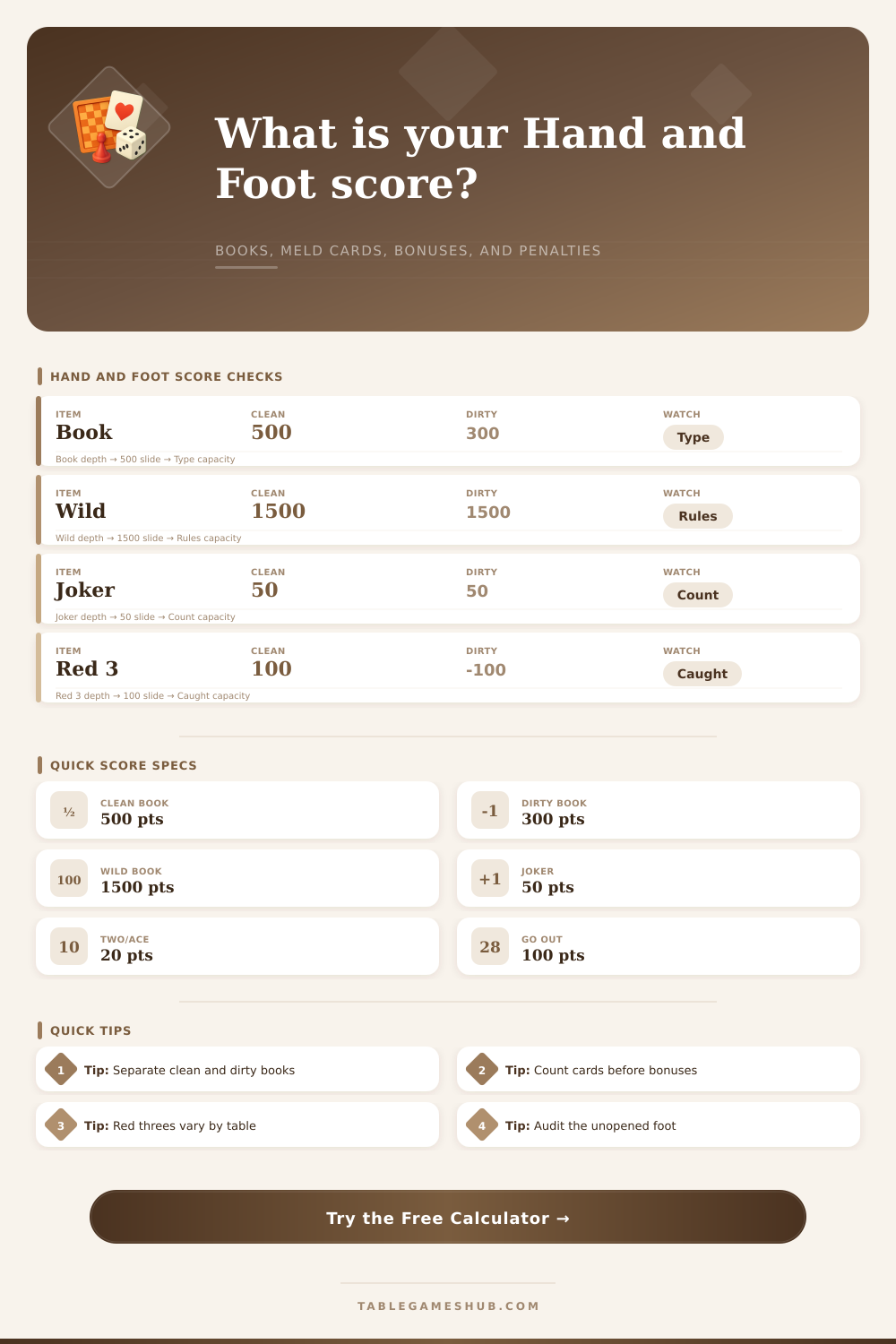
| Joker | 50 points | Melded or held | Melded jokers / leftover jokers |
| Two or ace | 20 points | Melded or held | Melded aces and twos / leftover aces and twos |
| Eight through king | 10 points | Melded or held | Melded 8-K / leftover 8-K |
| Four through seven | 5 points | Melded or held | Melded 4-7 / leftover 4-7 |
| Black three | 5 points | Usually penalty unless played at end | Melded black threes / caught black threes |
| Red three | House value | Bonus if down, penalty if caught | Red threes safely laid down / caught |
| Scoring Preset | Clean Book | Dirty Book | Wild Book |
|---|---|---|---|
| Classic table | 500 | 300 | 1500 |
| Family high book | 700 | 500 | 1000 |
| Tournament compact | 500 | 300 | 1000 |
| Custom score sheet | Editable | Editable | Editable |
| Round | Common Opening Meld | What to Verify | Score-Sheet Note |
|---|---|---|---|
| Round 1 | 50 points | Minimum can be reached from hand cards only | Confirm before taking discard pile |
| Round 2 | 90 points | Wild cards included by table rule | Some groups require natural cards |
| Round 3 | 120 points | Team has enough card value to open | Use melded card points section |
| Round 4 | 150 points | Opening meld is separate from final score | Still count all final cards normally |
| Audit Step | Count First | Add or Subtract | Common Mistake |
|---|---|---|---|
| Books | Clean, dirty, wild | Add book bonuses | Forgetting card face values also score |
| Meld cards | 5, 10, 20, 50 point groups | Add card points | Counting jokers inside wild book only once |
| Red threes | Down vs caught | Add or subtract by table rule | Mixing safe and caught threes together |
| Leftovers | Hand, foot, unopened foot | Subtract penalties | Missing a partner's unplayed foot |
8Fast Score-Sheet Checks
9Tip Boxes
Clean vs dirty check: Score the book bonus by type first, then count the individual cards inside the books as normal melded card points.
Unopened foot audit: If a partner never reached the foot, count those cards as held-card penalties or use the per-card unopened foot shortcut.
Unlike most card games that end in the blink of an eye with a quick point deduction or flip of some chips, Hand and Foot end with an audit. With six pile of cards each for every person plus two decks, there’s plenty of mathematical chaos to make a spreadsheet shed tears. The score sheet is not merely a means of keeping score… It’s the last place where bad arithmetic clashes with good luck.
If you have ever seen it, people counts jokers three different ways and still get the total wrong. That’s why knowing how to reliably total up your penalties, meld cards, red threes, and books matter far more than you’d imagine. This is especially true after last card has been turned. Remember: there are layers that most folks don’t consider when they add up their points. It’s not simply a matter of collecting points, you have to balance your bonuses with precise rules.
How to Score Hand and Foot Cards
For example, seven natural cards is a hefty number (often five-hundred points under classic scoring), but adding one joker makes those same cards dirty, typically reducing the score (down to three-hundred). Speeding up your hand is the trade-off, but a lowering of your point-ceiling-per-set apply. Once you enter your book types into the calculator above, it will do all that math for you, saving you from having to shift back-and-forth between dirty/clean coefficients while at play.
A bonus card if drawn is penalty magnet if it is still in your hand at the end of the round. The Red Threes are game winners and losers. Catching them in hand at the end of the round mean instant penalties; laying them down adds bonuses. But the variance here can be brutal. One player’s lucky draw is another’s disaster waiting to happen.
Keep track off the Red Threes that are safely out in the open separate from the ones still held in other people’s hands or trapped in their unopened feet. This is the most frequent mistake in casual play; mixing the two types together. That causes the whole team total to go haywire, this is why arguments happen even after the cards get shuffled away.
And then there’s the total number of individual card points: Face cards, jokers, aces and even twos counts against your final score with certain values which add up fast. Leaving an ace in your shoe adds one point. That point adds up fast when you multiply it by four people with two shoes each. You’ve got some serious pain in store. This page has a nifty calculator to break down the scores of those cards so you know precisely what kind of dead wood is bogging you down in total score. It divides the melded value into good and bad and shows you if your strategy to hold out for higher value sets backfire into piling up liability instead.
Many novice players don’t realize there is another complication with meld requirements. These requirement increase every round and typically require you to play at least that many points before starting your turn. You’re allowed to take one of the discard piles if you don’t hit the minimum, but it costs you turn efficiency. That places an interesting set of choices on you early in the round: do I break up my potential book to make the open meld requirement? Or should I go for broke and try to get ahead since I might not get another chance. As the round gets larger, this decision changes because the cost for being out of meld grows more expensive different than how much time remains in the game.
The second important thing was keeping up with the number of feet you have open, and any time your partner didn’t get to their foot deck because there wasn’t anything for them to throw down, those are penalties at the end. That means if someone is being really efficient at getting rid of their discard pile, that’s rewarded over someone who moves slow. This encourages both members of the team to contribute equally during an entire round instead of having one person do all the work while the other sits back and relaxes.
At the end of the day, however, it’s a game of resource management pretending to be a card game, one in which you’re sacrificing short-term security for long-term scoring possibility. Good players aren’t focused only on their own hand; they’re tracking the total course of the match, because they realize when to push for a clean book and when to cut losses by going out sooner then necessary.
When you get a sense for the importance of each piece, all of this sorts itself into a rhythm. You no longer guess about what your score will be. Instead, you know exactly where you sit. This makes you play different with every single hand from the moment you draw them.