Arboretum Score Calculator
Check scoring rights, the 1-cancels-8 hand rule, path bonuses, and your final score swing before the last draw.
Points already scored or confidently protected in other species.
Expected points from remaining species after this one.
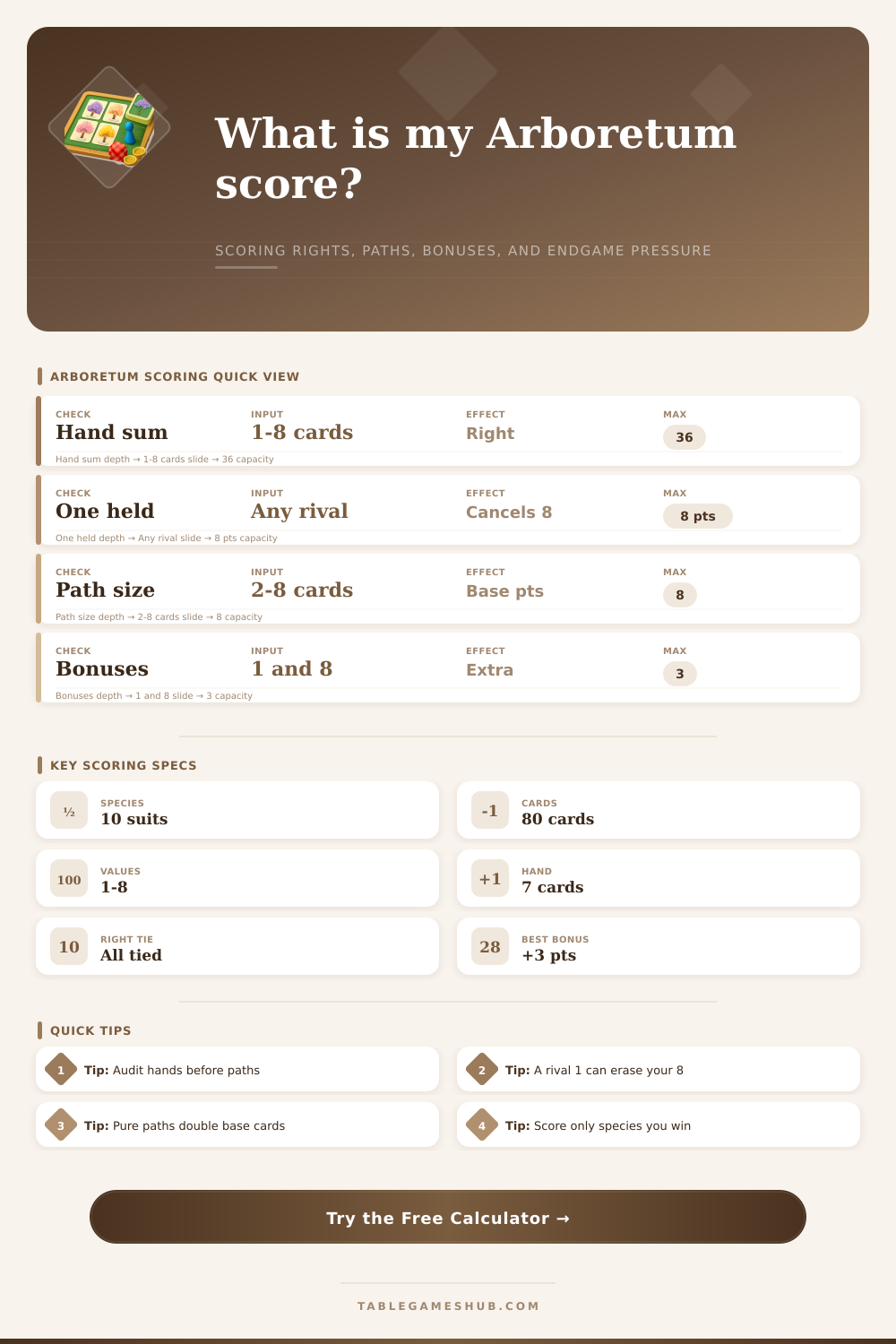
Enter each player's hand total for the selected species. If any opponent holds that species 1, your species 8 does not count for scoring rights; the same cancellation applies to every other player's 8.
You hand
Rival A hand
Rival B hand
Rival C hand
Table context tempo
Finish mode policy
Scoring result
Full calculation breakdown
| Scoring rights check | What to total | Important exception | Calculator handling |
|---|---|---|---|
| One species at a time | Only cards of that species in hand | Tableau cards do not grant rights | Uses hand totals separately from path score |
| Highest hand sum | Values 1 through 8 for that species | A species 8 may be canceled | Subtracts 8 when another player holds the 1 |
| Tied highest total | All tied leaders | Some tables prefer strict-only checks | Toggle supports shared or strict tie policy |
| No scoring right | Path is ignored for that species | Bonuses do not matter without right | Shows zero protected points plus pressure gap |
| Path scoring element | Requirement | Points added | Example use |
|---|---|---|---|
| Base card count | Legal ascending path | 1 per card | Five-card path starts at 5 points |
| Pure species path | Every card in path is scoring species | +1 per card | Five pure cards become 10 base points |
| Starts with 1 | First card is the scoring species 1 | +1 point | Helpful in short paths and denial hands |
| Ends with 8 | Last card is the scoring species 8 | +2 points | Strong if the 8 is not needed in hand |
| Species planning pattern | Typical hand target | Tableau target | Risk note |
|---|---|---|---|
| High-right lock | 14-20 points with 8 protected | Mixed 5-7 card path | Watch for a hidden 1 in rival hand |
| Low denial grip | Hold the 1 plus one mid card | Short 3-4 card path | Good when a rival exposes the 8 |
| Pure corridor | Enough total to tie or win | All same species, 4-6 cards | Powerful but fragile to missing values |
| Shared tie score | Match the leader exactly | Any legal scoring path | Viable only when table uses tied scoring |
| Endgame audit item | 2 players | 3 players | 4 players |
|---|---|---|---|
| Unknown hands to compare | 1 rival | 2 rivals | 3 rivals |
| Hidden 1 cancellation risk | Focused | Moderate | High |
| Tie scoring value | Usually strong | Situational | Often worth checking |
| Discard memory value | Very high | High | Critical for rights |
Arboretum looks like it has a promising hand, but this is a game of risk and hidden information. The goal are to win by having the rights to score particular types of tree. Having the longest path doesn’t matter if your opponent also have more cards in that suit. And rules for which one scores the points are strict: if you don’t have the rights, those points just don’t count. Just because you’ve got a high-value card showing doesn’t mean you’re safe from losing it.
Under the cancellation rules, if an opponent can match up with even a one-point card, that cancel out the value of whatever you had. It’s a sneaky trick in the game and lots of people don’t notice it till its time to add things up. So you think you have eight points of Oak and suddenly you remember your foe had the canceling one-card. That little rule matter a whole lot when you’re figuring out what stuff you want to keep around in the middle game.
How to Play and Win
Once you enter configuration of your paths and total hand, the calculator calculates result (above). Why? Because players gets confused by two distinct aspects: their path bonuses and their scoring rights. Having a double-points path is useless unless you win the species hand comparison and thus earn bonus points. The calculator help show where you fall short of your estimated score versus what’s covered, and you can change course before it’s too late.
The endgame pressure mean considering the entire board (not just what’s happening in your own corner). When playing with more than two players, uncertainty increase as there may be three additional hands containing the critical cancelling card. Player count make a difference to denial strategy; see reference table on the page. Are you ahead on overall points, but behind in one particular species? Do you stay defensive and guard against losing what might be your only hope of winning that species score, or do you go after it? Is having the one-card worth sacrificing the entire path where you’re weak, or will you gain an advantage elsewhere?
In cases of tight scores, knowing which policy the table follow makes a difference because tie-breakers differ by table preference. For some tables, everybody win points for tying for the best hand total; other tables demand a clear lead. In the case of shared scoring, it’s not a bad idea to establish a score comparable to the leader. But in the case of strict only, you’ll have to step on the gas and do whatever it takes to leave the rest of the field behind, even if that means getting more aggressive with your discards.
In the Arboretum finale, like many such matches, it’s part luck and part remembering what other people have (or don’t) drawn from their hands. To figure out the odds that a competitor has a certain card in hand, you have to keep track of how many cards is left unturned and which ones they may have discared. The calculator lets you plug those figures into fields marked “Remaining Draws” and “Known Outs,” putting numbers to the risk. It’s all about balancing the urge to take a big risk for a high score against the realization that there isn’t enough data to be sure.
I’ve learned a few things in this game. It’s not necessarily about having the most cards, but knowing which ones rank higher for scoring. Routes rank below rights. If you don’t possess the right to score, all your efforts would of been for nothing. Check them early and check them often so that if there is a collapse, it won’t be at the last minute. This translates into playing with confidence and taking calculated risks instead of being anxious. Detach yourself from your trees and think strategy.