500 Rummy Score Calculator
Total each player's meld value, cards left in hand, go-out bonus, house adjustments, running score, and exact gap to 500 after every hand.
1Preset Score Sheets
Choose a realistic hand state, then adjust any score line before calculating.
2Round Settings
3Player Score Lines
Round score = meld value - cards left in hand + bonuses - penalties. The marked go-out player also receives the go-out bonus.
| Player | Previous score | Meld value | Deadwood left | Bonus points | Penalty points | Went out? |
|---|---|---|---|---|---|---|
4500 Rummy Component and Score Specs
5Card Point Reference
| Card or group | Common value | House variation | Score-sheet use |
|---|---|---|---|
| Ace | 15 points | Some tables use 1 or 20 | Enter deadwood and meld value using your ace rule |
| King, Queen, Jack | 10 points | Usually fixed | Add face-card melds at 10 each |
| 10 through 2 | Face value | Usually fixed | Use the printed number as points |
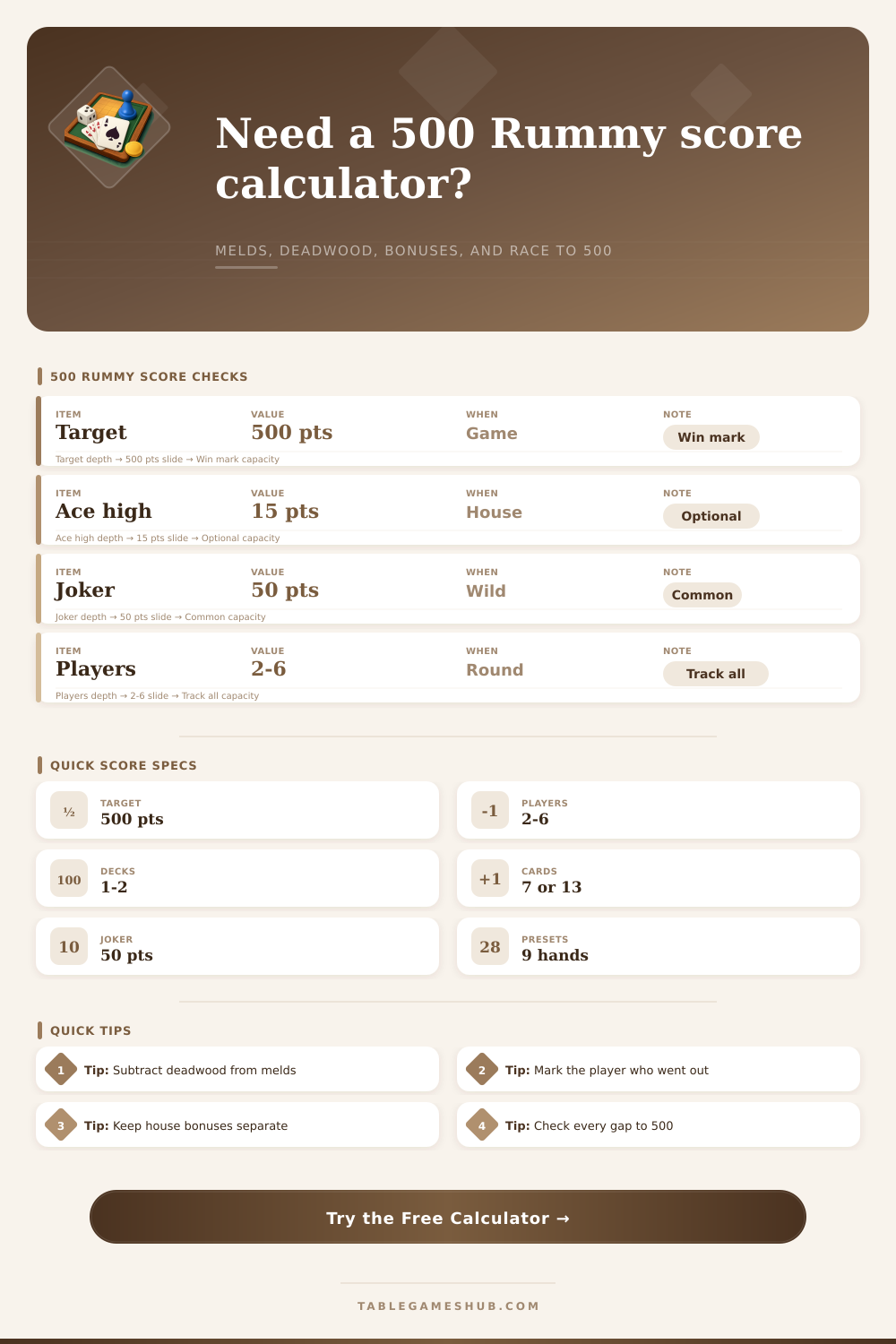
| Joker or declared wild | 50 points | 0, 20, or 50 by house rule | Use only if your table includes wild cards |
| Scoring step | Formula | Where to enter it | Common mistake to avoid |
|---|---|---|---|
| Round net | Melds - deadwood | Meld value and deadwood columns | Do not count unplayed hand cards as positive points |
| Go-out player | Net + bonus | Went out and go-out bonus fields | Mark only one player unless using a special house result |
| House bonus | Bonus - penalty | Bonus and penalty columns | Keep optional awards separate from meld totals |
| Running score | Previous + round net | Previous score plus calculated hand | Negative hand scores still affect the race |
| Preset scenario | Best for | Players | Typical scoring pressure |
|---|---|---|---|
| Two-Player Tight Duel | Head-to-head score race | 2 | Large swings matter more because every hand is direct |
| Big Meld Comeback | Testing a late push | 4 | One strong meld hand can erase a medium lead |
| Deadwood Penalty Swing | Auditing risky hands | 3 | High cards left in hand create a negative round |
| Final Sprint to 500 | Checking winners | 4 | The leader may cross target even without winning the hand |
| Table setup | Deck count | Cards dealt | Score tracking note |
|---|---|---|---|
| 2 players | 1 deck | 13 each | Record deadwood carefully; hands are deeper |
| 3-4 players | 1 deck | 7 each | Use clear go-out marking every hand |
| 5-6 players | 2 decks | 7 each | Wild-card value should be agreed before scoring |
| Short target game | 1 deck | 7 each | Change target to 250 or 300 before entering totals |
6Scorekeeping Tips
Tip: Count melded cards first, then count cards left in hand as deadwood. That order keeps positive and negative values from getting mixed.
Tip: If a player passes the target, still finish the hand total for everyone so final standings and margin are clear.
When somebody yells that they’re going out, it’s over. For a split second, nobody budges. Then, well … chaos follows. Hands is slapped onto the table. Cards are neatly stacked in piles. Everybody debates who has what, their voices getting louder with every argument or victory.
Suddenly, 500 Rummy is no longer about luck and memorization; it’s about arithmetic. If you don’t feel confident doing quick subtractions under pressure, it can makes this part of the game feel more like an audit than anything else.
How a Calculator Helps You Play Better
The calculator figures it out for you. You do not need to guess at conversions and coefficients. You won’t have to fret or stress about things that takes you away from your strategy.
The scoring formula create the central dilemma of 500 Rummy. The way you win is to eliminate points (race to 0), while the way the game measure progress is to increase your score (positive numbers only). At least initially, this is a bit counter-intuitive since every time you put down a card you get points.
Every round, you lose some points from the cards in your hand, which are called “deadwood.” This deadwood reduce your total gain for that round. Holding a Queen or King as deadwood hurts you more then holding a 6, an Ace, or any lower card.
This is where a lot of people misunderstands the game. They focus on not getting penalized rather than increasing their positive gain via large melds.
You can also factor in your house rules. Because there are so many variation of 500 Rummy, this is critical. In one table an Ace may be considered a low card (worth fifteen points) when used in a meld; on another table, it might not. A Joker could give you fifty more points added to your set, or you could choose to consider it a wild card with a value other than fifty. Plug that information into the calculator, and suddenly all players are working based off the same math-based real world.
Disputes over whether a Joker should of been worth twenty or fifty points usually end friendships. Set the rules ahead of time to avoid fights. This keeps tempers cool and keeps the game rolling along.
Deadwood management requires real skill. Novice player often get scared and throw away their best card before a bigger meld presents itself. Now they’re down a precious piece and have missed an opportunity to make a big meld later in the game.
The net change per hand shows you those swings on the calculator. See someone’s score drop significantly in one turn? Chances are they had a large pile of deadwood that magicly dissapears. This swing gives you insight into how threatening other players might be. Did they simply catch a lucky break or were they intentionaly getting rid of their higher point cards? Patterns appear in the data that don’t show up when looking casually at the game.
The closer to the goal of five-hundred points you get, the harder it gets. You don’t want to risk going out with a Queen and a King in your hand, because that means losing all those rounds where you played carefully, but the other person went out. The point values are clearly explained on the reference table so you know what you’re doing.
It’s not just about accumulating points: It’s about maintaining your position. Late in the game, if you’ve got a lead, you’ll be playing extra cautious. You will make sure not to expose any deadwood, even though you may have been taking big chances for huge melds earlier.
Accurate scorekeeping makes it a game of strategy instead of a casual diversion. It removes guesswork. Instead of wondering by how much you’re winning or losing, you know precisely what’s at stake. The calculator does the dull math while you read your opponents’ discards and time your go-out moves. It brings order to the madness that is the endgame.
You get to enjoy the excitement of the race without being distracted by calculations. When all the hands have been played and the scores have been added up, there’s no ambiguity over who has actualy won. The numbers don’t lie. The victor gets to claim bragging rights based off more than just luck.