Tournament Payout Structure Calculator
Quick Presets
Tournament Configuration
Game Component Reference
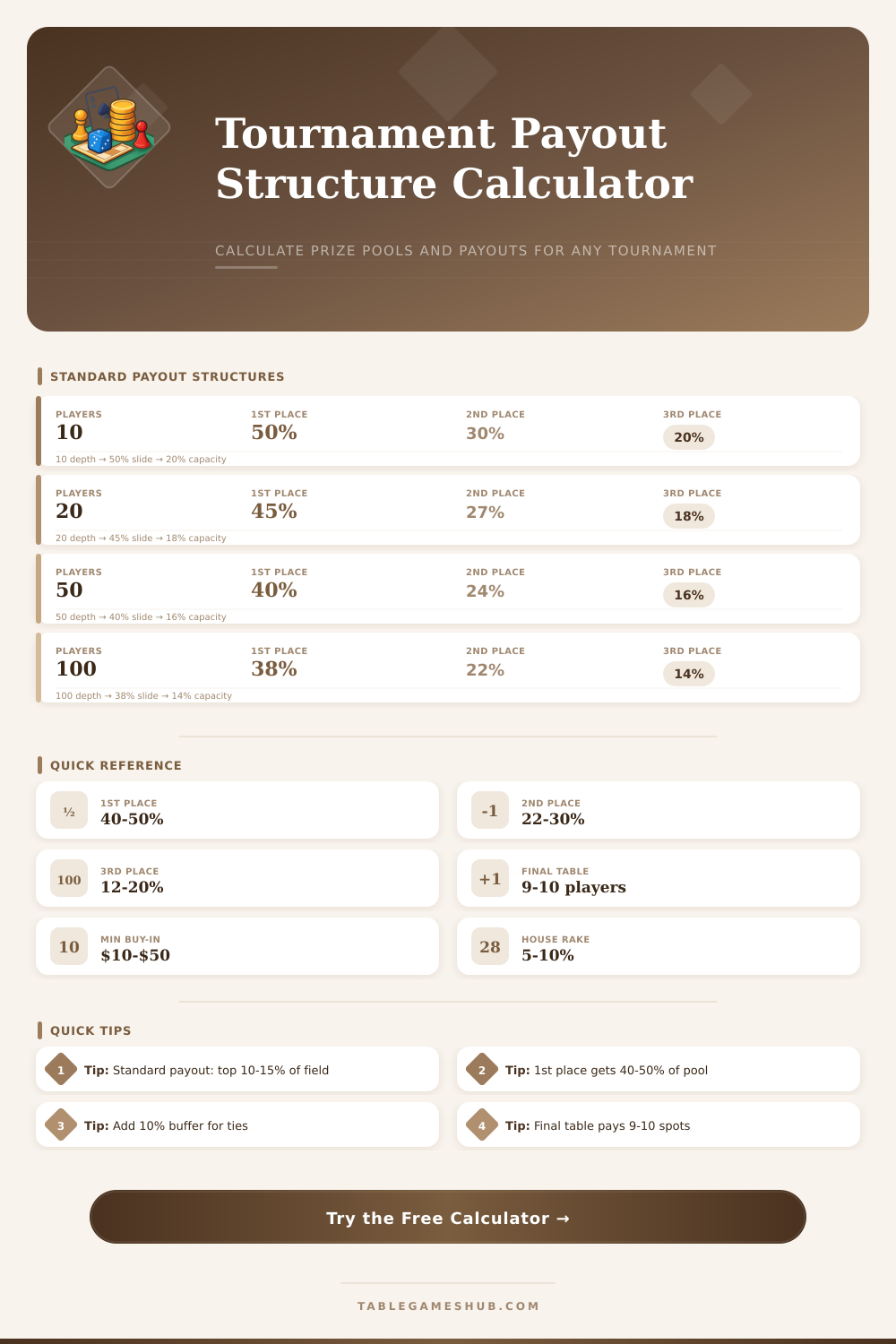
Standard Payout Structures
| Players | 1st Place | 2nd Place | 3rd Place |
|---|---|---|---|
| 10 | 50% | 30% | 20% |
| 20 | 45% | 27% | 18% |
| 50 | 40% | 24% | 16% |
| 100 | 38% | 22% | 14% |
Component Counts
| Game | Deck/Pieces | Accessories | Storage Size |
|---|---|---|---|
| Poker | 52 cards | Chips, Dealer | 12x8x4 in |
| Chess | 32 pieces | Clock, Notation | 15x15x2 in |
| Board Game | 80 pieces | Dice, Cards | 12x12x3 in |
| Dice | 5 dice | Score Sheet | 4x3x1 in |
Setup Configurations
| Players | Table Size | Chips/Player | Est. Duration |
|---|---|---|---|
| 4 | 36x36 in | 500 chips | 1-2 hrs |
| 6 | 48x36 in | 800 chips | 2-3 hrs |
| 8 | 60x36 in | 1000 chips | 3-4 hrs |
| 10 | 84x42 in | 1500 chips | 4-6 hrs |
A tournament payout structure decides how the prize pool gets split among the top finishers. Unless there are only two to four entries, tournaments cannot be winner-takes-all games. Each poker room has its own payout structure when distributing prizes, and it decides how much a player takes home from participation.
Poker tournament payout structures can generally be classified as either conservative or top-heavy. A conservative structure allows most entries to receive some amount of payout. At the extreme ends, the flattest payout structure possible is a satellite where all players get a prize of equal value, while the most top-heavy structure is the winner-takes-all tournament.
How Poker Tournament Prizes Are Divided
There is also a format where all participants win money, with at least their original entry fee.
When tournaments have a top-heavy structure, players want to keep building a stack, so the tendency is to play aggressively and look to double up as often as possible. Pay jumps are pretty small until the final table, so the focus is on finishing in the top three. When tournaments have a flatter payout structure, players tend to play a little tighter and protect their stack more
The buy-in and number of entries matter a lot. A fifty-dollar buy-in with ten thousand entries will have a very diferent payout structure than an eleven-hundred-dollar buy-in with five hundred entries. All else being equal, the more entries there are, the smaller the percentage of the prize pool going to first place.
In general, about ten to fifteen percent of the field makes the money in tournaments.
For small home tournaments, common payouts typically range from twenty to thirty-three percent of the field size, so paying two or three players in a nine-to-ten player field is acceptable. A good ratio is one paid position for every two to four players, two paid for five to seven, and three paid for eight to ten. For a fifteen-person tournament with a three-hundred-dollar pool, paying out the top four players keeps things competitive and fun for more people.
A common top-eight payout looks like this: first gets fifty percent, second gets twenty, third gets thirteen, fourth gets seven, and fifth through eighth split the rest in smaller amounts. Paying six spots in a thirty-six player event is reasonable at about sixteen percent of the field. Having a good prize money structure is key, but creating one is challenging, especially for bigger tournaments with dynamic prize pools.
Payout calculators can help organizers build fair structures for games including poker and Magic the Gathering. The important thing is to communicate the structure clearly and keep itstable from year to year.