Phase 10 Score Calculator
Total a Phase 10 hand from the cards left behind, update the player's phase, compare the table gap, and print a compact scoring breakdown for the next deal.
1Preset Score Sheets
Choose a named table state, then adjust the card counts and phase fields for the actual hand.
2Player, Phase, and Table Position
3Cards Left in Hand
4Component and Score Sheet Specs
5Phase 10 Reference Tables
| Card type | Score value | How calculator applies it | Score sheet note |
|---|---|---|---|
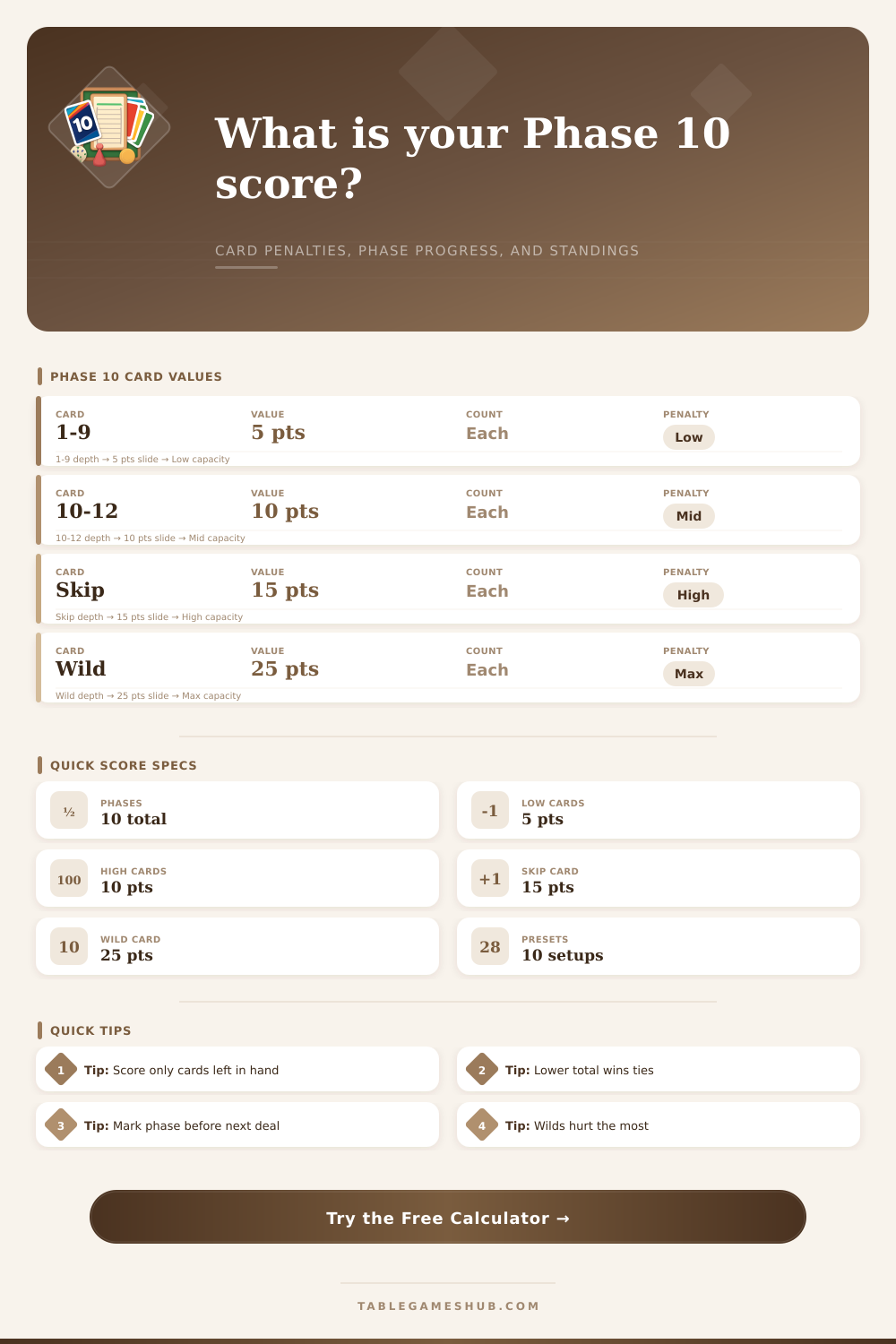
| Number cards 1-9 | 5 points each | Low-card count multiplied by 5 | Best cards to be caught with when someone goes out |
| Number cards 10-12 | 10 points each | High-card count multiplied by 10 | Separate them from 1-9 before adding the row |
| Skip cards | 15 points each | Skip count multiplied by 15 | Score even if the Skip was never played |
| Wild cards | 25 points each | Wild count multiplied by 25 | Highest penalty; check them first after the hand ends |
| Manual adjustment | Entered value | Added after card penalties | Useful for correcting a copied score-sheet total |
| Phase | Requirement | Scoring impact | Next-hand marker |
|---|---|---|---|
| 1 | 2 sets of 3 | No direct points; only hand cards score | Advance to Phase 2 if completed |
| 2 | 1 set of 3 + 1 run of 4 | Completed phase protects progress | Advance to Phase 3 if completed |
| 3 | 1 set of 4 + 1 run of 4 | Missed phase repeats next hand | Advance to Phase 4 if completed |
| 4 | 1 run of 7 | Long runs can leave high-card exposure | Advance to Phase 5 if completed |
| 5 | 1 run of 8 | High penalty risk if caught holding Wilds | Advance to Phase 6 if completed |
| 6 | 1 run of 9 | Often needs the cleanest tracking row | Advance to Phase 7 if completed |
| 7 | 2 sets of 4 | Many leftover cards can remain after a miss | Advance to Phase 8 if completed |
| 8 | 7 cards of one color | Color chase may strand off-color cards | Advance to Phase 9 if completed |
| 9 | 1 set of 5 + 1 set of 2 | Set-heavy hands can hide action-card penalties | Advance to Phase 10 if completed |
| 10 | 1 set of 5 + 1 set of 3 | If completed, compare lowest total score | Game-finish candidate |
| Score band | Status | Typical meaning | Calculator cue |
|---|---|---|---|
| 0-49 | Excellent control | Low penalty hands and steady phase progress | Strong low-score position |
| 50-99 | Normal table pace | Most family games sit here through the middle phases | Watch gap to current leader |
| 100-149 | Pressure range | One heavy Wild or Skip hand can define the standings | Calculator highlights table gap |
| 150-199 | Catch-up mode | Phase progress matters more than a single clean hand | Compare phase number and score together |
| 200+ | High penalty sheet | Usually means several stranded action cards or missed phases | Print breakdown before copying totals |
| Preset | Players | Phase focus | Why it is useful |
|---|---|---|---|
| Family 4-Player Round | 4 | Middle phase | Balanced example for ordinary score-sheet use |
| Two Player Duel Sheet | 2 | Early race | Shows how small gaps matter when turns return quickly |
| Six Player Long Game | 6 | Score control | Models slower progress and a wider table average |
| Final Phase Race | 5 | Phase 10 | Checks whether completing Phase 10 also wins on score |
| Tournament Score Sheet | 6 | Strict tracking | Uses table gap and average for cleaner round records |
6Scoring Tips
Separate the hand before totaling: Sort leftover cards into 1-9, 10-12, Skip, and Wild piles first. That makes the calculator match the physical score sheet and reduces missed action-card penalties.
Track phase and score together: A player ahead on phases can still lose the tiebreak on total points, so update the phase marker before comparing low-score position.
When you’re playing Phase 10, you’ll get to the later stages of the game where somebody has gone out and laid down their hand for all to see. Now it’s time to sift through what’s left in your hands, slap on some penalty points, recalculate your score and not make eye contact with whoever just stole the round from you. It’s frustrating. Your memory starts failing you. That’s why how you keep track of those penalty points matters more then most people realize.
Once you type in your card counts into the calculator above, it does the math for you and saves you from the fight about whether a Wild card is worth twenty-five points or whatever else. That said, scoring in Phase 10 is not just about math; it is also about how well you keep up with a changing goal. Every phase has its own unique structure. If you fail to finish one, you have to do it again next time. And you repeat this process over and over, which could be frustrating if you’ve got a big ol’ score balloon and everyone else are ahead of you.
Why You Need a Phase 10 Score Calculator
The tool lets you record whether you did get through the current phase or not, and will report back where you stand compared to both the overall average for the table and the lowest score. It gives you that clear information about the gap between you and the rest of them, which is what informs your decision to go for broke or stay safe. Maybe you’re sitting 30 points behind the person who started out first, in which case going all-in might actualy lose you the game since you won’t catch up soon enough. These are strategic trade-offs.
There’s an interesting set of strategic trade-offs based off the value of the cards themselves, which don’t necessarily jump out at you until you put them side by side. You might think “oh yeah I’m going to get this round” so you hold onto that low number card (one through nine) because it costs just five points. That seems reasonable, but then you see the breakdown section and realize: those low number cards is only five points, whereas holding onto a Skip card or a Wild is dangerous territory! Holding either of those action cards is dangerous territory, they have penalties of fifteen and twenty-five points, respectively. And one stranding Wild can mess up multiple rounds of good work.
Most players find this intuitive. However, having it spelled out in the breakdown section shows that sometimes letting go of those high-valued cards early is worth not completing the phase. The twist: Completing a phase doesn’t always equate to winning the whole game. One player might blaze through the first few phases and leave themselves in hot water. In this game, a heavier penalty means a higher score. Another player could take their time and avoid too many points. The catch is, when they reach Phase 10, they’re the last person standing; whoever has the lowest score wins.
This requires some careful thinking about pace vs. Efficiency. How does each phase requirement affects your potential score? The table on the site breaks it down nicely. It looks like putting together a chain of nine cards would impress people, but what happens if you get stuck with three Skips afterwards? Maybe that player who just got a four-card set will win instead.
When you have more than one person tallying points for family games, things tend to get ugly quickly. Young children still learning the game can count out their sets incorrectly while older players forget to include their running score before entering the latest penalties. An included sheet or even just filling out a list of card types simplifies everything quite a bit. Simply type in how many Wilds, Skips, High Cards, and Low Cards remain in your hand and let the computer handle the rest.
Accuracy matters. Missing a few points here and there won’t affect who wins a round too much at first. However, enough repeated mistakes will result in lost games and unfair gains over the course of ten phases. What I like most about having an accurate score is that it eliminates any uncertainty in the outcome. There’s no fumbling through illegible notes and no mentally tallying up totals to find out who has won or lost. Simply glance at the printout and there it is: Who’s behind? By how many? Done. No debating is needed; it is just a matter of fact. And seeing the progression of each player visually can help make the game’s direction clear to all. Seeing that three other players have completed Phase 7 while you’re mired in Phase 4 tells you something right quick: Time to change strategies now!
It’s luck to some degree, sure, but ultimately, Phase 10 is a game about managing resources. Managing your own hand, managing your turn timing, and even managing your score. Eliminating the sting from the penalty calculation frees up headspace for real in-game decisions. Should I go for that set? Should I try to steal this one? Do I discard this ten? Do I try to steal that set? THOSE are the questions you want running through your head, not if you got the right answer on that multiplication problem.
Let them do the math for you; watch those gaps at the table; and don’t forget: Lowest score wins at the end of the last phase. It may be a small thing, but it makes all the difference between a contentious game night and a clean victory.