Fort Score Calculator
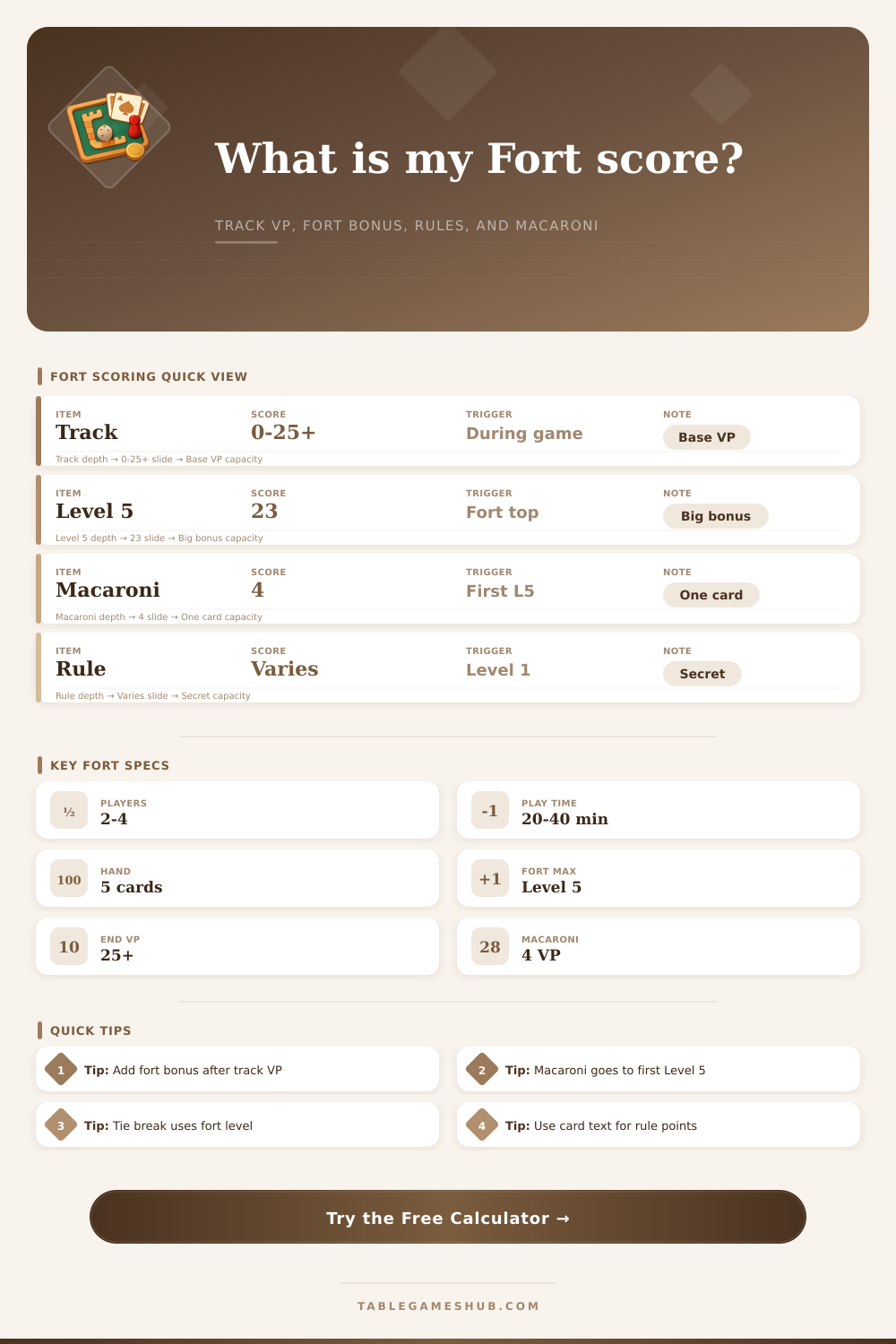
Total victory track points, fort level bonus, made-up rule scoring, macaroni sculpture, and tie-break position.
Use the exact card text at the table if your made-up rule differs.
Fort scoring result
| Fort Level | Fort VP Bonus | Pack Limit | Lookout Limit | Scoring Role |
|---|---|---|---|---|
| Level 0 | 0 VP | 1 resource | 1 card | Starting position |
| Level 1 | 1 VP | 2 resources | 2 cards | Choose made-up rule |
| Level 2 | 4 VP | 3 resources | 3 cards | Choose perk card |
| Level 3 | 9 VP | 4 resources | 4 cards | Solid final score base |
| Level 4 | 14 VP | 5 resources | 5 cards | Strong tie-break position |
| Level 5 | 23 VP | 6 resources | 6 cards | Can award macaroni |
| Upgrade | Pizza Needed | Toys Needed | Any Resource | Total Step |
|---|---|---|---|---|
| Level 0 to 1 | 0 | 0 | 2 | 2 resources |
| Level 1 to 2 | 1 | 1 | 0 | 2 resources |
| Level 2 to 3 | 2 | 2 | 1 | 5 resources |
| Level 3 to 4 | 3 | 3 | 1 | 7 resources |
| Level 4 to 5 | 3 | 3 | 1 | 7 resources |
| Level 0 to 5 | 9 | 9 | 5 | 23 resources |
| Check | When It Matters | Calculator Input | Result Impact |
|---|---|---|---|
| 25+ VP track | During game end check | Victory track points | May end round |
| Fort Level 5 | First player reaches top | Fort level and macaroni | 23 VP plus possible 4 VP |
| Park deck empty | Deck runs out | Park cards remaining | Final score immediately after round |
| Tied score | After all VP is added | Rival score estimate | Higher fort level wins tie |
| Model | Uses Input | Formula | Best For |
|---|---|---|---|
| Manual | Manual points | Entered VP | Exact card text |
| Popularity style | Lookout cards | 1 VP per card | Lookout scoring cards |
| Pack style | Pack resources | 1 VP per resource | Pack scoring checks |
| Big deck style | Deck cards | 8 VP if condition met | Majority or threshold rules |
| Minimalism | Fort level | 8 VP at Level 2 | Level-specific rule |
| Loner | Best Friends | 5 VP if none | No Best Friends checks |
| Fort symbol style | Fort level | VP equals level | Fort-level symbol text |
| Resource pairs | Pizza and toys | Lower resource count | Pair-based scoring |
The problem is that most board game evenings end with a mad dash to count your points accurately. Hey, there are only five minutes left. There goes the park deck. Oh no, I forgot about those 10 points in my back pocket. What should of be a climactic moment of strategy becomes instead a bureaucratic speed bump that risks spoiling the good time you’ve just enjoyed. The tension come from the fear of leaving points on the table or not realizing a bonus might swing the lead by one point.
Scoring in Fort is deceptively simple… until it’s not. First, you input where you are on victory track. Simple enough! Next comes your fort level. That increases at a jump dramaticly the higher up you get. Finally, you must determine your position on the victory track, add your fort level, and then calculate both your made-up rule points and your macaroni sculpture bonus.
How to Count Points in Fort
This calculator do the math for you based off your current state. You won’t have to do any head-scratching calculations and can just look at final standings. The key to mastering this game is knowing what each fort level adds up to your grand total. And no, they is not linear. Just reaching level 5 give you twenty-three victory points.
Just think about that. Those points alone are enough to win many games before you even consider any additional bonuses. This makes having that highest fort a strong motivation and will force you to consider trading off some short-term gain elsewhere just to secure it. Many gamers figure this out halfway through the game, but those who recognize it sooner tend to play differently with their resource.
The made-up rule scoring is what makes it interesting. Each game are different because you never know which combination of rules will score points. While some are simple multipliers, others are conditional bonuses where exact card combinations matter. There are also rules like “counting” cards in your lookout and even looking for particular pairings of resources in your pack. Common rules has their own presets within the tool, yet each card’s text remains final. Always check exactly which conditions apply by reading the physical card; small variations in word choice can make all the difference.
Then there’s macaroni, a variable that no one expects. Four points given to whoever gets to level five first doesn’t sound like much…until you’re two away from your opponent and realize it could be everything. Suddenly you’re racing for the top position in a way that may or may not have been in your plans. You had a slow and steady climb in mind. Then you see someone sprint for level five. Risk shows its ugly side.
Beyond that, points-to-fort levels is also far more important than they first appear. Even when two people’s scores add up to the same exact number, whoever have a higher level of fort will break the tie in their own favor. This is a really neat little mechanic that encourages going upwards rather then just accumulating horizontally. Occasinally, it will be worth having a lower but higher-level fort than someone who has a much bigger score on a lower-level fort. The calculator factors this all in to let you know how you’re doing in comparison to your opponents and whether you’re ahead or behind.
There’s a temptation for players to stop their turn at some “safe” number. In reality, there is certain conditions that end the game (e.g., the park deck empties out; someone reaches twenty-five points on the track). Even if these conditions are met during an earlier round, you still need to finish your turn. Failing to finish your turn can leave points and resources unused. While this is a small thing, it make all the difference in close games.
The calculator has a set of reference tables that allow you to know how many resources you’ll burn at every upgrade step. If you know it takes 23 resources in total to get to level five, you can plan ahead instead of simply reacting to opportunities as they arise. It clears up decision making greatly in the first few rounds when you know precisely how many toys and pizzas will get you to any given stage.
At the end of the game, that score is a picture of all the things you got right (or wrong). It’s a combination of your luck, rule-based bonuses, structural achievements, and how far along you were on the track. Spending some extra time getting the math right guarantees that who wins isn’t determined by an algebra error but instead by strategy and skill.
Next time your friends play together, spend a few seconds checking your math, whether you are celebrating your wins or understanding why you lost. That little breath will make the win feel deserved and the defeat reasonable which makes it a good game for all players.