Shot Put Distance Calculator
Estimate measured shot put distance from release speed, release angle, height difference, shot weight class, wind, sector-line clearance, and foul margin.
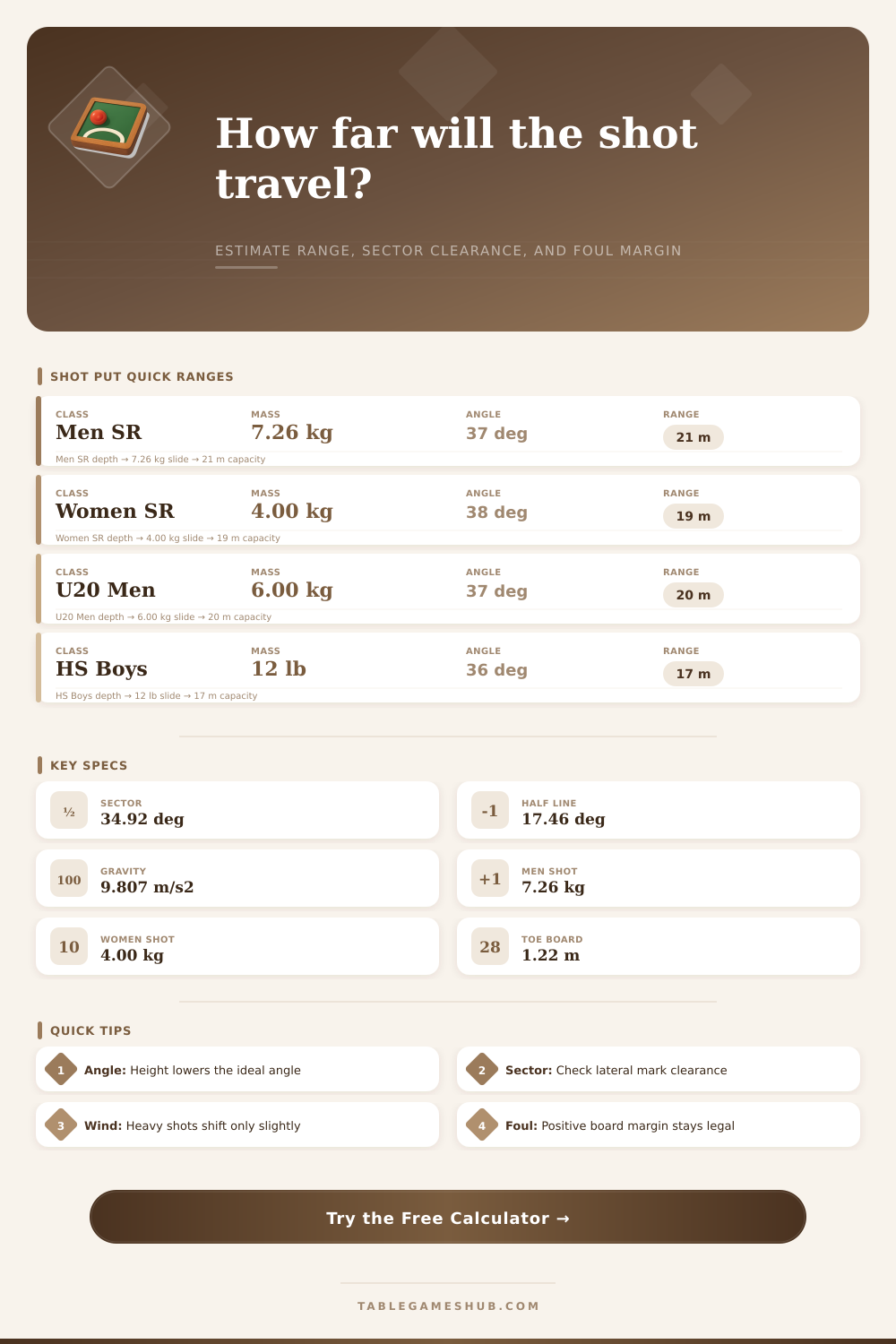
| Release condition | Why optimum is below 45 degrees | Common calculated band | Calculator use |
|---|---|---|---|
| High release, level sector | The shot lands lower than release, increasing flight time | About 34 to 40 degrees | Use exact release and landing heights |
| Lower seated release | Less height advantage keeps the optimum closer to 45 degrees | About 38 to 44 degrees | Reduce release height and offset |
| Raised landing surface | The shot has less time after crossing the apex | Higher angle usually helps | Enter a positive landing height |
| Lower landing surface | The shot stays airborne longer after release | Lower angle may still carry | Enter a negative landing height |
| Class in calculator | Mass | Typical diameter reference | Wind model sensitivity |
|---|---|---|---|
| Senior men | 7.26 kg / 16 lb | 110 to 130 mm | Lowest adjustment factor |
| Women and U20 women | 4.00 kg | 95 to 110 mm | Moderate adjustment factor |
| U20 men | 6.00 kg | 105 to 125 mm | Low adjustment factor |
| High school boys | 12 lb / 5.44 kg | Rules vary by federation | Low to moderate factor |
| U18 boys | 5.00 kg | 100 to 120 mm | Moderate adjustment factor |
| Youth or training | 3.00 kg | Training implements vary | Highest adjustment factor |
| Specification | Reference value | Calculation meaning | Result affected |
|---|---|---|---|
| Landing sector angle | 34.92 degrees | Full angle between the two sector lines | Sector clearance |
| Half sector angle | 17.46 degrees | Centerline to either sector line | Allowed lateral offset |
| Shot circle diameter | 2.135 m | Circle used for legal release position | Foul margin note |
| Stop board chord length | 1.21 to 1.23 m | Front board width across circle | Board margin context |
| Wind setting | Range component | Lateral component | Interpretation |
|---|---|---|---|
| Tailwind down sector | Positive | None | Adds a small range allowance |
| Headwind into throw | Negative | None | Subtracts a small range allowance |
| Crosswind from left | None | Right drift | Can reduce sector-line clearance |
| Quartering wind | About 70 percent | About 70 percent | Splits between range and lateral drift |
The shot put is heavy sphere that is thrown for distance. The distance of a shot put throw are dependent upon several physic variables of the sport. Many people may believe that a forty-five degree angle are the best angle for a shot put throw for every throw in competition, but a forty-five degree angle isnt the best angle for every shot put throw because shot puts is released from a height above the ground.
Because shot puts are released from a height above the ground, the shot put must fall for a longer distance than it needs to rise for the shot put to travel to its distance. Therefore, the ideal angle for shot puts is actualy lower than forty-five degrees, especially for those with high release points. A high release angle can waste the energy that the throwers produce in launch the shot put.
What Makes a Shot Put Go Far
The speed of the shot put is one of the primary factors that can influence the distance of the shot put throw, but the mass of the shot put as well as the wind can also influence the distance of the throw. For instance, a heavy shot put for senior males is less affected by the wind than a lighter shot put that the athlete use for training. If the shot put is lighter in mass, such as training shot puts, the crosswind can actualy push the shot put laterally to an area outside of the sector line.
Should the shot put land outside of the sector lines, it is a foul and doesnt count towards the distance of the throw. The toe board is another physical component of the shot put circle that the athlete is not to touch during the throw. The distance of the shot put is measured from the inner edge of the toe board to where the shot put lands, but the shot putter doesnt leave the hand of the shot putter from the toe board.
Therefore, there is a gap between the hand and the toe board that must be account for in calculating the distance of the shot puts. The conditions of the wind can impact the distance of the shot puts and can either help or hinder the distance that the athlete throws. Tailwinds can increase the distance of the shot puts but headwinds will decrease the distance that the shot put flies due to the additional force require to push it towards the target distance.
Additionally, a quartering wind will impact the distance as well as the lateral drift of the shot put. In this case, the athlete may need to adjust the aim of his or her shot puts to one side of the centerline to ensure it land in the center of the sector lines. The area where the shot put is to land may also impact the distance.
For instance, if the area where the shot puts are to land is slightly raised in relation to the ground, the shot put will hit the ground sooner and the flight of the shot put will be short. However, if the shot put is to land on a downhill slope, the shot put will remain in flight longer and the distance will increase. The slope of the landing area must be taken into consideration because it will impact the angle at which the athlete should of release the shot put.
The distance that the shot put travels is also influenced by the release speed of the shot put as well as the release angle of the shot put. If the release angle is set too high, the athlete may lose some of the horizontal velocity of the shot put. Similarly, if the release angle is too flat to the ground, the shot put may hit the ground before it reach its full trajectory.
Shot putters who understand how each of these variable interact with each other, especially the relationship between the height of the athlete, the mass of the shot put, and the conditions of the wind at the moment of release, can adjust their technique to enhance their performance in the shot put events.