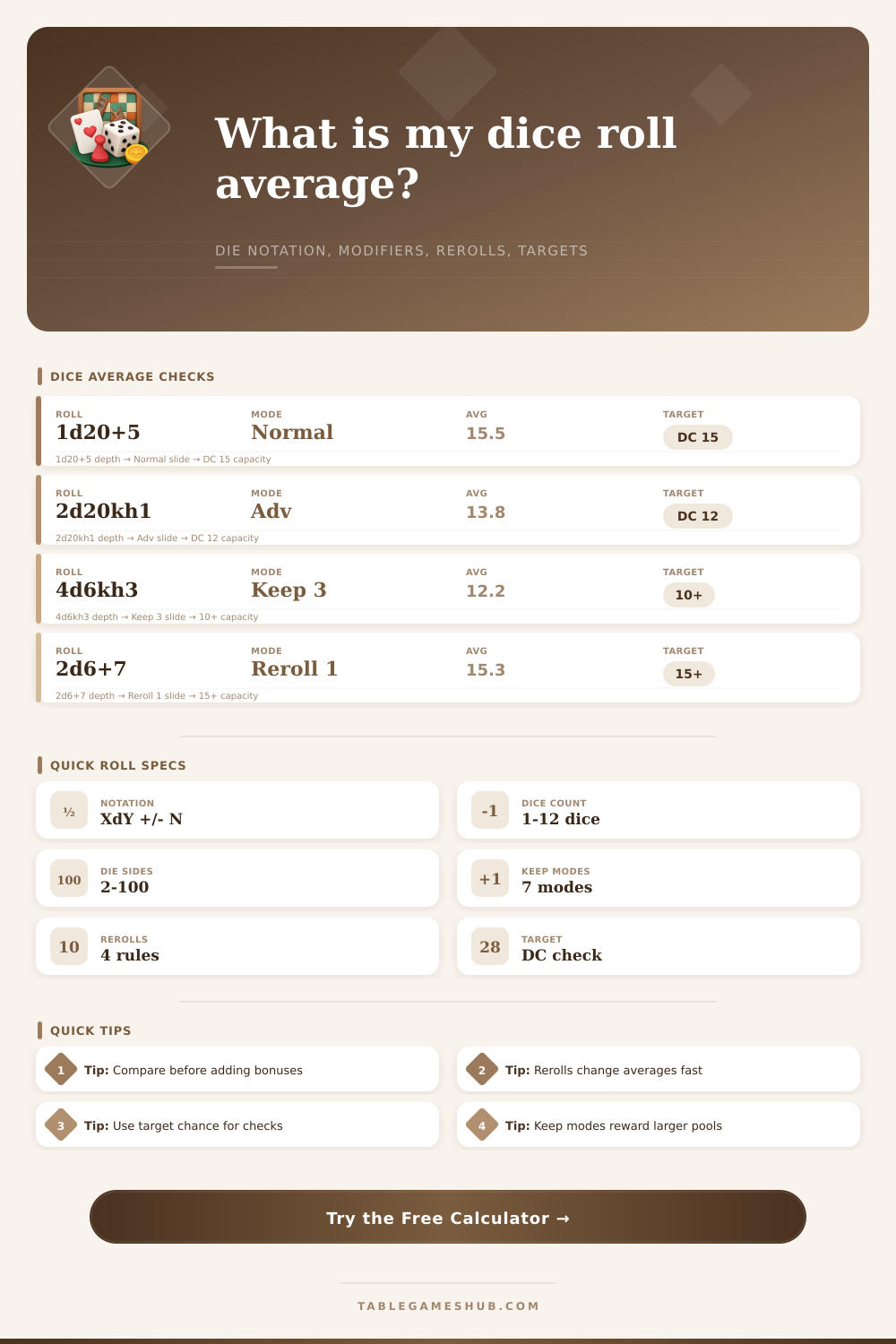
Dice Modifier Average Calculator
Average dice notation with flat modifiers, advantage, keep-high pools, reroll rules, target thresholds, and bonus or penalty scenario adjustments.
Enter notation for reference, then tune count, sides, modifier, keep mode, rerolls, target number, and the current table bonus or penalty.
| Notation | Base Average | Range | Table Use |
|---|---|---|---|
| 1d20+5 | 15.5 | 6 to 25 | Attack or skill check |
| 2d6+3 | 10.0 | 5 to 15 | Weapon or movement roll |
| 3d8-1 | 12.5 | 2 to 23 | Damage pool with penalty |
| 8d6 | 28.0 | 8 to 48 | Large spell or hazard pool |
| Mode | Best For | Average Shift | Target Effect |
|---|---|---|---|
| Advantage | Single check die | Raises center | Strong near middle DCs |
| Disadvantage | Hard conditions | Lowers center | Hurts moderate DCs |
| Keep highest | Dice pools | Rewards more dice | Improves high targets |
| Keep lowest | Risk or strain | Suppresses peaks | Protects low thresholds |
| Rule | d6 Lift | d8 Lift | d20 Lift |
|---|---|---|---|
| No rerolls | +0.00 | +0.00 | +0.00 |
| Reroll 1s once | +0.42 | +0.44 | +0.48 |
| Reroll 1s and 2s | +0.67 | +0.75 | +0.90 |
| Reroll below half | +0.75 | +1.00 | +2.50 |
| Chance | Feel | Use Case | Table Note |
|---|---|---|---|
| 80%+ | Reliable | Routine check | Good for fast scenes |
| 60%-79% | Favorable | Skilled attempt | Still has tension |
| 40%-59% | Uncertain | Even contest | Most swingy band |
| Under 40% | Risky | Hard target | Consider a bonus |
Modifier tip: Add flat bonuses after dice, keep choices, advantage, and rerolls so the target chance matches the table sequence.
Reroll tip: A reroll rule changes every die in the pool, so its average gain scales quickly on multi-die damage or movement rolls.
What’s it worth? This dice roll calculator for tabletop gaming will tell you the chances of any die roll. In many games, you get advantages such as rolling twice and taking best result. A lot of people just go with their guts in these situations, but your instinct is often wrong when confronted with a probability distribution. The calculator translate that abstract guesswork into hard numbers so you can base decisions on them.
First off, we should of take a look at what the average score of each die is. If you roll a normal six sided die enough times it will have an average score of 3 and a half. That’s not the exact number a die will ever land on but it gives us a starting point for what we should expect in the long run.
Why Dice Math Helps You Play Better
If you combine several dice together, then you can just add the averages. So two dice combined equal a seven on average, and three dice equals ten point five on average. You know this works every time because it stacks up evenly; one plus one equals two.
This nice bell curve gets distorted by variables like keep mode or reroll rules. Let’s say that with four six-sided dice you only keep the three best. Every time, you throw away your worst result. This have a huge impact on raising the average compared to adding up all four dice. Keeping higher dice puts a floor under your outcomes, limiting your downside risk and rewarding bigger pools. A single bad die won’t affect rest of your roll. You’re aiming for consistency instead of maximum variance.
Another wrinkle is that rerolls alter this equation. A rule granting you the ability to reroll ones changes the distribution of every die you reroll. These results are then recombined with all other dice in pool. A small lift per die becomes a substantial shift in total output. The effect multiplies rapidly; a tiny bump on each die adds up into a significant swing at the end.
Remember: a flat bonus is not the same thing as altering the nature of the dice themselves. Adding plus five to your roll is simple math. Changing how dice operate is something else entirely and it involves different kind of thinking.
The intersection of game theory and the pressure of play comes down to targets. Average scores can be helpful, but what useful information do you have about whether a given action will hit or even beat a certain difficulty level? You want to hit an eighteen and average a fifteen, then you’re probably going to fail at least as much than not. That distance between the mean and your target indicates whether you should shrug it off or hope for help from the table. It turns a yes/no moment (did I make it or didn’t I?) into an assessed risk (what are my chances?), changing how you approach the game.
Once the dice have been decided, there is often scenario adjustments like penalties for terrain or bonuses for positioning. They’re things that tip the scale on those edge cases that becomes the moments we remember in a game. That’s why a -2 penalty doesn’t sound all that important until it moves your chances of hitting from 50% to 40%, which totally changes how the scene plays out. Those adjustments are handled by the calculator, so they apply correctly in terms of reroll and keep rules. It ensures that subtle errors don’t creep in with manual calculation.
“Dice games are all about managing randomness. There’s no way to control what happens when the dice hit the table, but there is a way to control your interpretation of their results. Learn the mechanics that support the numbers and you no longer look at your rolls as random luck; they become calculated risks. Next time someone rolls for advantage or asks for a reroll, you’ll instantly know what it costs you (or gives you) and make an informed strategic choice. That kind of knowledge alters your gameplay, turning a gamble based off luck into a series of calculated decisions.