Acrostic Puzzle Calculator
Track acrostic puzzle progress from solved clue answers, quote letters filled, errors, hints used, puzzle length, time spent, and the selected difficulty setting.
Adjust the puzzle counts to recalculate the acrostic progress.
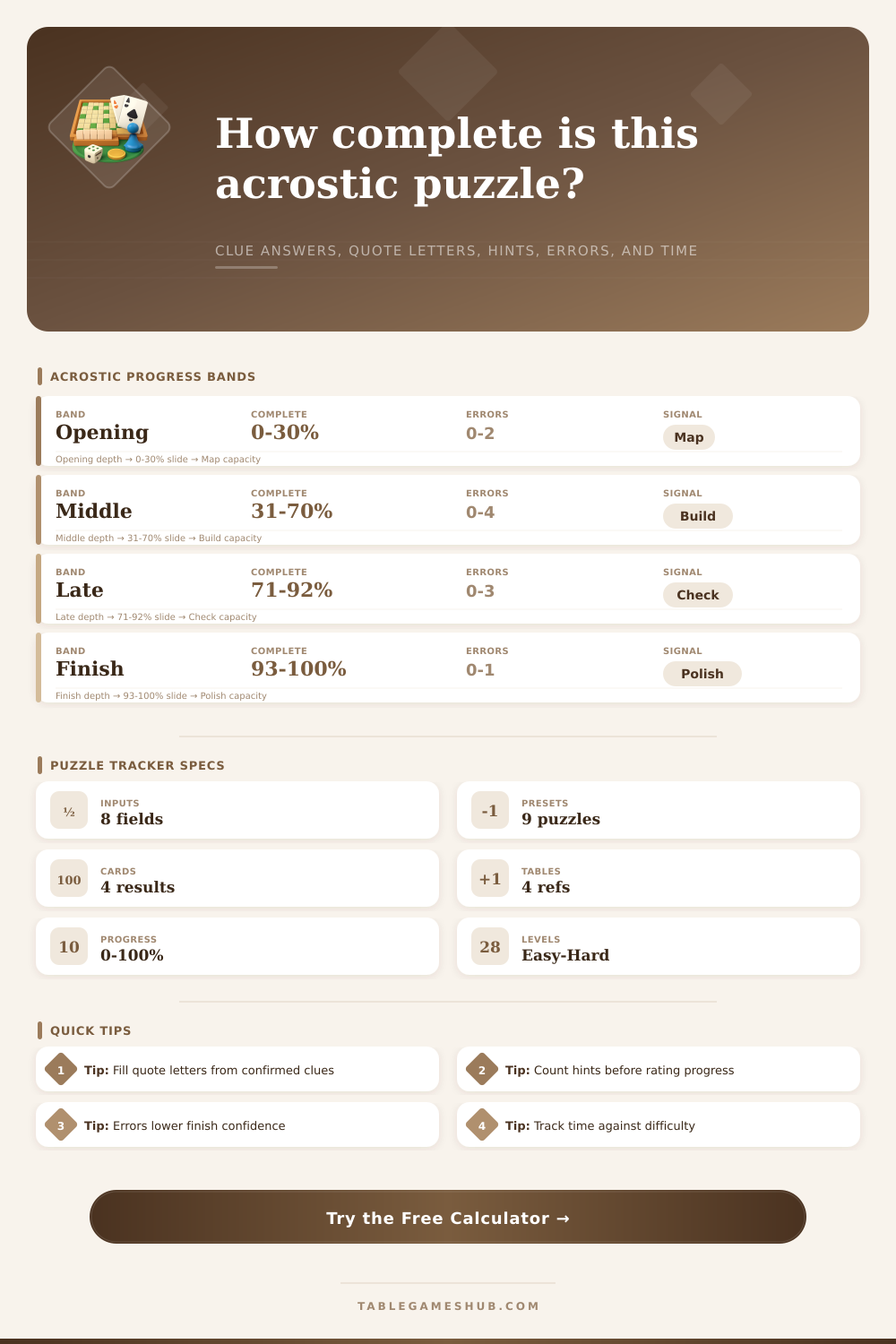
Completion bands
| Band | Weighted completion | Typical state | Progress cue |
|---|---|---|---|
| Opening map | 0-30% | Scattered answers | Build crossings |
| Middle build | 31-70% | Quote fragments visible | Use repeated letters |
| Late check | 71-92% | Theme and voice emerging | Audit conflicts |
| Finish sweep | 93-100% | Mostly filled quote | Verify every clue |
Difficulty and pace targets
| Difficulty | Time model | Hint tolerance | Error tolerance |
|---|---|---|---|
| Easy newspaper | 0.22 min per letter | Low | Low |
| Medium literary | 0.32 min per letter | Normal | Normal |
| Hard anthology | 0.45 min per letter | Moderate | Moderate |
| Expert barred | 0.62 min per letter | High | Tight |
Clue answer status checks
| Status | Answer signal | Quote signal | Calculator effect |
|---|---|---|---|
| Unstarted | Few solved clues | Few letters placed | Low completion |
| Crossing | Many partial leads | Words appear | Fast gain |
| Conflict | Answer disagrees | Odd quote letter | Error penalty |
| Locked | Answer confirmed | Quote phrase fits | High confidence |
Hint and error adjustment
| Adjustment | Light amount | Heavy amount | Read change |
|---|---|---|---|
| Hints used | 1-2 hints | 6+ hints | Lowers purity |
| Known errors | 1-2 errors | 8+ errors | Lowers confidence |
| Slow pace | 110% time | 160% time | Signals stuck areas |
| Fast pace | 80% time | 50% time | Check for guesses |
Acrostic frustrations have a familiar course. They begin full of excitement as you fill in straightforward clues and marvel at the developing quote. But then comes muddle that is usually middle part, when poem appears as gibberish and solutions feel vague.
Now we can make this experience more measurable: We can turn your subjective sense of being lost into an objective measurement of progress. Not only it can tell how many boxes is filled, but also how well they’re filled. It takes into account errors, hints, and solved clue so it gives you a realistic view of your current standing.
How to Measure Your Puzzle Progress
Because it’s an acrostic, though, it’s actualy two puzzles. Which makes it twice as hard. On top of writing a sensible paragraph or sentence, you also need to fill out all the independent crossword clues. Try doing both at once and you’ll probably mess up at least once. That’s why the inputs mirror its duality.
By entering how many letters from quote have been filled and how many solved clue have been entered, the calculator can finds a weighted completion percentage. This accounts for the fact that filling out a big obvious clue is not the same thing as cracking a difficult five-letter answer that knocks down three intersecting words. Letting the calculator do this arithmetic means you can concentrate on logic side instead.
The most common error among many solvers are waiting too long before checking their error count. When you do, it is often because you made a bad guess earlier. Now, a single typo in an initial clue has spread through half the puzzle. This makes a mess that is difficult to fix.
This is laid out in table at the bottom of the page as bands, Finish, Middle, Opening, and how much wiggle room each band allows. While it’s normal to have a few mistakes while mapping out the structure of the puzzle in the open, one mistake in final sweep means your quote won’t make sense. If you know your error count along with how long it takes you, you get a confidence score that tells you if your path forward is solid or just built on shaky guesses.
The game changes completely depending on difficulty setting. With a simple acrostic in the newspaper, clues may be simple and quote well-known. It is something that pops into your head immediately. On a harder anthologist puzzle, they’ll throw some complex phrases at you with obscure references. And that’s what the calculator takes into account.
If you choose an expert-level grid, it expects you to take longer per letter then if you’re just tackling a quick mini on the coffee break. This way, it doesn’t let you panic if you run up against a wall, maybe what feels like stalling out is expected pace for that difficulty level. By knowing that, you can remain calm and methodical instead of rushing and making careless errors.
There’s also a matter of hints, which can be overlooked when considering self-assessment. There’s nothing wrong with using a hint, it simply makes the solve different. And so your confidence score is reduced if you’ve used them extensively. In a sense, it’s an honest measure for what part of the puzzle was truly solved by you, and not helped along.
That’s not to say there’s anything wrong with taking advantage of hints; rather, it’s important to know that it changes purity of the accomplishment. Knowing this tradeoff can help you determine when to push yourself through a difficult clue, or when to take the easy road.
Perhaps the best lesson here is that solving an acrostic can be nonlinear: For 20 minutes you may be making absolutely zero progress; then, boom! The single right answer opens up everything else on the board. That’s what makes these puzzles so satisfying.
And while the calculator will give you a picture of where you’re at, it won’t tell you when you’ll have that “aha!” moment. It just helps make sure you know when it arrives so you’re prepared for it.
So in the end, solving is about iterating on your approach based off what you track. Maybe you notice that a particular type of clue always trips you up. Or maybe you realize that you always rush through the last check of your solution. Whatever it is, the tool reflects yourself back at you. And then you iterate. That’s how it becomes more than just a fun hobby: it becomes something you can learn and get better at.
Solving an acrostic is like watching a painting come together layer by layer. Initially it’s blobs and shapes, which don’t look like anything. Then more detail appears. Forms start to take shape. The painting comes into focus. What you’re left with when you finish isn’t only filled out boxes but a complete, coherent picture.
The calculator keeps track of each layer so what you see when you’re done isn’t just random boxes, but a complete picture.