Splendor Cities Calculator
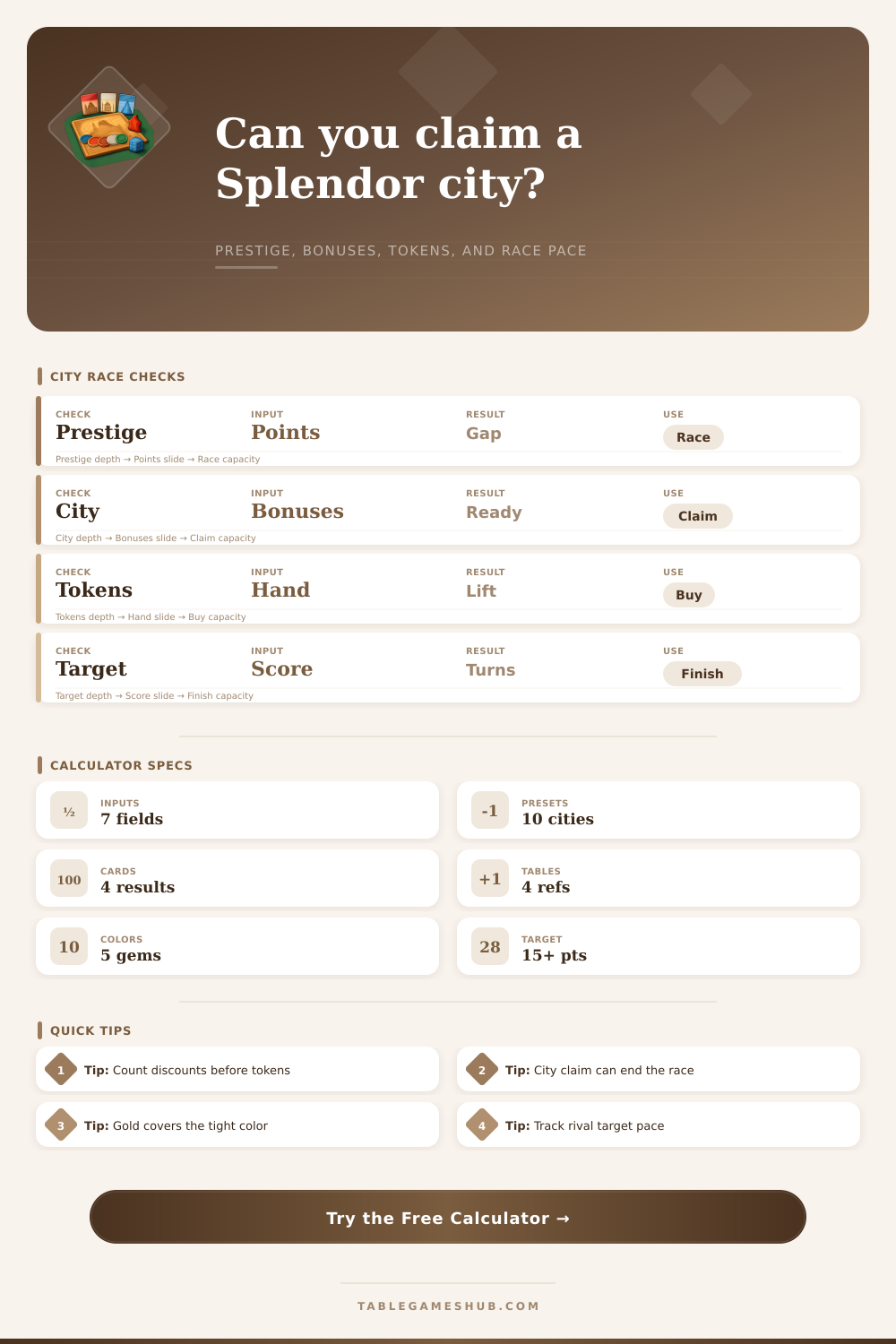
Estimate your prestige race, city tile readiness, gem-color development bonuses, noble or city claim state, token lift, and turns needed to close the table.
Breakdown
| City Pattern | Bonus Shape | Total Discounts | Best Use |
|---|---|---|---|
| Harbor Triad | 3W / 3B / 3G | 9 bonuses | Early blue-green engine |
| Canal Triad | 3B / 3G / 3R | 9 bonuses | Middle-row tempo |
| Spice Triad | 3G / 3R / 3K | 9 bonuses | Red-black pivot |
| Guild Pair | 4W / 4R | 8 bonuses | Focused two-color rush |
| Balanced Court | 2 each color | 10 bonuses | Wide engine claim |
| Token Position | Hand Meaning | Likely Buy Pace | City Impact |
|---|---|---|---|
| 0-3 tokens | Thin hand | Needs takes | Slow |
| 4-6 tokens | Flexible | Can buy soon | Normal |
| 7-10 tokens | Loaded | Must spend | Fast |
| Gold tokens | Wild cover | Reserves help | Gap closer |
| Race State | Point Gap | City Status | Recommended Focus |
|---|---|---|---|
| Build engine | 5+ short | Not ready | Buy discounts |
| Threaten city | 2-4 short | Near ready | Claim colors |
| Finish line | 0-1 short | Ready | Score now |
| Tie pressure | Target met | Any | Count cards |
So what’s a player to do when they see an adversary has just taken a noble tile and sits two points away from victory in Splendor? Gems abound in your hand, plus you have running discount engines; still, it feels like navigating your way to fifteen prestige points is more like walking through a maze. You know you need one more card, but the path to fifteen prestige points suddenly looks like a maze and you don’t even know which one.
The secret lies within interaction of your current gem bonuses versus the prerequisites for city tiles, here’s a calculator that will help show how near you are to unlocking the hard-to-find last few bonus points available before time expires. The core of the game is not just accumulating points; it is about timing your entry into endgame. Getting points is simple; build discount engines. That’s true, but early on.
How to Win Splendor Using a Calculator
Building an engine is pointless unless you use it to purchase cards cheaply during a shortage (either from limited supply or because a rival needs that color). You want to see how far down the development bonus rabbit hole you can goes. You measure your success against the point value of the city tile, minus whatever discount you’ve built up using the tool. If you can get three white cards for free, and the city tile asks for three white cards, you don’t care about white gems anymore. Just give me the card.
The card calculator calculates the gap between the discounted cards you have and what the board wants. And that shows as a percentage readiness score. That might sound silly compared to raw point totals. But it isn’t.
Lastly, don’t conflate tokens held vs. It is permanent power. On the one hand, gems are versatile currencies which allow you to purchase whatever you want today, but won’t help you tomorrow unless you transform it into cards. For example, a player with ten tokens appear formidable, yet without any discounts, they will ultimately fizzle out once prices rise or gem supplies run low. On the other hand, someone with just two gems plus five white discounts can buy white cards for free as long as anyone else buys one first.
In the tool, we model this by considering your token increase towards following city color. If you’re light on tokens but heavy on discounts, the math implies waiting for an opponent to pull the chain of your discount is more lucrative than clogging your pockets with gems you may never spend.
Splendor involves accumulating prestige points through cards and city tiles. Of those four categories, cities are the most unstable point generator, a well-timed city claim can reset the game entirely and put you right back into contention. To understand why cities is so powerful, let’s examine the reference tables within the tool. These will highlight which pattern is simplest to achieve given your current hand shape.
If you’re sitting on a pile of white and red cards, there’s no sense in aiming for a court tile that requires five unique colors; focus instead on triad or pair cities that align with your existing strength. The tool flags these mismatches, preventing you from burning turns in pursuit of an impossible goal while extending your hand too far.
Turns matter more than points; whoever figures out the turn economy usually wins at the end of the game. How long will it take me to get 15 points? If the tool estimates that you need two and a half turns to hit fifteen points, you must compare that against your opponent’s pace. Now how quickly can my opponent do so? Are they two turns from claiming a Noble? Then maybe you have to rev your engine up because otherwise they’ll be able to use an action to buy a card, while you’re stuck spending your action taking gems.
That’s when the expected turns per development setting matters. You start modeling different market conditions: What happens if everyone has an engine and buys on every turn? What happens if there’s always someone blocking something and you have to wait for prices to fall? All of this adds up to: You want to end the game with as few cards in your hand as possible, and enough points to beat everyone else out.
So you should of always prefer cheap cards that give one point over expensive ones that give two, unless the second card opens up a massive discount or city claim, because that wins ties. If it’s more expensive, go for the 2-point card, unless the second card opens up a massive discount or city claim, since you want to finish with fewer cards to win ties.
The calculator doesn’t evaluate your gameplay (that’s up to you). But it will flag the times when you’re lagging behind the pace necessary to pull off a victory. Plug in where you currently stand and observe the prestige gap shrinking or expanding. That lets you know whether to push for the next claim ASAP, or add some durability to your engine instead.
Rarely will you see someone in last place because they didn’t try their best. It’s more likely that at some point along the way, they failed to track the moment when their discounts outweighed their token needs. Watch out for those break-even points, and follow your numbers when the heat is on.