💬 Balderdash Score Calculator
Score one player or the dasher across Balderdash rounds using correct guesses, bluff votes fooled, real answer votes, dasher sweep points, category mode, player count, and target pace.
This score is on pace but still below the target. Watch bluff capture rate; it is the easiest source of repeat points in larger groups.
Live score projection ladder
| Round point | Projected score | Target share | Race note |
|---|---|---|---|
| 4 rounds | 10 | 33.3% | Building |
Category mode scoring profiles
| Mode | Correct guess | Vote fooled | Dasher shutout |
|---|---|---|---|
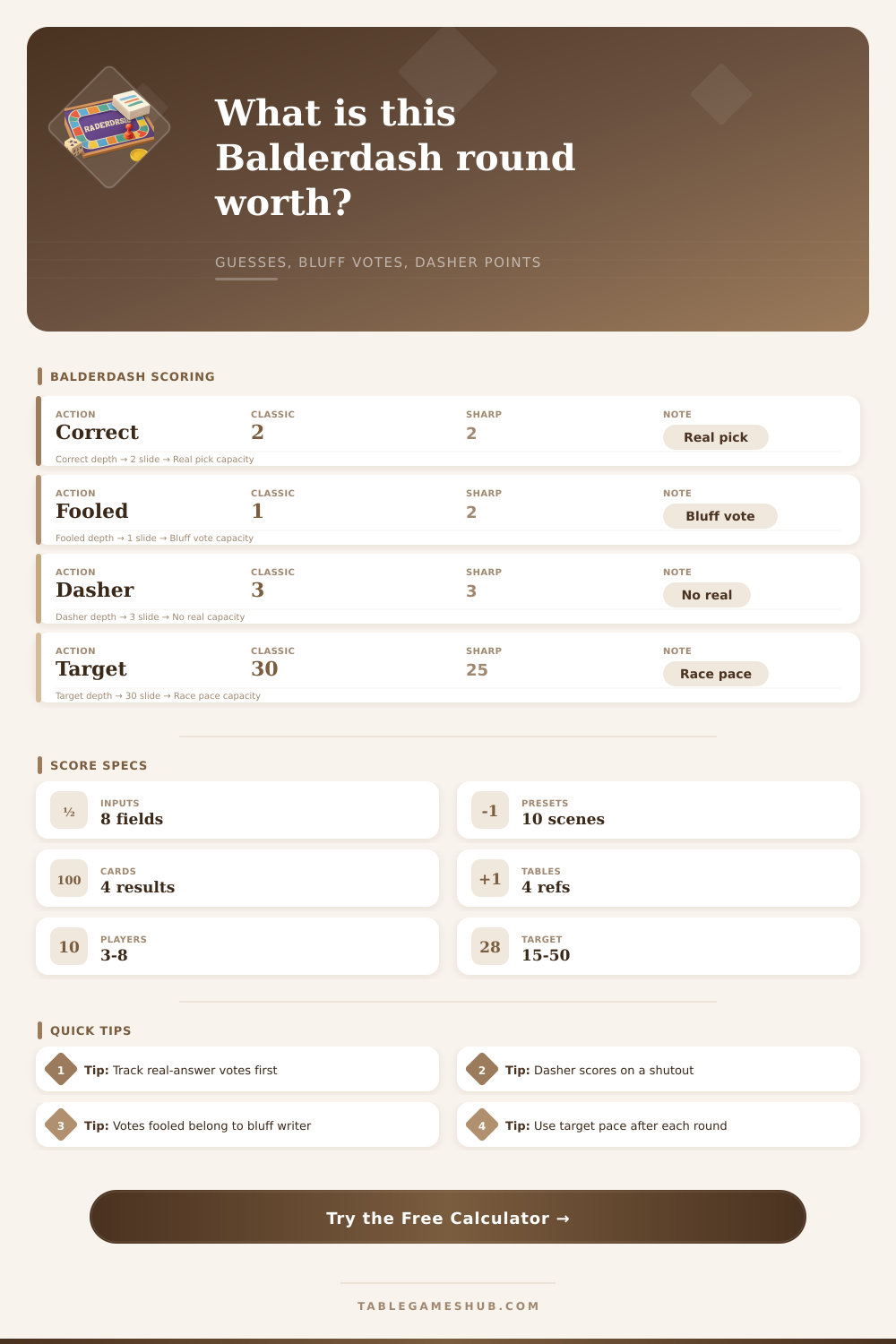
| Classic word round | 2 points per real-answer pick | 1 point per bluff vote | 3 points if nobody is correct |
| Beyond mix | 2 points per real-answer pick | 1 point per bluff vote | 3 points plus exact-answer bonus tracking |
| Party quick play | 1 point per real-answer pick | 1 point per bluff vote | 2 points for a shutout |
| Sharp bluffer | 2 points per real-answer pick | 2 points per bluff vote | 3 points for a shutout |
| Family easy score | 1 point per real-answer pick | 1 point per bluff vote | 1 point for a shutout |
Vote pool by player count
| Players | Non-dasher voters | Four-round vote pool | Bluff scoring meaning |
|---|---|---|---|
| 3 players | 2 voters | 8 total votes | Every fooled vote is a major swing |
| 4 players | 3 voters | 12 total votes | One good bluff can match a correct guess |
| 5 players | 4 voters | 16 total votes | Classic balance of guessing and bluffing |
| 6 players | 5 voters | 20 total votes | Bluff capture rate becomes very important |
| 8 players | 7 voters | 28 total votes | One standout fake answer can surge ahead |
Target pace guide
| Points per round | 30-point finish | Score pattern | Table read |
|---|---|---|---|
| 0 to 1.4 | Long game | Mostly missed guesses | Needs stronger bluff or real-answer picks |
| 1.5 to 2.4 | 13 to 20 rounds | Steady casual scoring | Good for relaxed table pace |
| 2.5 to 3.9 | 8 to 12 rounds | Strong bluff and guess mix | Leader can reach target quickly |
| 4 or more | Under 8 rounds | Runaway scoring window | Check whether house mode is too generous |
A game of Balderdash has its own brand of chaos, one where five friends sits around a table, the air full of betrayal and bluffing, and everyone laughs as a friend boldly backs up their definition of an ancient Roman plumbing system. It’s a game that thrives on words and wits, but without good bookkeeping, all the fun slips through your fingers. If you’re arguing with each other over who voted for whose lie and whether a round should be worth two or three points, there goes the playtime. Because it’s the tension of the race that makes people want to bluff, keeping score in real time is important.
A clear ledger prevents the game from slowing down; what starts as laughter become accounting. To use it, simply enter the numbers for each round into the calculator, then let it do the math for you. There’s no need to do mental gymnastics to reconcile multiple different scoring sources.
How to Use the Balderdash Score Calculator
You begin by inputting some basic information: How many times did your player guess correctly? And how many other player did they swindle votes away with their fake definition? These might sound like straightforward inputs, until you consider that not all modes are created equal. So, the calculator let’s you choose a category mode. This is important because different houses have wildly different house rules.
Some play classic mode (two points if you’re right; one point if you fool a voter). Other houses plays the sharp bluffer variant, where bluff points is worth two apiece. You must match your scoring profile with what you actualy agreed on before sitting at the table. Otherwise, those points totals won’t be trustworthy. So yes: Mode selection is as much about hitting calculate as it is choosing the right one.
And with knowledge comes understanding of the inputs. Since you are the dasher, you do not get to vote on the true answer; instead, you also stands to get a huge reward if nobody else guesses correctly. That’s called a shutout, and in most default modes, it will pay three points if no one gets it. The calculator will ask how often you’ve gotten that prize, taking it into account as well. If someone happens to make a correct guess, though, then you’ll get zilch from that row. It’s a risky play. You have to consider whether you want to gamble on everyone else failing while you stay safe, or whether you want to go with your gut and hope for the best. Casual players won’t think about that balance until after they watch their buddy get a winning string of actual answers, leaving them with a goose egg.
Also, number of players matter. Three at a table gives you such a small vote pool as opposed to eight. Because there are so many votes to trick in bigger groups, there’s more room for bluff points to build up. It shows this in the reference section on the page that explains how much the max vote pool increases for every extra player. With four players, sometimes two accurate guesses will be your most likely route to winning since there just aren’t enough votes to spread around for everyone’s bluffs. But with an eight player party game, one awesome fake definition could of earn five points all by itself.
Your strategy needs to change different than how many players are at the table. The calculator takes that into account, changing your outlook on how well you’re doing based on the number of people playing. The last part of the puzzle is pacing. Games tend to run to some goal (thirty points, fifty points). So as long as you know how many rounds in you are, the tool can approximate where you sit in relation to winning or needing to take chances.
You are halfway through the rounds but only have half the points. Time to stop playing it safe. How about two rounds left to go, but you’re way ahead? With the pace percentage and estimated number of rounds you’ll hit at this rate, the calculator puts your abstract anxiety into concrete numbers. How close do you think your lead realy is? Are you that far behind?
But at its heart, Balderdash is a math game that’s about lying and words. The beauty of it is, once you let the calculator do the math, your mind clears. This lets you come up with better lies and sell them effectiveley. Do you really need to remember whether Bluff gets a point or two under this set of house rules? Or would you rather spend that time figuring out an acceptable-sounding story of where the word kerfuffle comes from?
With the score keeping off your plate, you get back to what matters. It is good, old-fashioned friendship and befuddlement.