🎯 Petanque Score Calculator
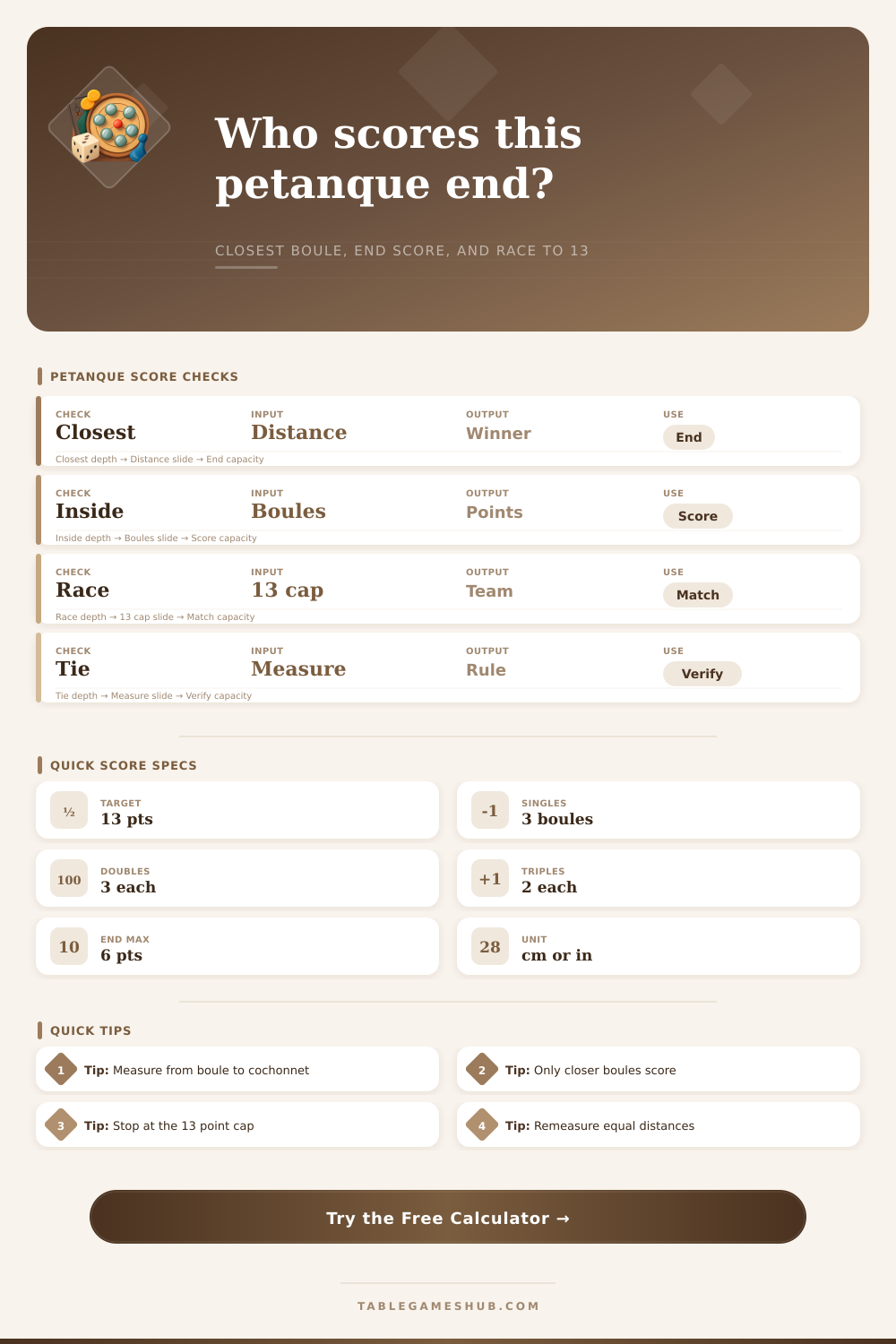
Compare each live boule to the cochonnet, find the closest side, count scoring boules before the opponent, and update a race to 13.
| Measure | Value | Formula | Read |
|---|
| Scoring step | Calculator input | Result | Petanque read |
|---|---|---|---|
| Measure live boules | Team distance lists | Sorted closest to farthest | Distances are from boule to cochonnet. |
| Find closest boule | Lowest Team A vs lowest Team B | End owner | The side with the closest boule is the only side that can score. |
| Count scoring boules | Winning side distances | End score | Each winning boule closer than the opponent's nearest boule scores one. |
| Apply target cap | Previous team score and end score | Updated team score | Standard matches stop at 13 points. |
| Format | Boules per player | Boules per team | Maximum end score |
|---|---|---|---|
| Singles | 3 | 3 | 3 if all Team A or Team B boules are closer. |
| Doubles | 3 | 6 | 6 if one team owns every closer boule. |
| Triples | 2 | 6 | 6 with two boules from each of three players. |
| Custom practice | Varies | 2 to 6 | Set the boule limit to match your drill. |
| Distance comparison | Example | End score | Reason |
|---|---|---|---|
| One clear closest | A: 9 cm, B: 14 cm | Team A scores at least 1 | A owns the nearest boule. |
| Multiple inside | A: 8, 11, 13; B: 15 | Team A scores 3 | Three A boules are closer than B's nearest. |
| Opponent breaks count | A: 8, 12, 18; B: 14 | Team A scores 2 | A's 18 cm boule is not closer than B's 14 cm boule. |
| Equal closest | A: 10 cm, B: 10 cm | Remeasure or no score | The calculator follows your selected tie rule. |
| Scoreboard state | Previous score | End result | Updated team score |
|---|---|---|---|
| Early end | 2-1 | Team B +2 | 2-3 and match continues. |
| Mid match | 7-6 | Team A +2 | 9-6 with Team A leading. |
| Match point | 11-10 | Team A +2 | 13-10 and Team A wins. |
| Over-target raw | 12-8 | Team A +4 | Cap mode shows 13; raw mode shows 16. |
Compare against the opponent cutoff
After finding the closest boule, score only that same team's boules that sit closer to the cochonnet than the opponent's nearest live boule.
Keep the race cap visible
A big end can mathematically add more than needed, but a standard petanque scoreboard stops when the winning team reaches 13 points.
Jump to the reference tables and use this petanque score calculator to compare distance-to-cochonnet measurements, score the end, and update each team score.
Petanque scoring are the process of determining how many points a given team will earn after the end of a game. The end occurs after each round of players have thrown their boules. To determine the score for each end, the distance of each team’s boules from the cochonnet must be measured.
Only one team can earns points during an end; points are only awarded to the team whose boule is the closest to the cochonnet. To determine the score for each end, the distance of each team’s boules to the cochonnet must be measured. Each team’s distance to the cochonnet must be compared to the other team’s distance to the cochonnet.
How to Score in Petanque
The team whose boule is the most closest to the cochonnet is the team that owns that end. The owning team calculates the number of points that they earn by counting the number of the owning team’s boules that are closer to the cochonnet than the opposing team’s best (closest) boule. Thus, any boules of the owning team that are further from the cochonnet than the opponent’s best boule are not counted toward the team’s score.
To determine the score for each end, the distance of each team’s boules to the cochonnet must be measured. The accuracy of those measurements will determine the score for that end. Thus, if the measurement of the distance of any of the boules to the cochonnet is incorrect, the score for that end will be incorrect.
Because measuring the distances with the naked eye may be difficult for some players, measuring tape or calipers can be used to determine the distance of each of the boules to the cochonnet. Using a measuring tape will allow for the score of each end to be correctly calculated. Furthermore, using a measuring tape will also reduce the arguments between the players regarding the score of that end.
For instance, if a player’s boule is only a few millimeters away from an opponent’s boule, that small difference in distance will determine the score of that end. The number of boules that are used during a game may differ depending upon the format of the game. For singles games, each player will have three boules.
For doubles and triples games, each team will have six boules. Thus, because there are more boules on the court during doubles and triples games, the maximum possible score for a single end is higher for those game formats than for singles games. However, regardless of the number of boules that are used during a game, the rules for scoring remain the same.
Regardless of the game format, the rules for scoring are that each team earns points for each of their boules that are closer to the cochonnet than the closest boule of their opponent’s team. Ties may occur during a game. A tie will occur if each team’s closest boule is the same distance to the cochonnet as the opponent’s closest boule.
In these instances, because there is no “winner” of that end, the teams will have to agree to a rule that will govern that scenario prior to the start of the game. Some possible rules that the teams may agree upon include the rule that each team earns zero points for that end, that the teams will re-measure the distance of each of their boules to the cochonnet to determine a winner of that end, or that one of the teams will be awarded a point for that end. Regardless of the rule that the teams establish prior to the start of the game, it is important that the teams agree upon such a rule so that there is no argument between the teams after that end is completed.
Boules that are declared to be “dead” or “fouls” do not count toward a team’s score for that end. A “dead” boule is any boule that is outside of the marked playing area, or that touched the cochonnet in a way that did not comply with the game’s rules. Thus, when calculating the score for each end, the dead boules are ignored.
Furthermore, the players that are watching the game make the decision of whether a boule is dead. The goal of each team in a game of petanque is to be the first team to reach a specific number of points. The target number of points is usually thirteen points for each team.
Thus, the first team to reach a score of thirteen points will win the game. Furthermore, as the team whose score reaches the target number of points of thirteen, the game will immediately end. Should a team score more than the target number of points during an end, the team will only earn a score that will allow their total score to reach the target number of points.
For instance, if one team scores twelve points, and they earn six points during an end, the team will only earn one point during that end to their total score; scoring to reach the target number of points of thirteen. Thus, each team must aim to score each end to ensure that they will reach the target number of points. Furthermore, consistency in scoring is essential for winning the game.
Common errors in scoring include mistakes made by the players in the counting of the team’s score. For instance, common errors include counting every boule that is near the cochonnet, instead of only counting those that are closer to the cochonnet than the opponent’s best boule. Furthermore, players may make errors in that they forget to compare their closest boule to their opponent’s closest boule.
To avoid these errors, the players should determine the best boule for each of their teams before beginning to count the points for that end. Furthermore, the location of the cochonnet does not determine the winner of that end. Thus, the points are only earned based upon the distance of each of the team’s boules to the cochonnet.