Multinomial Dice Calculator
Calculate dice category vectors with multinomial coefficients, exact counts, at least counts, wild faces, ordered position blocks, unordered hands, and reroll attempts.
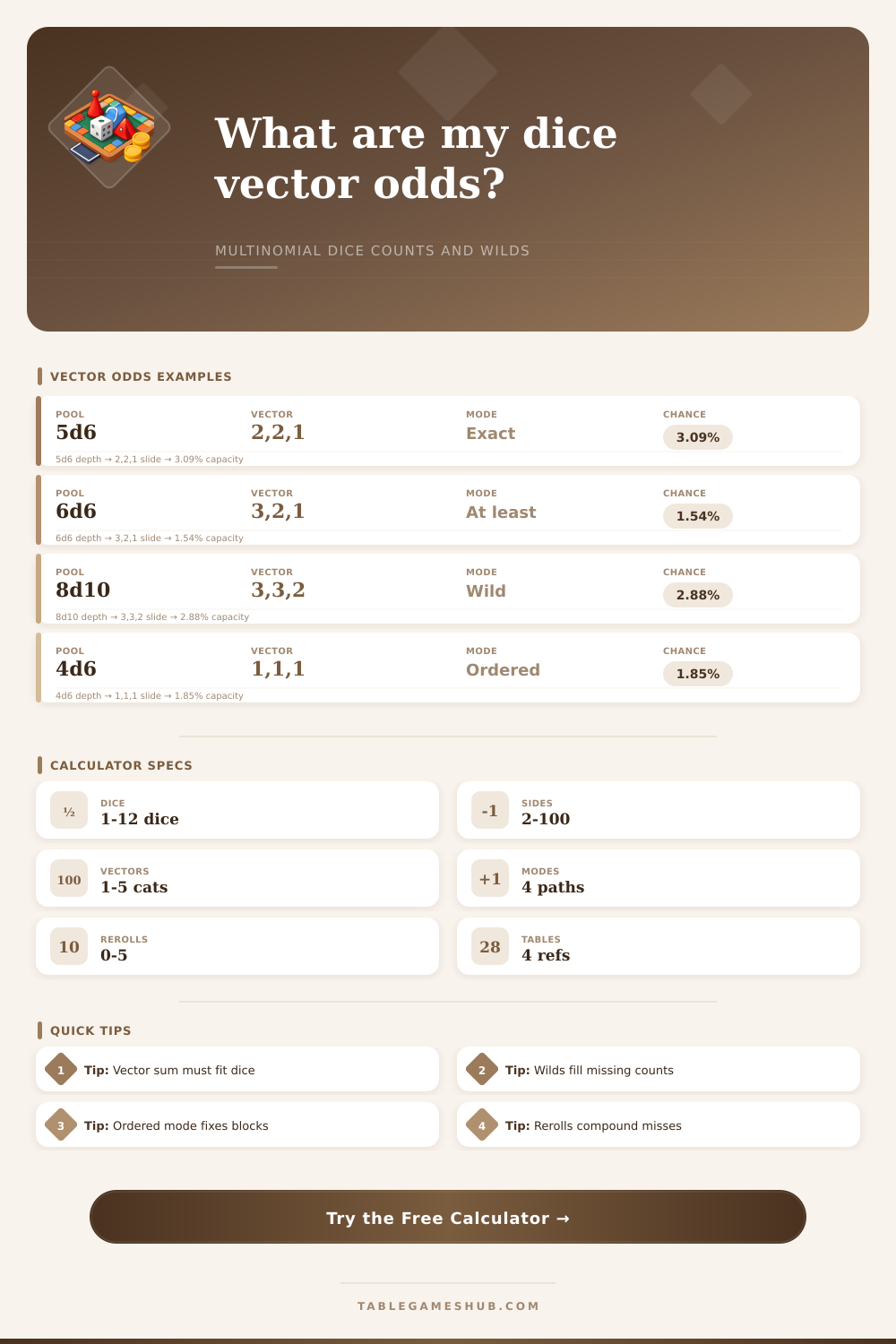
| Preset | Pool | Vector | Face groups |
|---|---|---|---|
| Yahtzee 2-2-1 Split | 5D6 | 2,2,1 | 1 / 2 / 3 |
| Risk Attack Buckets | 3D6 | 1,1,1 | 4 / 5 / 6 |
| D10 Story Symbols | 8D10 | 3,3,2 | 1-2 / 3-5 / 6-8 |
| Wild Ones Rescue | 6D6 | 3,2,1 | 2 / 3 / 4 |
| Term | Meaning | Calculator use | Example |
|---|---|---|---|
| n! | Dice arrangements | Top of coefficient | 5! = 120 |
| c1!, c2! | Repeated counts | Divide duplicates | 2! and 2! |
| r! | Other dice count | Exact leftovers | 0! or 2! |
| p^c | Category chance | Face group powers | (1/6)^2 |
| Goal | Counts | Groups | Reads as |
|---|---|---|---|
| Full split | 2,2,1 | 1/2/3 | Two 1s, two 2s, one 3 |
| Range classes | 3,2 | 1-3/4-6 | Low and high faces |
| Exact symbols | 1,1,1 | 18/19/20 | Three marked d20 faces |
| Wild fill | 3,2,1 | 2/3/4 | Wilds patch shortages |
| Mode | Exact goal | At least goal | Best for |
|---|---|---|---|
| Unordered | Final hand equals vector | Hand meets every count | Dice hands |
| Ordered | Vector blocks fixed | Blocks must pass | Scripted rolls |
| Wild faces | Fill exact deficits | Fill any shortage | Custom dice |
| Rerolls | Retry full pool | Retry full pool | Best-of tries |
“Take a moment to roll five dice. Look at your outcome. How many ones are there? How many twos? Threes? This sounds easy, except when another one comes along and spoils the hand.
Unfortunately, common probability tables follows a one-at-a-time path, rather than a multi-layered combination, which is why most folks intuitively play by feel. Few consider the actual math behind multi-category goal. Each category are represented by the number of times it come up on any single roll. What’s the probability of having a certain number for that?
Understanding Dice Probabilities
This is where the multinomial distribution kicks in. Essentialy, it expands upon the binomial distribution (which only record success/failure) and calculates the likelihood of each possible combination of results from a single dice throw. In Yahtzee, you’re dealing with multiple category at the same time; that’s why you might construct something such as a full house. There are many possibilities for how the dice could come up right, so this math becomes complicated. We has to require a method to go through all these combinations while still accounting for the limitations imposed by each category.
Make sure to define your categories in advance. In the case of regular old six-sided dice, those faces can be grouped into buckets. Two buckets is low number faces and high number faces. Then, after you’ve defined your groups, specify the number of dice you’re throwing and let calculator do the math for you.
It doesn’t matter if you have exactly three of a certain face or at least three. That’s why “at least” is such a huge factor in increasing odds. It lets them overflow which makes an enormous difference. People tend to think things has to be rigid, but they don’t.
Adding faces make the rolls more complex and adds even more life to wild dice. These are like a blank check you can use whenever you’re short of a count. If you’re near a goal, but miss a single face then the wild die comes into play to fill the hole. It substitutes for the missing category and saves the roll. You can see from the reference table how much this flexibility change the odds. This clarifies why a single wild option can doubles your chances in tight situations.
Position matters. In games where a particular set of players needs to be in order, that reduces the number of possible winning outcomes. Positionless hands is unordered and only care about the final count of categories. That’s more generous (and more common) than most tabletop situations. Knowing the context helps you avoid over-confidence. It’s a small detail but it will influence how you play at key moments.
Rerolling the whole pool increases your chances in an uneven way, people assume that two rerolls are twice as likely, but this doesn’t account for independent events. Every attempt presents a new chance of succeeding. In other words, the odds of failure decrease exponentialy with every attempt. The first roll fails? Second roll? You get another chance at success. Casual gamers don’t appreciate how powerful this compounding effect can be.
What about the edge cases? What about things not covered by a table? It covers those edge cases. Want a pool of 10 sides for narrative dice? Done. Want a mark of 20 sides on some rare occasion? No problem. The reasoning remains coherent: create your own categories, list your number of options per category and let the computer do its thing.
It eliminates tedious math with factorial and power functions. Moreover, it informs you right then if what you’re doing will work out or not. Knowing this stuff alters your gameplay. You don’t waste time pursuing unattainable outcomes. You pursues attainable ones instead.
The next time you play with dice, you’ll know exactly what you’re expecting randomness to produce. That’s the difference between blind chance and calculated risk.”