Qwinto Score Calculator
Total orange, yellow, and purple rows with completed-row scoring, pentagon column bonuses, failed throws, and legality checks for Qwinto score sheets.
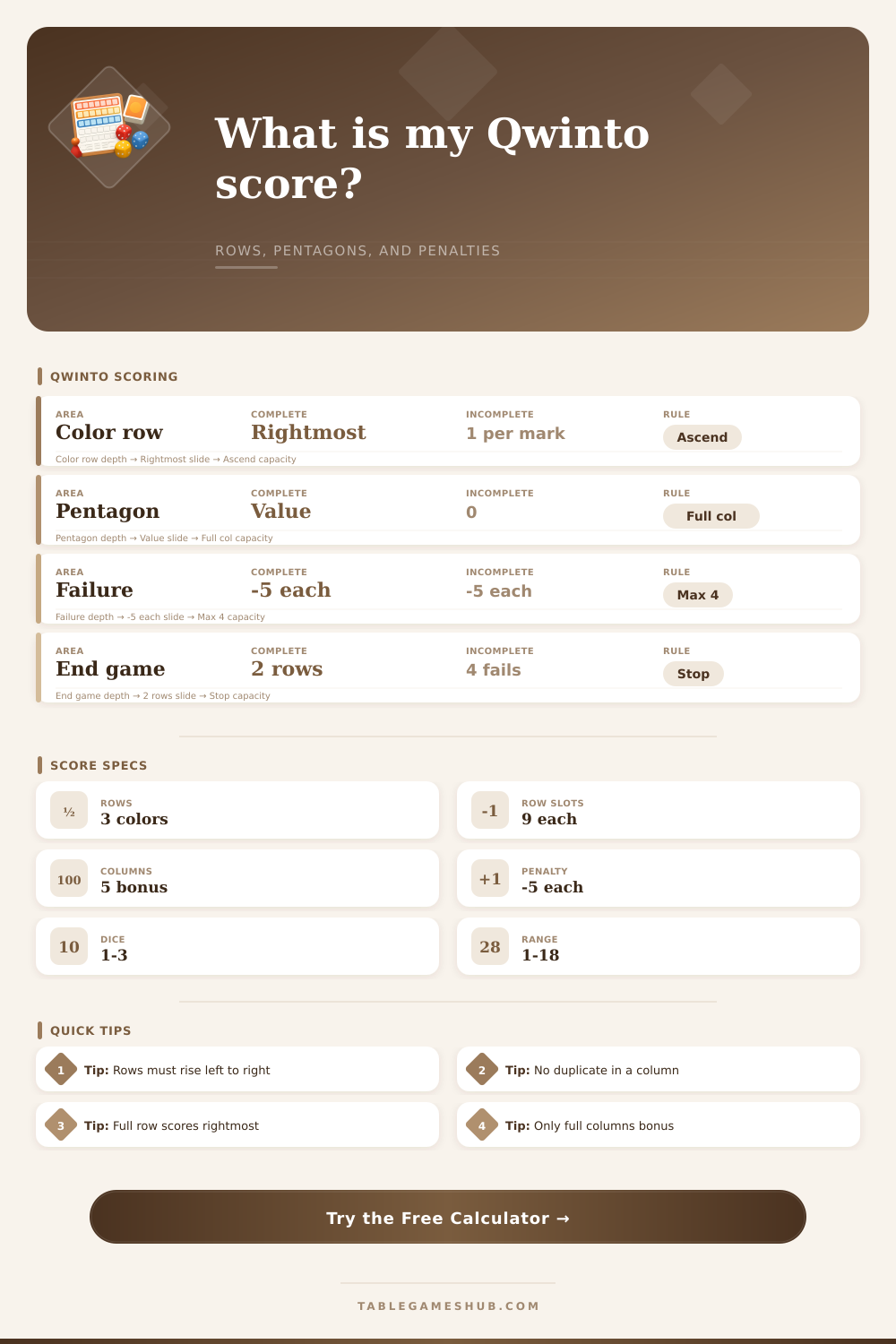
| Score Area | When Complete | When Incomplete | Calculator Treatment |
|---|---|---|---|
| Orange, yellow, or purple row | Score the number in the far-right filled field when the row has no empty fields. | Score 1 point for each entered number in that row. | Auto mode treats 9 valid entries as complete; manual selectors can override for odd score sheet notation. |
| Pentagon column bonus | Score the value in the pentagon only if all three fields in that column are filled. | Score 0 for an incomplete pentagon column. | The bonus selector should contain only the values from completed 3-field columns. |
| Failed throws | Each marked failed attempt subtracts 5 points at the end. | Four failed attempts can end the game. | The failed throws input is capped from 0 to 4 and shown as a separate subtotal penalty. |
| End game check | The game ends when a player completes two colored rows. | The game also ends when a player records a fourth failed attempt. | The result card flags these end states without changing the scoring formula. |
| Check | Valid Qwinto Rule | What To Enter | Warning Trigger |
|---|---|---|---|
| Ascending row order | Numbers increase from left to right in each colored row. | Use nine left-to-right slots with blanks for empty spaces. | A later number is equal to or lower than an earlier entered number. |
| Row duplicates | No number repeats in the same row. | Enter each number once per row, even if gaps remain. | The same number appears twice in orange, yellow, or purple. |
| Column duplicates | No number repeats vertically in a two-field or three-field column. | Keep x placeholders so orange, yellow, and purple positions align. | Two colors show the same value in the same column position. |
| Number range | One, two, or three dice can create totals from 1 to 18. | Use whole numbers from 1 through 18 only. | Any entry is below 1, above 18, or not a whole number. |
| Bonus Set | Values Entered | Bonus Total | Use Case |
|---|---|---|---|
| No completed pentagons | 0 or blank | 0 | Use when every pentagon column still has at least one empty field. |
| Sarah example set | 5, 10, 12 | 27 | Mirrors the published scoring example where three completed columns score 27 bonus points. |
| Odd column finish | 5, 9, 15 | 29 | Useful for a sheet with first, third, and fifth pentagon columns complete. |
| All five columns | 5, 8, 10, 12, 15 | 50 | Use only if all five 3-field columns are fully filled with legal numbers. |
| Reference | Publisher Type | Scoring Detail Used | Link |
|---|---|---|---|
| Nürnberger-Spielkarten-Verlag Qwinto rules | Official rule PDF | Rows score by completion, five pentagon columns score only when filled, and failed attempts subtract 5. | Official PDF |
| The Board Game Family Qwinto review | Rules summary | Completed row uses the last number; incomplete row uses filled-space count; failed boxes are -5 each. | Rules summary |
| Meeple Mountain Qwinto review | Rules example | Shows pentagon column scoring only for completed columns and deducts failed attempts after bonuses. | Scoring example |
| Board Game Arena Qwinto announcement | Digital rules overview | Confirms orange, yellow, and purple dice rows, ascending entries, no duplicate columns, and four failed attempts. | Rules overview |
But as you get further into Qwinto, math gets less intuitive. Especially on those final turns where you panic. “I could of filled out that row, but now I’ve lost more then what I gained.” That’s when your gut won’t help. The game has strict rules around how much points is worth, and how many rows can be worth what… Before you take another chance, you must know exactly how much the last turn will cost. It does the math for you (see above), and then you can play without guesswork.
There are three row, one for each color. Each row contain nine spaces, all of which help with the Qwinto scoring. Inexperienced players sometimes fail to realize that numbers contained within those rows are not necessarily the ones used to score them. If there’s even one open spot in a row, then that row counts as only one point per filled-in slot. That may sound like a pretty decent deal…until you look at the score from a filled-in row, where the score is simply the final number in that row. For example: A completely filled-out orange row ending in a 16 is worth 16 points. But a partially-filled out orange row with eight filled slots and one gap is worth just eight points.
How Qwinto Scoring Works
And this makes a huge difference in how you prioritize your dices. Instead of thinking about the score sheet as three distinct lines, think of it more like a grid. Pentagon bonuses are generous yet rigid. They live in the vertical columns, which means those columns is just as important to consider as horizontal ones. One number out of place means no bonus money, and there’s always the temptation to fill a row for its face value while leaving a column empty for possible gain.
Your final score is also heavily affected by the number of failed throws you make. When you throw dice and none of them land on your board, you put down an X. For each X you get a -5 point deduction against your total score at the end, and hitting 4 of them will result in immediate loss. While the calculator takes care of this for you, it’s important to know how much these count for as a -5 penalty is not nothing in close games. You may want to take a gamble with one of your rolls to fill up one spot, but missing and taking the penalty could be worse than helpful.
But it’s also useful for maintaining a clear mind as you go through play. For instance, rules dictate that you cannot have duplicate numbers in a row or a column, and all numbers in a given row must increase from left-to-right. Trying to do both that and keep your head clear is almost impossible… So you’ll likely slip up and put down a number that violates the ascending rule. You can use the tool by simply entering what’s currently on your board to see if the numbers follow the rules before you commit to them permanantly on paper.
Early in the game, make your moves with an eye toward the tradeoffs. Big point totals are nice in the far-right spots, but they leave gaps that prevent you from completing columns. Full columns guarantee a consistent stream of bonus points… but can result in emptying out rows which will cost them at the end. No best move exists, just good moves given what’s been rolled so far. This is spelled out nicely on the page with a reference table explaining the valuations of complete vs. These are incomplete rows. As the table shows, not all full boards are the most valuable if they lack those key column completions.
People get way too locked into the space they’re looking for. “I’m going to work on my orange row”). They forget about the space they actualy have: 3 spaces in their purple row, but nothing in their orange? Stop working on that! Anytime you spend a point in there, its wasted. You should of be paying attention to where those points are accumulating. There aren’t many of them, so you have to adapt to where they are, rather than having a rigid plan.
To conclude, Qwinto is a game where you’re being tricked into solving spatial problems with a die roll. It’s about spatial reasoning on a dwindling grid, and great players know how and when to lock down that bonus spot. It’s not mathematically complex enough for you to need to be a mathematician to win, but it’s just complex enough that you have to pay attention to the numbers if you want to succeed. Clear your head, get out the tool, and validate what you think until you’re sure. Then trust your gut. Because even then the dice still find a way to surprise you. Let the calculator do the work.