Kismet Dice Score Calculator
Score a five-dice Kismet roll with colored pip groups, category eligibility, Basic Section bonus progress, and reroll state in one compact table-game tool.
| Basic subtotal after scoring | Bonus awarded | Typical use | Calculator display |
|---|---|---|---|
| 0 to 62 | 0 points | Below the first Kismet bonus threshold | Shows points needed to reach 63 |
| 63 to 70 | 35 points | Standard upper-section target | Bonus State card shows 35 |
| 71 to 77 | 55 points | Strong Basic Section pace | Bonus State card shows 55 |
| 78 or more | 75 points | Top Kismet bonus level | Bonus State card shows 75 |
| Category | Roll requirement | Score formula | Color role |
|---|---|---|---|
| Two Pair Same Color | Two pairs whose face values share a color, or four of a kind | Sum of all five dice | Requires same color pair group |
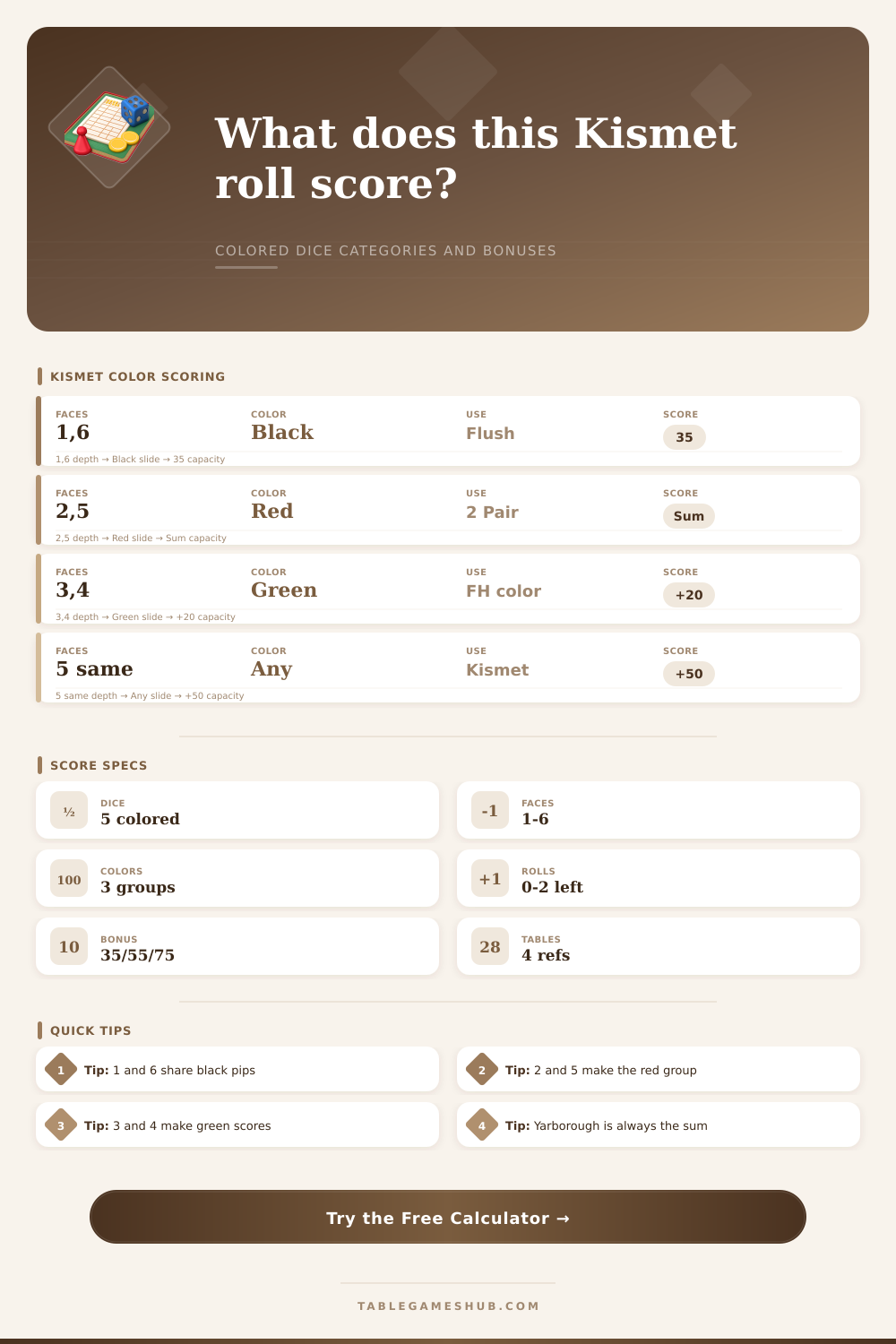
| Flush | All five dice are black, red, or green faces | 35 points | Uses 1/6, 2/5, or 3/4 color groups |
| Full House Same Color | Three of one face and two of another in one color group | Sum plus 20 | Examples include 1/6, 2/5, or 3/4 |
| Kismet | All five dice show the same number | Sum plus 50 | Color follows the repeated face |
| Face values | Pip color | Color category impact | Common scoring note |
|---|---|---|---|
| 1 and 6 | Black | Can form black Flush or same-color Full House | 1-1-1-6-6 scores Full House Same Color |
| 2 and 5 | Red | Can form red Two Pair Same Color | 2-2-5-5 plus any die scores Two Pair Same Color |
| 3 and 4 | Green | Can form green Flush with mixed 3s and 4s | 3-3-4-4-4 scores a same-color Full House |
| 1 through 6 | Any | Number categories ignore color | Yarborough and Basic entries are simple sums |
| Preset | Faces | Best scoring angle | Reroll context |
|---|---|---|---|
| Black Flush Push | 1, 6, 1, 6, 6 | Flush or black Full House Same Color | Final score comparison |
| Green Two Pair Same Color | 3, 3, 4, 4, 6 | Two Pair Same Color, sum all dice | One extra die does not need to match |
| Four Fives Red Power | 5, 5, 5, 5, 2 | Four of a Kind or Flush | Can be held for Kismet if rerolls remain |
| Kismet Treys | 3, 3, 3, 3, 3 | Kismet, sum plus 50 | Category should be checked before using joker logic |
They drop onto table in a flurry of chaos. The dice bounce, tumble, and for a brief instant, you don’t know what you’ve thrown. That’s when it happens; that’s where fate is won or lost.
You know this because it’s nothing more than a familiar-looking six-sided die, except the numbers are painted on different. Red, green, black, red, green, black. It is not an aesthetic choice. No, sir. It is the heart of the game. The game’s core mechanic transform a simple number into a strategic puzzle.
Why Color Matters More Than Numbers
Because it’s not just numbers you’re throwing. It’s colors. It’s combinations. It’s bonuses and triggers. People tend to get it backwards. They look at a couple of fives and say, “Oh, ten points.” The number on the die isn’t what matters most; it’s the color group it belongs to. A Black Flush pay out thirty-five points, period. A Straight doesn’t care about what the total adds up to. However, holding two Red in expectation of a Straight blinds you to that possibility.
You can choose the faces you’re rolling and the category (e.g., Flushes) and the calculator will do the rest. Knowing why that matters is where smart strategy differ from casual play. Now look at Bonus Points given in Basic Section. They’re broken up at 63, 71, 78 points. Get past them, and get 35, 55, 75 bonus points, respectively. That’s a huge gap. It can mean that what looks like an average roll for a certain category is, in fact, your ticket to the best possible bonus in the higher end of the section.
Should you take it, or go for something that keeps you under the threshold? It depends on whether you think the short term score will outweigh the long term benefit. Pushing just hard enough so that you overshoot a threshold may be less wise than playing conservatively to avoid going over, even if it means taking a lower number. The chart on the page give you a clear sense of just how near (or far) away from the mark you are.
The other wrinkle of tension comes from Rerolls. With each one, you get an additional opportunity to enhance your hand. But each reroll also costs a turn from the game clock. Should you stick with a potentially good green pair, and hope? Or reach for the Flush? You need three of any one color. How many categories is still open? What’s the score so far? Are you nearing completion of the Basic Section? In that case, scoring those bonus points should of been more important than trying to track down some rare combination of Kismet.
It’s all about managing resources. It’s a resource management game masquerading as luck. Don’t skip over the Yarborough safety net: Summing your dice is your fallback when everything else fails. You’ll always get something for your dice. However, don’t rely on this strategy so much that you leave points on the table.
Consider how many different colored dice appears before settling on your number. If the composition favors the color categories, they will offer more points than just summing them. A three-three-four-four combo looks like a Three of a Kind at first. However, since each color is green, it is also a Full House Same Color, which adds 20 points to the sum. This bonus dissapears if you only look at numbers.
But here’s where the tool shines: It lets you simulate that decision tree in an instant. Enter your roll, find the highest-legal category and voila, you can see how it impacts your bonus state. No more worrying if you missed a rule exception or miscounted. But it doesn’t take away from the humanity. The tool will say what you’ve scored. But it won’t say who to block next and what section to rush next. That’s up to you, and those decisions make the game.
Fate boils down to that. It is seeing the pattern before it forms. You see beyond the surface and spot the color relationships buried in the blend. After all, when you begin to see the dice as clumps of red, green, and black instead of just numbers one-six, the board becomes more transparent. And the math? Let the calculator take care of that. Your sharp color vision is what’s doing most of the work there.
That’s where the true fun lies, turning a simple roll into a calculated strike against the odds.