Maximum Roll Probability Calculator
Calculate natural maximum odds, kept-total distributions, modifier effects, high-value rerolls, keep/drop dice modes, and table-game cap or bust outcomes.
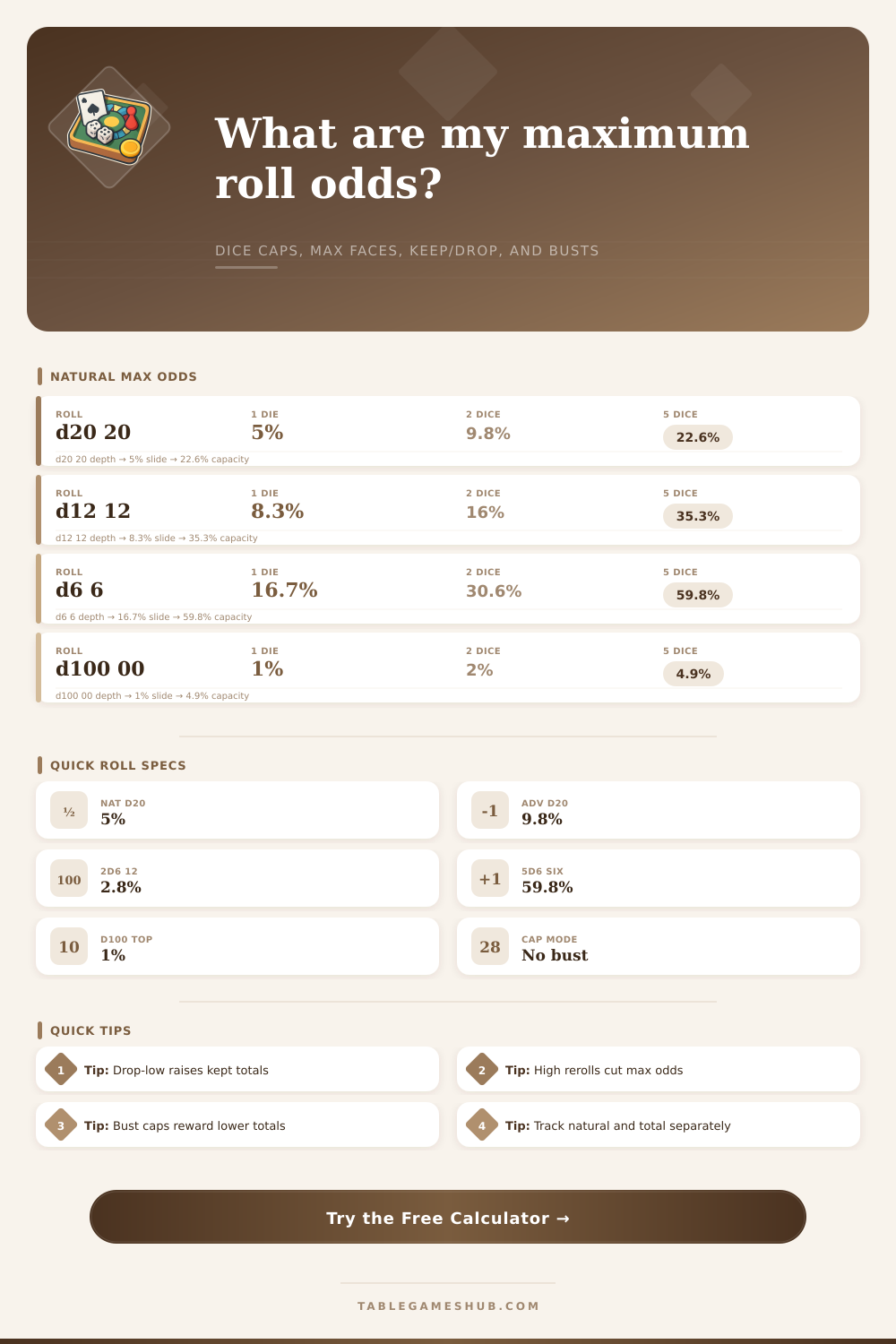
| Roll setup | Natural mark | Single die | At least one |
|---|---|---|---|
| 1d20 check | 20+ | 5.0% | 5.0% |
| 2d20 advantage style | 20+ | 5.0% | 9.8% |
| 5d6 dice pool | 6+ | 16.7% | 59.8% |
| 1d100 percentile | 100+ | 1.0% | 1.0% |
| Mode | Total method | Common use | Maximum effect |
|---|---|---|---|
| Keep all | Sum every die | 2d6 and pools | Preserves full ceiling |
| Drop lowest | Sum minus low die | Ability rolls | Raises average total |
| Drop highest | Sum minus high die | Penalty pools | Lowers total ceiling |
| Keep highest | Top dice only | Advantage pools | Boosts max chance |
| Reroll rule | Trigger faces | Applied when | Probability effect |
|---|---|---|---|
| Top face once | Only the die max | Before keeping dice | Cuts perfect face odds |
| Natural max+ | Chosen max zone | Before total math | Suppresses natural spikes |
| Top 2 faces | Highest two faces | Before keep/drop | Softens ceiling totals |
| Upper half | Half die or better | Before keep/drop | Strong negative swing |
| Rule | Success meaning | Ceiling output | Best fit |
|---|---|---|---|
| Meet or beat | Total reaches target | Over target allowed | Target number checks |
| Cap total | Total reaches cap | Excess becomes cap | Maximum score limits |
| Bust above | Total stays legal | Above target busts | Push-your-luck rolls |
| Exact only | Total equals target | No overage value | Boxcars and exact sums |
There’s no tool for this that you don’t need because “rolling a 20 on the first try doesn’t feel so bad…until the dungeon master tells me I’ll roll again and it instantly triggers a death trap.” A set of dice are more than just a randomizer; it’s a probability engine with its own curve, and while most players assume they’re using the former, it turns out we’re all really playing complex games which require the latter. That’s the distinction between playing by the numbers vs. It is about gut feeling, or knowing how to get that capped result from a pool of dice versus a natural max on any individual die.
Dice pools is no longer a matter of guessing with this calculator, which spits out the math for you when there’s a modifier involved in your pool or some sort of failure condition to account for. It spares you from doing the hard work of combinatorics and lets you worry if you realy want to go for it.
How Dice Pools Really Work
But knowing how to input the numbers into the calculator is the trick. A threshold total isn’t the same as a natural maximum face. One represent the final result; one represents the feel of the roll. Think of a typical d20 found in most tabletop roleplaying games. On any given roll, you has five percent to get the absolute maximum.
Seems tiny, but then you throw in some advantage mechanics, which means you roll twice and take the best result. Boom! Your chances are almost doubled to around ten percent. No longer is this just relying on Lady Luck; this is now moving that curve of probability. The more dice you pile into the pot, the greater effect the law of large numbers have on squishing those crazy outliers out of existence if they’re not what you want.
That’s when the keep and drop rules starts playing an even more important role in the game. It makes sense that dropping the lowest die will increase your average outcome. However, dropping the highest one stops those high value spikes. This could of actually be a better strategy if you don’t want to hit a bust condition or trigger some sort of cap. Lowering your ceiling could be preferable than trying to get that perfect roll. The page has a great reference table that lays this out clearly for popular configurations.
Adding more dice increases your chances of getting a max face but also smooths out your total sum. Another complication that most people overlook is rerolling. The forced reroll rule provides another kind of brake on success: when you have to reroll at a certain value, you’re basically taking the top end off of your range of possible outcomes. It means it’s more difficult to reach whatever threshold it is, and that you’ll get less variance in the results. You’re trading off the potential high for the safer middle, but that can be a good strategy if what you want is consistency over peak performance.
That’s flipped around in bust mechanics. You push your luck in scenarios where going over the target results in failure. A big natural result is bad news. You love to roll sixes? Too bad you’re playing with standard dice and the threshold is seven and going over is getting nothing. That’s a liability when it comes up. The calculator shows the conflict between the natural max chance and the actual success rate under the rules. How many times do you hit the ceiling vs how many times does the attempt succeed?
Where modifiers come in is between the raw dice result and what it means during play. A static modifier like plus five shifts all possible totals up by a fixed amount. This doesn’t change the shape of the distribution, but it alters the odds of hitting or missing a given threshold. That’s a massive swing for just adding something. And understanding how much it moves things around will allow you to know when to fold and when to press your luck.
But these tools reveal the illusion that we create around randomness. We believe we can feel the roll, when in reality we’re typically only feeling the confirmation bias. They let you measure the likelihood of surviving a bust and getting a hit on a cap. This takes the emotions out of it and lets you decide rationally by calculating true risk versus hoping something works out.
Next time you pick up those dice, take a second to reflect on what the numbers are telling you before you shake them. If you know their story, then each roll will count that much more.