Mexico Dice Game Calculator
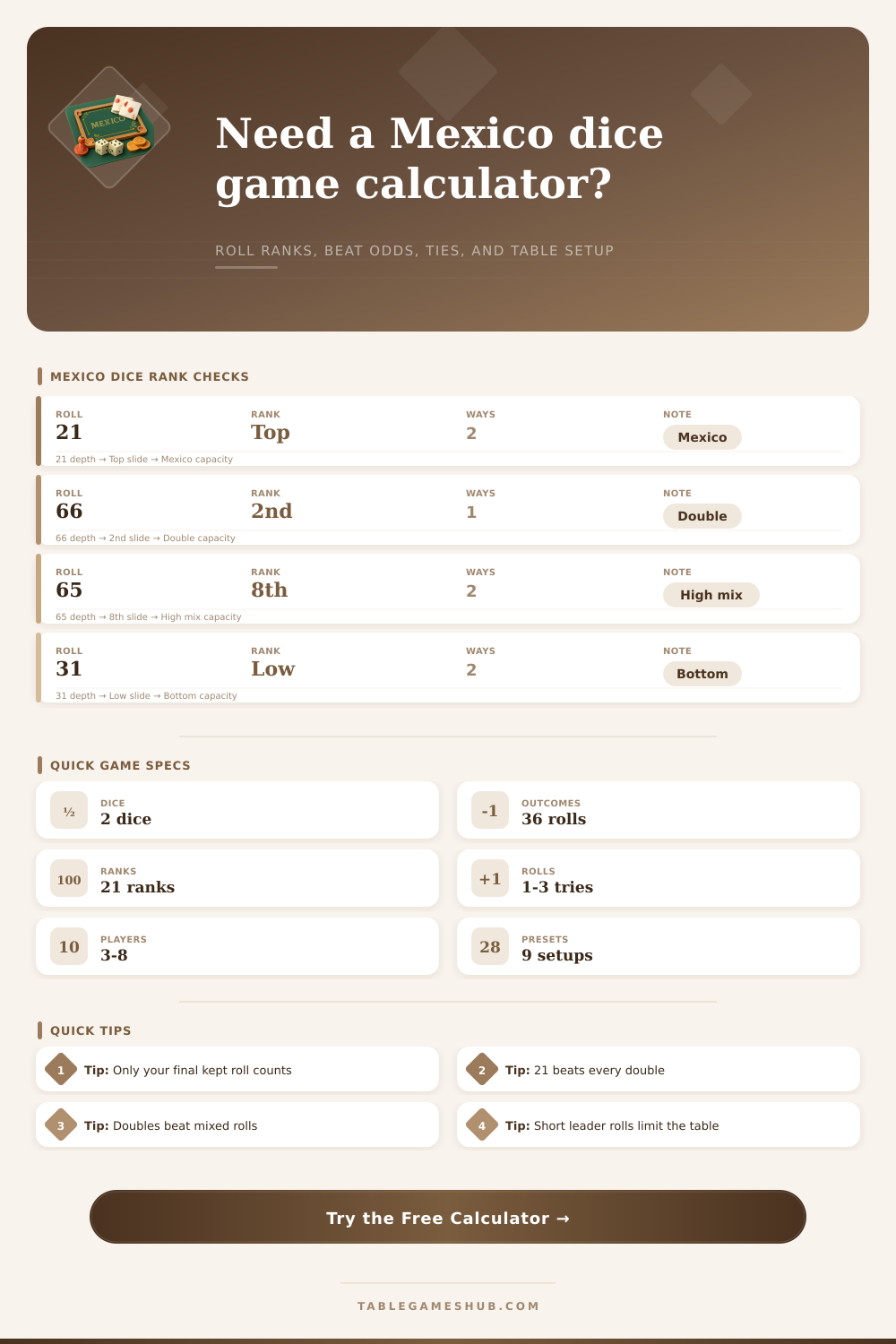
Compare Mexico roll ranks, odds to beat a target, tie exposure, player pressure, and table setup requirements for a two-dice round.
1Mexico Dice Presets
Pick a live-table situation, then adjust the rank, roll limit, player count, and table layout.
2Round Inputs
3Table And Component Inputs
4Component And Setup Specs
5Mexico Scoring Ladder
| Rank band | Scores in band | Dice ways | Calculator meaning |
|---|---|---|---|
| Lowest mixed rolls | 31, 32, 41, 42, 43 | 2 each | Easy to beat, useful for one-roll pressure checks. |
| Middle mixed rolls | 51, 52, 53, 54, 61 | 2 each | 54 is near the single-roll median for a follower. |
| High mixed rolls | 62, 63, 64, 65 | 2 each | Strong if the leader allowed only one roll. |
| Doubles | 11, 22, 33, 44, 55, 66 | 1 each | Every double beats every mixed score. |
| Mexico | 21 | 2 ways | Top score; only another 21 can tie it. |
6Reference Odds Table
| Target | Beat in 1 roll | Beat in 2 rolls | Beat in 3 rolls |
|---|---|---|---|
| 43 | 77.8% | 95.1% | 98.9% |
| 54 | 55.6% | 80.2% | 91.2% |
| 65 | 22.2% | 39.5% | 52.9% |
| Double 3 | 11.1% | 21.0% | 29.8% |
| Double 6 | 5.6% | 10.8% | 15.8% |
| 21 Mexico | 0.0% | 0.0% | 0.0% |
7Table Setup Reference
| Setup | Suggested surface | Player range | Use case |
|---|---|---|---|
| Travel cup | 24 x 24 in | 2-4 | Small tray, quick scoring, minimal edge space. |
| Kitchen table | 60 x 36 in | 4-6 | Comfortable for score tokens and a shared tray. |
| Long game night | 84 x 42 in | 6-8 | Best when every player keeps a personal note area. |
| Round card table | 48 in diameter | 4-5 | Easy reach to the middle but limited spare area. |
| Octagon card table | 52 in across | 6-8 | Clear seats, central dice zone, compact footprint. |
8Component Spec Grid
| Component kit | Piece count | Storage footprint | Best player count |
|---|---|---|---|
| Pocket two-dice cup | 2 dice, 1 cup | 3.5 x 3.5 in | 2-4 players |
| Six-dice spare set | 6 dice | 2 x 2 in | 3-6 players |
| Small felt dice tray | Tray and 2 dice | 10 x 10 in | 3-6 players |
| Rail-friendly dice tray | Tray and 2 dice | 16 x 12 in | 4-8 players |
| Family-table kit | 12 dice and cup | 8 x 6 in | 5-8 players |
| Large-group spare kit | 18 dice, 2 cups | 9 x 7 in | 7-12 players |
9Practical Calculation Tips
Leader limit: The leader's number of rolls controls how many chances later players may take, so a modest score can be strong after only one roll.
Table fit: Use at least 20 to 24 inches of edge per adult player when dice trays, drinks, or score markers share the table.
For example, the Mexico dice game calculator help manage the tension after one person rolls high on the first roll. The table goes quiet and now you are faced with a decision: Do you fold? Or do you chase that number? You get two additional opportunities to pull it off. This take away some of the “what if” aspect of playing from behind. It converts your gut feeling into numbers to help in clear-cut decisions.
Beyond the fact that doubles beats any mixed pair (even if it totals more), there’s a rank ladder to the game, and that will trip you up if all you’re looking for is the sum of the dots. In standard play, that mean two and one trumps everything except double six which is king. While most folks grasp that vague notion of “doubles are good,” what they seldom translate is just how unlikely those winning combos are given your limited number of chances. Enter the calculator; after plugging in your remaining tries and target roll it crunches the numbers on probability math so you don’t need to memorise each combination of possibilities.
How to Use Numbers to Play Better
For instance: If the first player goes first and rolls a fifty-four on their first shot, they’ve established a middle-of-the-road bar. Sounds like something you can overcome, right?… except wait, fifty-four’s pretty high to try to get on just one roll. There’s about a 55% chance you’d be able to beat it on your very next roll. This means there is a coin-flip hovering above your head before you grab the cup.
But what if the guy who threw that fifty-four did so after exhausting his own supply of luck? What if he got his fifty-four across three rolls? Suddenly everything changes. He’s burned through his supply. You now have three brand-new shots at a fixed target. Now you’re statistically advantaged just by the fact that you possess greater opportunities then the guy whose hand was forced to establish the bar.
But all this focus on dice miss the physicality of the table. Eight people can’t sit comfortabley at a tiny kitchen island and expect everything to go smoothly. Dice will tumble from their trays. Elbows will knock elbows. The inputs in the tool allow you to measure your real-world surface area versus number of players. It determines the edge space per player needed to seat everyone comfortably. If your table’s too small it will result in rushed rolls and missed rules. When things are more relaxed, that gives people time to properly consider rolling again or taking the tie instead.
The thing about ties: they’re their own special brand of chaos. A lot of house rules say if there’s a tie, then we both get to keep our scores, and the next guy has to do better than us. That puts up the bar for everyone else. The calculator takes into account tie risk, how likely am I to have two people wind up tied? It go up sharply as the number of players increases, particularly when you’ve got six or more. When the field’s crowded it may make sense to settle for a point or two less rather than risk getting caught in a cluster-tie mess.
The components also set the pace of the evening. If you get one of those little felt trays that hold the dice and prevent them from rolling around on the carpet, they’re hard to see. When it comes time to settle a dispute about whether or not a die rested in the corner, you should of had a big enough tray so everybody can see what happened. The kit specs section will help you identify how much you’ll want to bring based off the number of people. For a date night with your honey, there’s no reason for a huge travel set. On the other hand, if you’re at a packed family reunion, a pocket cup isn’t going to cut it. Make sure the hardware fits the space.
In the end, this game is about taking risks against the clock. You get three rolls. And the calculator reduces everything down to nothing but that. Where do your three rolls fall on the distribution curve? If you can beat that double three, is it a risky move of fools? Or is it a worthy wager? With these numbers in your head walking up to the game, you begin to play the odds instead of reacting emotionaly. This is how you transform nervous quiet into measured action.