Cheerio Dice Game Calculator
Score a five-dice Cheerio turn, check Aces as wilds, track Multiples progress toward the bonus, and see whether the chosen scorecard target is still on pace.
This is a useful Multiples row but it does not finish the bonus yet. With one reroll left, keep the Queens and use the Ace as a flexible helper only if the next roll creates a stronger fixed hand.
Multiples section scoring
| Scorecard row | Dice face | Base score | Bonus contribution |
|---|---|---|---|
| Aces | 1 | 5 points per Ace | Counts toward Multiples total |
| Kings | 2 | 5 points per King | Wild Ace use halves the row score |
| Queens | 3 | 5 points per Queen | Three Queens are worth 15 progress |
| Jacks | 4 | 5 points per Jack | Four or five matching dice can rescue bonus pace |
| Tens | 5 | 5 points per Ten | A full row of five is worth 25 |
| Nines | 6 | 5 points per Nine | Low rows still matter for the 90 threshold |
Poker-hand category scoring
| Scorecard row | Requirement | Clean score | With Ace wild |
|---|---|---|---|
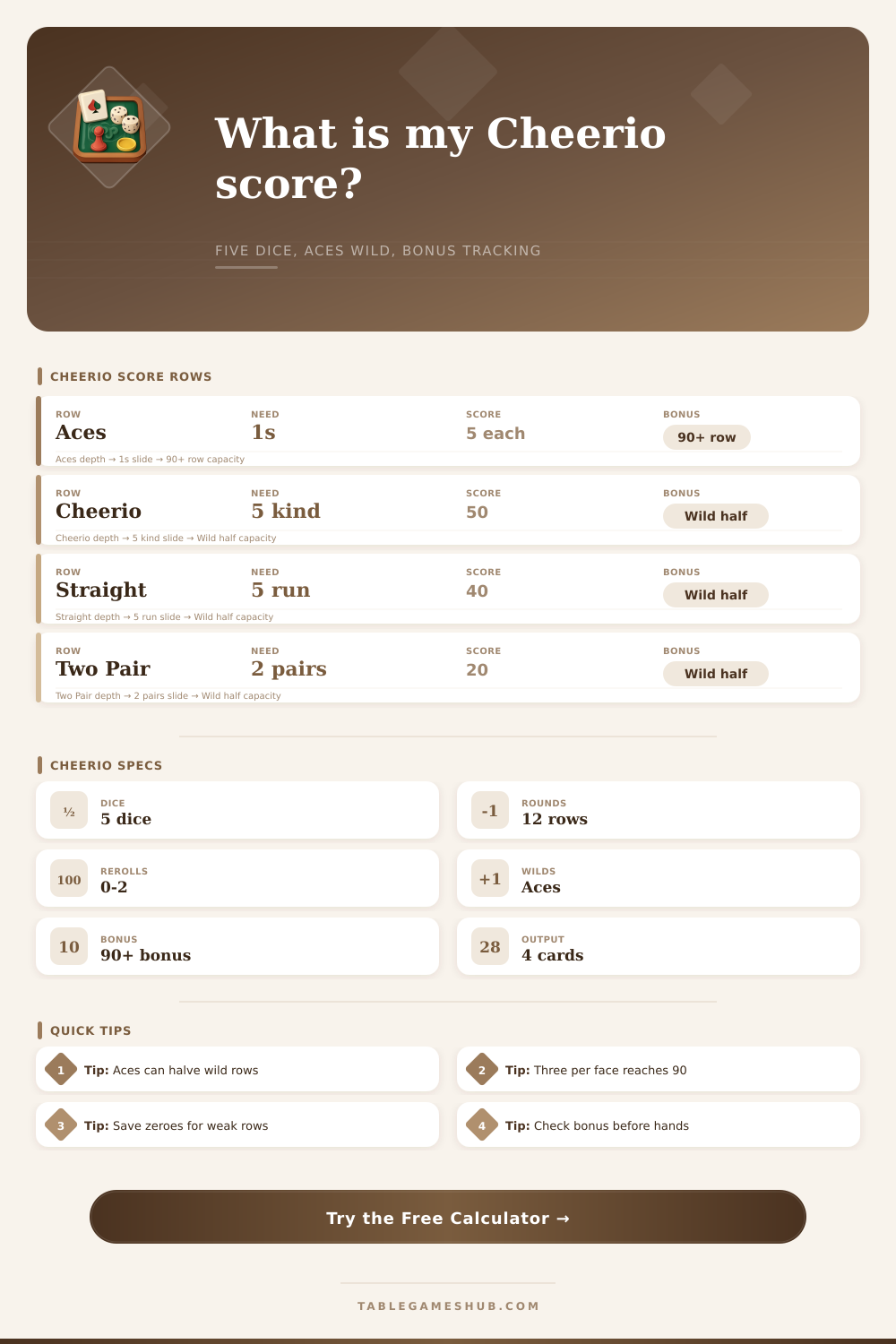
| Cheerio | Five of a kind | 50 points | 25 points if wild Ace fills the pattern |
| Four of a kind | Four matching dice | 40 points | 20 points if wild Ace is needed |
| Straight | Five in a row | 40 points | 20 points if wild Ace is needed |
| Full house | Three of a kind plus one pair | 40 points | 20 points if wild Ace is needed |
| Three of a kind | Three matching dice | 30 points | 15 points if wild Ace is needed |
| Two pair | Two separate pairs | 20 points | 10 points if wild Ace is needed |
Bonus and target pace guide
| Checkpoint | Healthy Multiples total | Scorecard read | Common decision |
|---|---|---|---|
| After 3 Multiples rows | 45 or more | Three matching dice per filled face | Keep building upper section |
| After 4 Multiples rows | 60 or more | Bonus is still on average pace | Take a clean poker hand only if strong |
| After 5 Multiples rows | 75 or more | One solid remaining face reaches 90 | Avoid wasting a four-of-face row |
| After 6 Multiples rows | 90 or more | Add the 10-point bonus | Switch fully to poker-hand value |
At first glance Cheerio appear straightforward, until you realize you’ve missed out on the bonus up top and your plan falls apart. To win, you need to form poker hands using regular dice like straights or full houses. However, what is happening behind the scenes are something most people do not see: arithmetic. There are multiple lines where you’re working toward ninety, and failing by just one point feel disastrous when your goal was to achieve a big total at the end of the round. Knowing how the dice play into the scoring board makes all the difference between being lucky and performing consistant.
After entering your scorecard and roll into the calculator above, it crunches all those pesky numbers, freeing you up to worry about strategy instead. Just enter your five dice results, pick a section to add to, and follow along as you work through multiple sections. That’s where the game gets interesting, because now it’s all about resource management.
How to Win at Cheerio Using Math and Strategy
The trick is getting each of the nine faces (from Nines down to Aces) to add up to at least ninety points apiece before moving down to the next set of cards. If you fall too far behind that schedule, a cautious three-of-a-kind worth just fifteen points may be better then risking a straight worth a high 40. Otherwise, you might end up short on bonuses. Go for the ceiling while protecting the floor.
The other wrinkle with Cheerio’s mechanics: the Ace functions as a wild card. On one hand, it sounds great, Joker, anyone? But when you use an Ace to fill out a poker hand, entire row score is cut in half. That means a nice three-of-a-kind worth thirty points are only worth fifteen if you had to use an Ace to make it happen. It adds another layer of decision-making tension: do I go for the higher point-efficiency play or risk forcing myself into a hard-to-fill pattern? Early on, you may want to keep your Aces aside to lock down multiples bonus; they’re not necessarily part of the hand, just flexible tools to be used as needed. The calculator will let you know which would of been better for your target pace right now, a clean score, or a penalized wild score.
The other resource you need to use wisely is rerolls. Each turn you begin with two rerolls to give yourself an opportunity to upgrade a so-so roll to a respectable one. But remember, each reroll eats up time. And if your outcome turns out less than ideal, it narrows your options. It’s equally important to know how (and when) to lay down and take what you get from a low scoring row, as it is to understand when to go all-in on hoping for the best. Comparing current potential to overall target scorecard helps you see the trade-off based off logic.
Want to stay alive in the game? That means making sure to play safe with 10-pointer of two pair. Otherwise, you may end up with nothing if the dice don’t go your way while you are going for broke on a five-of-a-kind. That’s not super hard to wrap your head around, but once you do it becomes easier to intuitively know how close you’re getting to the bonus on the fly.
Let’s say you’ve gotten three sets of matching dice on every multiples row which means you’ve got an average of fifteen points from those rolls already. After only a couple of rounds, you can get a good idea if you’re going to hit the bonus or not by knowing that three matching dice in each multiples row averages fifteen points. But now you realize that if you fill another four rows and find yourself with sixty points then you better hope the next two faces really kick ass, otherwise the pressure will be on big time. Now you move away from blindly rolling the dice and instead begin to think about taking calculated risks.
Each roll isn’t isolated anymore but rather part of a greater mathematical equation stretching across twelve rounds. To win at Cheerio, you need to learn to manage short term pleasure against long term plans. The temptation of catching a rare hand will make it hard to resist, but those who always do well knows the shape of the game. Do I want this? What are my bonuses looking like? How much am I willing to pay for Wild Aces? When should I reroll?
Running different scenarios on the calculator lets you test out these choices without stakes. After a while, every roll becomes part of an overall pattern. The randomness fades as you see patterns emerge. You realize there’s a method to the madness if only you can be patient and precise enough to unlock it. That change of mind allows what was once just a fun game night turn into a serious competition of wits.