Notre Dame Score Calculator
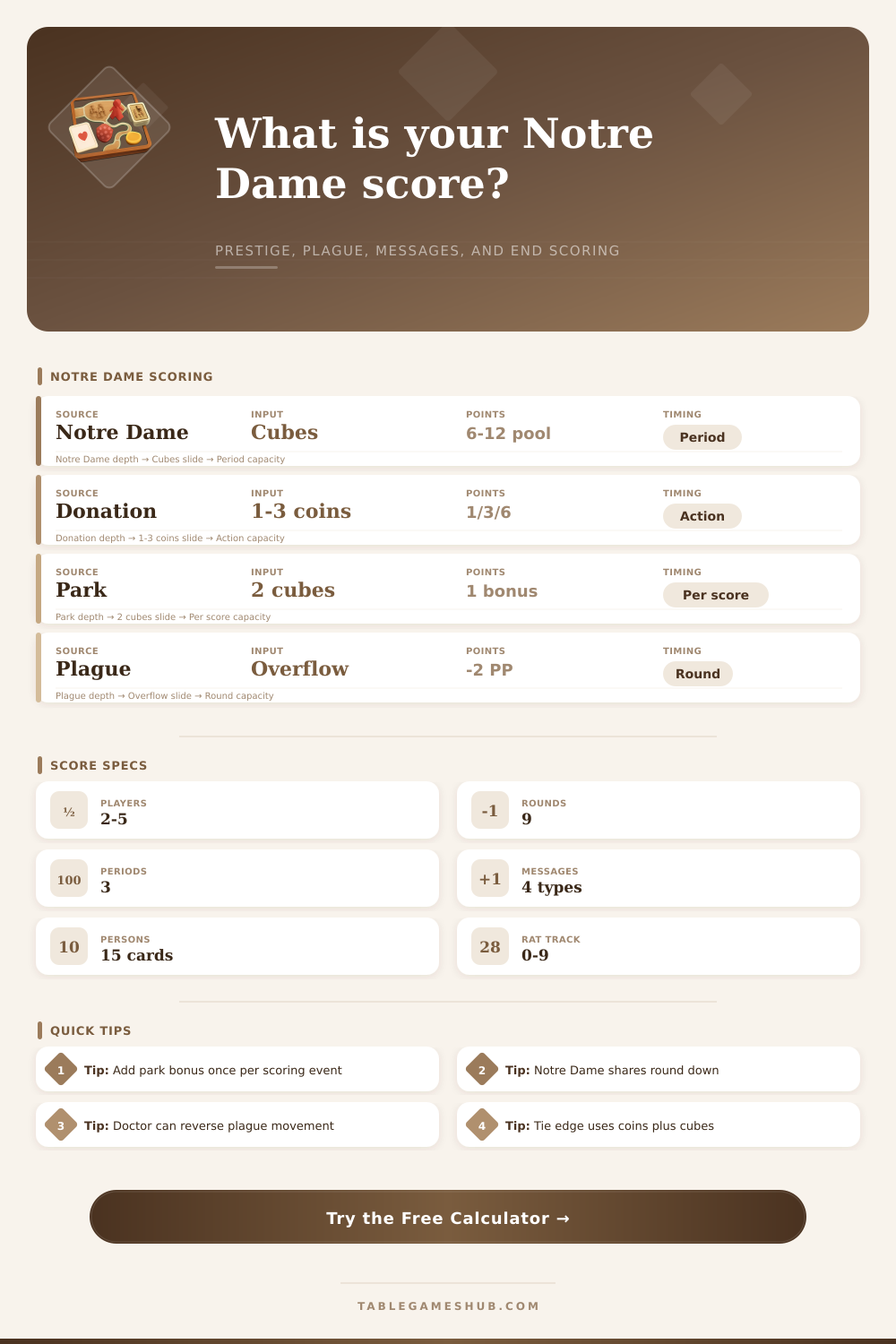
Total prestige points, Notre Dame shares, message rewards, park bonuses, person cards, plague overflow, and final tie-break pressure.
| Scoring source | Calculator input | Formula used | Park bonus? |
|---|---|---|---|
| Residence action | Markers in selected district | 1 PP per marker in Residence | Yes, once |
| Notre Dame donation | Coins donated now | 1 coin = 1, 2 = 3, 3 = 6 PP | Yes, once |
| Notre Dame period share | Your cubes and total cubes | Pool divided by total cubes, rounded down | Yes, once |
| Carriage message | Next message reward | 1, 2, 3, or 4 PP by message token | Yes, once |
| Person card | Period | Scoring input | Formula used |
|---|---|---|---|
| City Guard | A | Total markers and friend | 1 PP each, including Notre Dame |
| Advocate | B | Total collected messages | 3 PP per complete pair |
| Guild Master | B | Sectors with at least 2 | 2 PP per qualifying sector |
| Mayor | C | Sectors with at least 3 | 3 PP per qualifying sector |
| Carpenter | C | Occupied sectors | 1 PP per occupied sector |
| Bell-ringer | Expansion B | Your Notre Dame cubes | 3 PP per cube in Notre Dame |
| Plague item | Input | Effect | Calculator note |
|---|---|---|---|
| Person-card rats | Three rat values | Sum becomes plague value | Same base value affects all players |
| Hospital | Markers plus friend | Subtracts from plague value | Can create backward movement |
| Doctor | Doctor hired | Sets plague value to 0 | Hospital still moves rat back |
| Overflow | Rat would pass 9 | Lose 2 PP and 1 marker | Calculator subtracts 2 PP |
In Notre Dame de Paris, choosing to drop a marker on the final sector are more than just dropping a piece; it’s making a statement about your overall game plan. It’s about triggering a cascade of scoring events that could either cement your lead or hand the initiative to someone else. Or how do I give the other guy his chance?”
Your prestige points is bookkeeping only if all you’re doing with them is keeping score. But they represent a strategic way to track your status: How close are you to winning this thing right now? Are you ahead or behind? By the time the plague marker hits, you want to know for sure. So yes, it tracks the math for you.
How the Calculator Helps You Win
Once you enter how the board look now, the calculator does its job. No need to try to figure out the complicated interactions between people card mid-game while under pressure.
It’s all about the cathedral, the engine’s heart, but also its great equalizer. When you throw some coins into Notre Dame, you get instant bragging rights plus future leverage. Two coins buy three points, which sounds good until that multiplier is beaten by the next player who cashes out in a huge final period payout. Or a park bonus multiplies their points.
How does the pool split? Input your current cubes count, add in size of your donation, then click the button: There. Here’s how the money splits up. Note: it rounds down. One additional cube makes the difference between keeping that one extra point your competitor lose to rounding off. Tiny, right? But when it’s close…
Every decision depend on the plague. Your sector may be decked out with lovely spreads throughout the boroughs, but if that plague marker is inching towards nine, your advantage is shaky. The only true protections against the overflow penalty are hospital markers and hiring a doctor. Did you hire a doctor? What’s your current rating in hospitals? That, plus some math, is what the calculator wants from you. Losing two prestige points and a marker will ruin your day when the plague reaches space number ten. It leaves you with a choice: how do you want to play it out, attack or defend? Or do nothing at all because doing anything risks a score that sends the rat into nothingness.
The other problem is that messages work as instant gratification and investment. A carriage message provide points instantly, and adds to the total collected for those card set associated with its advocate Person card. But do you weigh the value of the coin or marker you recieve against the prestige you might unlock later? Or will it be worth more later if you save your points and use them on that set?
The page has a handy reference table explaining it all: which types of messages goes into which scoring engine. If you save one message, you might lose a whole collection at the game’s end. That could flip a comfortabley margin into defeat.
The game is set by the pace of person cards, which change the value of your marker placement on the board round-to-round. During period A, the City Guard values total influence so everyone spreads out. But in period C, the Mayor prefer concentration with a few well-chosen sectors. In those cases, that scattered placement look like wasted turns. You can playtest this using the calculator, where you input your sector placements then choose which person card is active… Enabling you to see if that particular move will pay off under the current rules or should of been held in reserve for a future round.
It turns the abstract into numbers to show the potential, helping you avoid one of the most frequent mistakes: Optimizing for yesterday’s scoring conditions rather than tomorrow’s. It’s a hard game that requires understanding how to weigh the balance of risk and reward in several ways. You have to control not just the amount of resources, but when they arrive and where on the board you put them.
The tool does not do any of this automatically, but it eliminates the friction of doing the math in your head so you can attend to the larger picture. Whether pushing hard for a massive increase or defending against the plague, you know exactly where you stand and can do so with confidence instead of hoping that things will work out. It brings clarity to the mess of the Parisian streets. What was once a scramble for points is now a calculated move toward victory.