Santorini Board Calculator
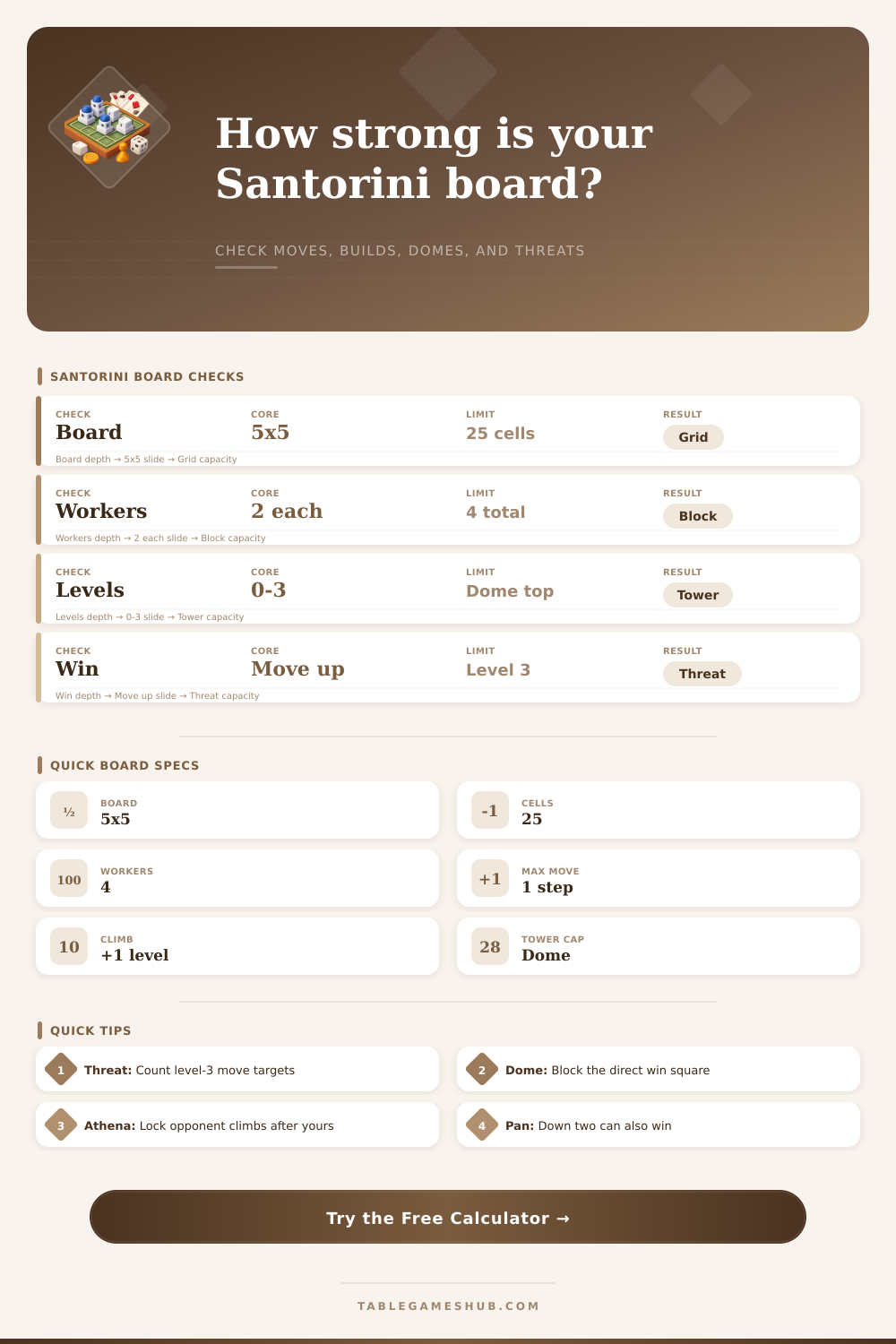
Evaluate a worker's local board position: coordinates, tower levels, domes, legal moves, build choices, climb limits, and god-power pressure.
| Position Element | Standard Rule Check | Calculator Input | Result Impact |
|---|---|---|---|
| Adjacent square count | Corner 3, edge 5, center 8 | Worker X and Y coordinates | Caps local move inventory |
| Climb limit | Move up at most one level | Worker level and target levels | Filters legal moves |
| Domed square | No worker may move or build there | Adjacent domes | Removes move and build options |
| Occupied square | Blocked unless a god power moves it | Occupied spaces and push lines | Blocks or adds Minotaur lanes |
| Level 3 target | Win by moving up onto level 3 | Open level-3 towers | Adds immediate win threats |
| God Toggle | Move Effect | Build Effect | Calculator Adjustment |
|---|---|---|---|
| No god power | One adjacent move | One adjacent build | Uses standard legal count |
| Artemis | May move a second time, not back | Normal build afterward | Adds mobility bonus to pressure |
| Athena | If you moved up, opponent cannot move up | Normal build afterward | Flags climb-lock value |
| Atlas | Standard move | May build a dome at any level | Build choices become stronger blocks |
| Minotaur | May push an opposing worker backward | Normal build afterward | Adds clear push lanes as moves |
| Pan | Also wins by moving down two or more levels | Normal build afterward | Adds drop targets as win threats |
| Prometheus | May build before moving if not climbing | Possible pre-build plus after-build | Adds non-climb build pressure |
| Worker Location | Coordinates | Maximum Neighbors | Board Meaning |
|---|---|---|---|
| Corner | A1, A5, E1, E5 | 3 | Lower mobility, easier to fence with domes |
| Edge non-corner | Any outer row or file | 5 | Moderate mobility with clear directional bias |
| Inner ring | B2 to D4 edge of center | 8 | Full move scan and strong build flexibility |
| Central square | C3 | 8 | Maximum reach, but often highly contested |
| Threat Pattern | Needed Board State | Best Defensive Check | Calculator Signal |
|---|---|---|---|
| Direct level-3 move | Your worker on level 2 beside open level 3 | Dome the level 3 or occupy path | Win threats above 0 |
| Build-to-threat | Safe level 2 plus adjacent build square | Block build square before it becomes level 3 | High build choices and pressure |
| Minotaur lane | Opponent adjacent with empty square behind | Fill or dome the landing square | Push lines added to moves |
| Pan drop | Pan can legally descend at least two levels | Keep Pan off high towers | Drop targets counted as wins |
The Santorini board is a 5×5 grid and is the space in which all the players make all of their game and build decision within a neighborhood of eight square or fewer. The neighborhood is small; but, because of this small neighborhood, every placement of a worker is coupled with some calculation about the potential placement of an opponent’s level-3 worker that could end the game. While many player treat the Santorini board as if it is like a chessboard, treating the Santorini board like a chessboard causes players to miss some of the pressure that the levels of the towers, the placement of the domes, and the occupied space place upon the eight different directions in which any of the workers can move.
Position is more important than power due to the rules of the game limiting the movement of each worker to only one square, and the rules limiting the climb of workers to only one level at a time. Workers on the edges of the board only has five neighbors, as opposed to the workers in the center of the board who have eight neighbors. This impact upon movement impact the number of building option available to each player, which the calculator can take into account for each player, allowing for each player to not have to manually calculate these numbers for themselves.
How the Board, God Powers, and Calculator Change Your Moves
There are a variety of god power that impact the game in various ways. For instance, the Artemis god power introduces the idea of rewarding players for there extra mobility within the game. Additionally, the Athena god power introduces the idea of defending one’s own building with the ability of a player to perform a climb into their own level-3 square that will win the game for them.
Additionally, the Atlas god power makes every build for a player more dangerously as a result of the ability of a dome to land on any height within the game, while the Pan god power provides for an alternate winning condition for the player that control the Pan god power. Each of these gods can be selected within the calculator, which will adjust the pressure value to reflect the potential impact that the selected god will have upon the current game layout. Each player’s domes and occupied squares create hard block within the game, limiting each player’s workers movement to only those neighborhoods in which they can move without encountering another player’s domes or workers.
Furthermore, each of these blocks shrink the area of the board that each player can access. A single dome in a specific spot within the game can end a player threat of winning the game, but that same dome can also potentially trap the player’s own worker if it is placed too early within the game. These reference tables provides an indication of how many squares of the board are accessible by each player’s worker based off the position of that worker.
These reference tables provide players with a way to evaluate whether any given player’s worker is mobile or likely to become boxed in during the game. In most games, one of the players will be the first to control a level-3 square, which wins the game for that player. However, the build choices that each player makes after each move will determine whether that player can control those level-3 squares.
For instance, placing a worker on a level-2 square with many build options for the player will allow that player to force the opponent to build in some way, while placing a player’s worker on a level-2 square with no build options for that player will allow the opponent to threaten to win the game. Therefore, the calculator can estimate the number of build options available to each player after each move; this helps each player to understand whether they should build or not. Within the game, there are some common mistake that players make.
For instance, one of the most common mistakes is to count the number of squares within the game without considering the limit to the player’s climbing abilities. Furthermore, a similar mistake is to ignore that the rules of the game change for the opponent if the opponent controls the Athena god power. The calculator accounts for the limit to each player’s climbing ability, as well as for the rules change of the Athena god power if the player that use the calculator selects the Athena god power lock toggle.
Furthermore, the calculator also separates the calculation of each game’s standard wins from the wins that result from each of the god powers to ensure that the player that controls the Pan god power, for instance, does not overlook their ability to drop two levels. The skill that is required to play the game of Santorini is the player’s ability to properly read their neighborhood on the board, rather than the entire game of Santorini. All of the decisions that each player makes are made within the context of the eight square of that neighborhood.
The calculator calculates these numbers, allowing each player to easily compare their value of each potential decision to that of their opponent. However, each player will still have to use some judgment to decide whether they will act on the numbers that are provide by the calculator before their opponent does.