Yacht Dice Score Calculator
Score a five-dice Yacht roll by category, upper-section bonus progress, rerolls left, scorecard state, and optional Yahtzee-style Joker handling.
Yacht score result
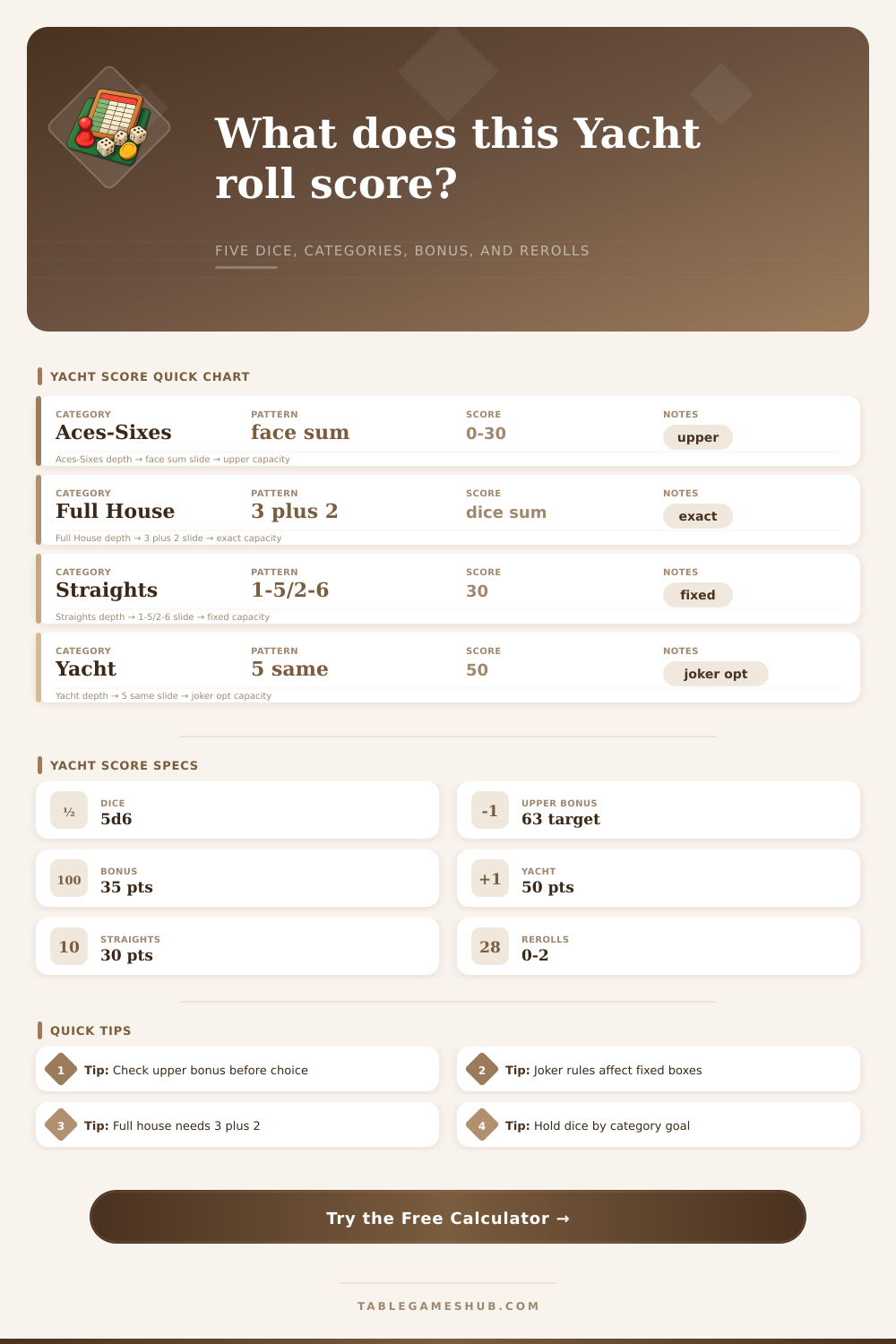
Five standard six-sided dice are scored as one roll.
Six upper boxes and six lower boxes.
Three of every face reaches the classic bonus line.
Awarded after the upper section reaches the threshold.
| Upper category | Score rule | Maximum | Bonus role |
|---|---|---|---|
| Aces / Ones | Sum all 1s | 5 | Counts toward upper subtotal |
| Twos | Sum all 2s | 10 | Three twos gives par value |
| Threes | Sum all 3s | 15 | Three threes gives par value |
| Fours | Sum all 4s | 20 | Four or five fours can repair a shortfall |
| Fives | Sum all 5s | 25 | High-face box for bonus recovery |
| Sixes | Sum all 6s | 30 | Highest upper-box swing |
| Lower category | Required pattern | Score | Calculator handling |
|---|---|---|---|
| Choice | Any five dice | Sum of all dice | Always scores the roll total |
| Four of a Kind | At least four matching dice | Sum of all dice | Five of a kind also qualifies |
| Full House | Exactly three of one face and two of another | Sum of all dice | Joker mode can force a fixed score |
| Little Straight | 1, 2, 3, 4, 5 | 30 | Must show all five listed faces |
| Big Straight | 2, 3, 4, 5, 6 | 30 | Must show all five listed faces |
| Yacht | Five matching dice | 50 | Repeat Yacht can enable Joker mode |
| Scorecard mode | Repeat Yacht? | Joker effect | Best use case |
|---|---|---|---|
| Open scorecard | No override | Score selected box normally | Early or middle turns |
| Yacht already 50 | Yes in Joker mode | Full house and straights can score fixed values | Second Yacht roll |
| Yacht already scratched | No bonus Yacht | Selected category uses normal Yacht math | Damage control turns |
| Upper pressure | Only if box has 50 | Shows bonus gap prominently | Chasing the 63 target |
| Reroll signal | Meaning | Typical hold | Score caution |
|---|---|---|---|
| 0 rerolls | Score is final | None | Scratch lowest-value box if needed |
| 1 reroll | One hold decision remains | Keep matching faces or straight run | Full house can break easily |
| 2 rerolls | Opening roll value | Keep strongest category seed | Upper bonus may beat a low Choice |
| Joker Yacht | Repeat five of a kind | Keep all dice | Check table rules before using |
Five dice clatter on the wood. You catch yourself getting good at translating that sound into something more than noise. The potential that comes with those falling dice dissapears as soon as they do.
At first glance there are random numbers in front of you and your brain needs to absorb pattern fast. In three shakes you need to make sense of all of this, turning chaos into points, and seconds matter if you’re about to shake for a straight or hold onto two threes.
How to Play Yacht Like a Winner
Too often people bet on there gut. Before they even leave the table, they’ve snatched up the biggest number they can easily see and walked away, missing out on math which differentiates decent scores from winners.
At first glance, nothing too bad here. Just add up corresponding dice on each row. That’s where the trick is, though. If your total adds up to less than sixty-three, you lose thirty-five bonus points. This leaves a massive hole in your scorecard and change your outlook with every single roll.
Anything below becomes “junk” points, except they’re not junk at all, they’re actualy rent payments toward a bigger prize. With one number entered into the calculator, you’ll know just how far off you are from that magic number. It will let you know when pursuing a minor straight is not worth risking an important top box. This eliminates any guesswork regarding bonus pressure.
The bottom part of the card are ruled by patterns. There’s the full house, roll all your dice and add up the numbers, which doesn’t sound like much till you remember that most category here will get you less than a decent category elsewhere. Straights is worth a solid thirty points (though they always pay out, and serve as a nice landing spot when you find one).
But it’s the Yacht that really keeps things interesting: Five matching dice earn you fifty points, the big jackpot. Most playgroups uses some variant of the “Joker” rule, where an unused Yacht fills in the blank spots for its highest value instead. It’s a huge difference in strategy. You no longer dread rolling yet another Yacht; now you bet on it. The app includes an option to toggle this rule on or off. It recalculate based off whether it makes sense to hold out for another five-of-a-kind or take the sure thing now.
The game has a currency; Rerolls. There is two initial bonus rolls. And every time you use them, it’s at the cost of momentum. The temptation is to go for safety and keep all your dice, even though rerolls are a limited currency of just two extra chances. But most people end up clogging their hand early by rolling three identical dice together. And they never think about that now they’re locking down a worse hand then what could of been.
Risk is a dry way of describing what gamblers call expected value. Sometimes holding onto just one die are worth more than holding onto three. This is true if you have two reroll cards in your hand and realize you aren’t close to filling some box anymore. Our UI reflects that change in expected value and marks where you should let your gut guide you, except now it’ll be losing you points. It is a small thing, but it makes a difference.
The state of your entire card, not just the dice in front of you, determine scoring. Is your top row mostly full? You might use that as a strategy, but are there any empty spots? A whole other one. When there is only one or two left, you begin to play strategically: for availability and for maximizing point value rather than simply getting more. You’ll scratch down an unused spot with a zero, saving a valuable category for later use.
That kind of thinking isn’t usually considered part of the strategy because everybody are running around chasing high number scores until there’s nowhere left to stick ’em. With the scorecard mode settings, you can simulate that pressure at the end of the game and try things like that out against certain board configurations. After all, Yacht is basically a game of controlled randomness.
There’s no controlling the dice, only yourself. Discipline is yours to control. Your every decision are a tradeoff between immediate gain versus future possibility. Some of those dice rolls will be gifts, while others will be traps that look like opportunities. Math makes the difference when it comes to understanding the decision-making process behind holds. Luck becomes skill.
Next time you see those dice spread out on the table, take a second before reaching down to pick them up. Let the numbers guide your hand by looking at both what is facing up and what is missing from your card.