Archery Cut Chart Calculator for Shaft Length
Set your shaft cut, finished length, and spine band before the saw comes out.
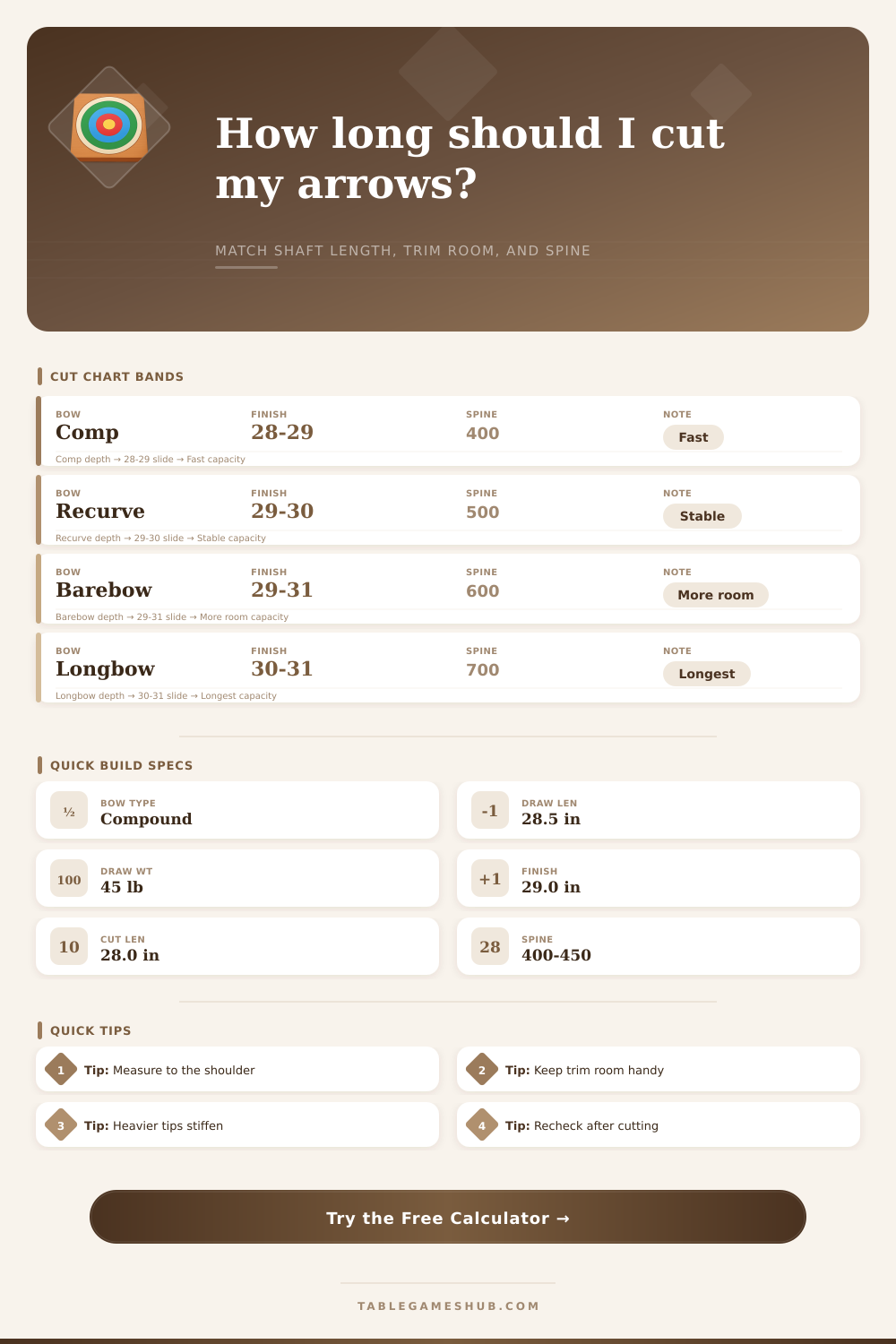
| Bow Type | Finish | Cut Bias | Build Note |
|---|---|---|---|
| Compound | 28.5-29.5 in | Short | Fast cams |
| Recurve | 29.0-30.0 in | Medium | Clean release |
| Barebow | 28.5-30.5 in | Medium | Crawl room |
| Longbow | 30.0-31.0 in | Long | Softer shaft |
| Spine Band | Draw Wt | Point Wt | Use |
|---|---|---|---|
| 200-250 | 70+ lb | 100-125 gr | Stiffest |
| 300-340 | 60-70 lb | 100-125 gr | Fast tune |
| 400-450 | 45-60 lb | 100-125 gr | All round |
| 500-550 | 35-45 lb | 100-125 gr | Longer cut |
| Part | Depth | Weight | Effect |
|---|---|---|---|
| Insert | 0.5 in | 60-80 gr | Shortens cut |
| Outsert | 0.75 in | 80-120 gr | More trim |
| Point | 100-150 gr | 100-150 gr | Stiffens |
| Wrap | 5-15 gr | 5-15 gr | Balance only |
| Scenario | Shaft Cut | Band | Note |
|---|---|---|---|
| Hunt 65 | 28.25 in | 400-450 | Broadhead |
| 3D 58 | 28.75 in | 350-400 | Fast tune |
| Youth 24 | 24.50 in | 500-550 | Light build |
| Longbow 38 | 29.50 in | 500-600 | More room |
In order to prepare the arrows for the bow, it is first important to measure and cut the shafts of the arrows to the necesary length. The length of the arrow is the distance from the bottom of the nock groove of the arrow to the end of the shaft that will hold the arrow point. The length of the arrow are important in that the length of the arrow must match both the draw length of the bow being used and the type of bow that will be used.
If the length of the arrow is too short, it may not be able to pass through the bow correct. If the length of the arrow is too long, the arrow may be unstable during it’s flight. The type of bow that will be used will determine the length of the arrows that is needed.
How to measure and cut arrows
Bows like compound bows typicaly require arrow lengths of between 28 and 29 inch in length. This is because the components of compound bows allow for shorter arrows to be used with those bows. Bows like recurve bows and longbows, however, require arrows of 29 inches in length or longer.
These bows require the longer arrows for stability. Thus, the type of bow that will be used will impact the length of the arrows needed for the bows. The arrow spine is also important in the construction of the arrows.
The arrow spine is the stiffness of the arrow shaft. More specifically, the spine of the arrow should be matched to the weight of the bow that will be used. If you are to use bows of heavy draw weight, a stiffer spine will be required to prevent the arrows from buckling when they is released from the bows.
With bows of light draw weights, however, softer arrows will be required. Additionally, the weight of the arrow point will impact the spine of the arrow. More specifically, arrows with heavier points will behave similar to arrows of a stiffer spine.
Thus, you should account for the weight of the arrow point when selecting the arrow spine. When cutting the shafts of the arrows, it is important to leave a cut reserve for those arrows. A cut reserve is the amount of length that is left on the arrows when they are first cut.
This cut reserve is necessary to allow for the gluing of inserts to the arrows. Inserts are glued to the arrows to provide stability to the arrows while they are in flight. Because these inserts reduce the length of the arrows, it is necessary to leave a cut reserve on the arrow shafts prior to gluing the inserts to those arrow shafts.
The measurement of the arrows known as front of center (FOC) determines how the arrows will be weighted. More specifically, FOC is the amount of weight that is located at the front of the arrow shaft. If more weight is located at the front of the arrow, it will exhibit more stability in relation to flight in the wind.
However, more weight at the front of the arrow will require a stiffer spine for the arrow shaft. Thus, an adjustment must be made in relation to the FOC and the spine of the arrow to ensure that the arrows will perform correct. There are a few common mistakes in the cutting of the shafts of the arrows.
One of the most common mistake is using the distance from the tip of the string to measure the length of the arrow. By measuring from the tip of the string, the length of the arrow will be incorrect. Another of the common mistakes is to fail to account for the depth of the insert that is to be glued to the arrow shaft.
If the insert is deeper then the shaft, the length of the arrow will be shorter than intended. When purchasing the arrows, it is important to purchase raw arrow shafts that are longer than the length that will be used for the arrows. The reason for purchasing arrow shafts that are longer than the lengths that will be used in the arrows is that mistakes can be made in cutting those arrows to length.
Additionally, the archer will glue inserts to the shafts of the arrows. Thus, longer arrow shafts will allow for mistakes and for the gluing of inserts. In the case that the arrows are too long, they can always be cut to the necessary length, but if the shafts are too short, they cant be made longer.
You should of bought extra shafts.