Tabletop Hex Grid Distance Calculator
Measure diagonal-free hex distance with axial or cube coordinates, hex size, terrain multipliers, movement points, and range bands.
| Point | Axial q,r | Cube x,y,z | Coordinate sum | Role |
|---|---|---|---|---|
| Start | 0,0 | 0,0,0 | 0 | Origin |
| Target | 4,-2 | 4,-2,-2 | 0 | Destination |
| Delta | 4,-2 | 4,-2,-2 | 0 | Distance vector |
| Band | Hex span | Distance span | Current target | Common use |
|---|---|---|---|---|
| Short | 1-6 | 5-30 ft | In band | Thrown weapons |
| Medium | 7-12 | 35-60 ft | Past target | Bow fire |
| Long | 13-18 | 65-90 ft | Past target | Artillery |
| Extreme | 19-24 | 95-120 ft | Past target | Spotting |
| Terrain setting | Multiplier | Example meaning | 8-hex trip | Use when |
|---|---|---|---|---|
| Road or flight | 0.5x | Fast road, glide, river current | 4 MP | Movement is easier than open ground |
| Clear ground | 1x | Plain hex movement | 8 MP | Default tabletop hex math |
| Light rough | 1.5x | Brush, broken floor, low rubble | 12 MP | Movement is slowed but still direct |
| Difficult terrain | 2x | Forest, swamp, steep slope | 16 MP | Each hex costs about double |
| Severe terrain | 3x | Deep snow, cliffs, heavy rubble | 24 MP | Travel needs multiple turns |
| Impassable tax | 5x | Abstract wall, hazard, crawl | 40 MP | A route is technically possible but costly |
| Method | Coordinates | Conversion | Distance formula | Best fit |
|---|---|---|---|---|
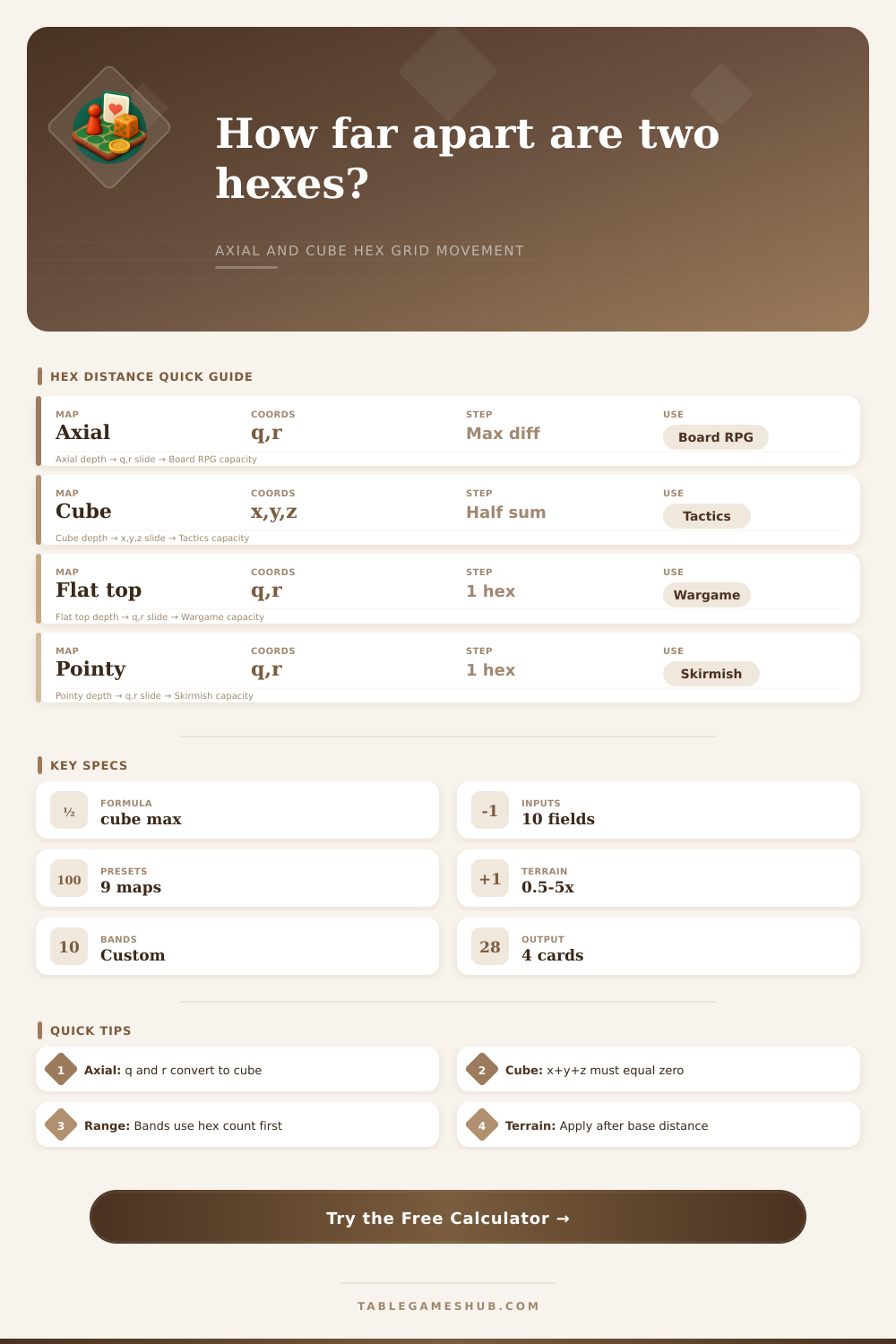
| Axial | q,r | x=q, z=r, y=-x-z | max(|dx|, |dy|, |dz|) | Most tabletop maps and overlays |
| Cube | x,y,z | x+y+z must equal 0 | (|dx|+|dy|+|dz|)/2 | Precise hex algorithms |
| Offset | row,column | Convert to axial first | Use cube after conversion | Printed map sheets and apps |
| Physical mat | hex count | Multiply by hex size | hexes x scale | Miniatures, rulers, and templates |
| Unit pace | Movement points | Clear hex cost | Practical reach | Typical table use |
|---|---|---|---|---|
| Slow infantry | 4 MP | 1 per hex | 4 clear hexes | Dungeon crawl, heavy armor |
| Standard hero | 6 MP | 1 per hex | 6 clear hexes | Fantasy skirmish movement |
| Fast unit | 8 MP | 1 per hex | 8 clear hexes | Mounted or light troops |
| Action-point system | 10 MP | 2 per hex | 5 clear hexes | Tactical board games |
Tabletop games rely on the distance between two point on a map. The distance between two points on a map will ultimately determine how the unit move in the game. You must calculate the distance between two points on a map in order to decide what actions can occurring between those two points.
Many game designers choose a hex grid for their games because it eliminate the diagonal movement issues that square maps create. Furthermore, if you understands how distance works on a hex grid, you can understand the rules of the game because the rules of the game are based on the distance between two points on a map. The first thing that you need to understand is that each step on a hex grid cost the same amount of movement for the units.
How to Measure Distance on a Hex Map
There are no shortcuts on a hex grid to make a unit move from one point to another quick. Furthermore, there are no expensive corners on a hex grid because every movement cost the same amount of movement for the unit to move one step. This is due to the use of cube coordinates.
You can use axial coordinates for your map, but you should use cube coordinates for your calculation. Cube coordinates use three axis that always sum to zero. Furthermore, the largest difference among those three cube coordinate value is the distance between two hexes.
This will remain consistent throughout the game, no matter which direction the unit face on the map. Terrain can change the cost of movement for the units on the map. Furthermore, the cost of movement can change how units and players perceive distance on the map.
For example, a unit might take movement point to move from one hex to the next on the map. However, if the terrain between those two points costs two movement points, the unit will have to move from one point to the next with twice the movement point. This is referred to as a terrain multiplier for that specific unit.
This force the player to consider whether the shortest distance between two points is the one that will provide the most efficient movement for the unit. Range and movement are two different concept in the game. Range is the distance that a unit can attack from, and the number of hexes that a player can attack from a position.
This distance is not affect by terrain yet. Furthermore, attack range is usually categorize into bands of hexes. For example, a band of six hexes will make the first six hexes short range, the following six medium range.
You will count the actual hexes to find the distance between two points. However, you will use the range band to find the correct column for the weapon on the weapon table. Movement points determine how many hexes a unit can move on the map.
For instance, a unit with six movement points can move six hexes on the map. However, if a unit has four movement points, it can move only four hexes. Furthermore, if each clear hex cost one movement point for a unit to move, then the unit will move a hex with each movement point that it has.
However, if each clear hex costs two movement points, the unit will only be able to move half as many hexes. This is because the movement cost is higher than the unit’s available movement point. Terrain will change how many hexes a unit can move on the game board.
Each of the game’s maps use different coordinate system to represent the same distance on the map. For instance, players use axial coordinates for their compact nature on the map. However, cube coordinates are better for distance calculation because they use three axes.
Furthermore, offset coordinates are used on some maps but require an extra step to convert the coordinates. These systems all record the same distance on the map but change how the location of the hexagon is recorded on the map. Furthermore, distance on a tabletop game also has a variable associate with it: scale.
On some maps, one hexagon can represent five feet in distance. On other maps, one hexagon can represent fifty feet in distance. This scale will determine the physical distance between two points on the map.
Furthermore, it will also determine the distance that a weapon can go and the time that is required for certain maneuver on the game board. Therefore, scale is used to transform the number of hexes between two points into inches or feet on a map. Many people will make mistake when playing these games.
Some will add terrain to attack range when they should only be use for movement. Some will forget that the cube coordinates will always sum to zero. If a player forgets this, they will make impossible position on the game board.
Some will also treat a range band as the actual distance between two points. However, the range band only contains the number of hexes for a given range. Some mistake can be avoided by following the proper order of operations for these games.
First, find the raw distance between the two points on the game board. Then, find if there is terrain between the two points. Then, find the range band for the distance between the two position.
Finally, find the movement cost for the unit and compare it with the unit’s movement point. Furthermore, game length will have a cumulative effect on the game’s length. The unit that takes the shortest path to the target may use up all of its movement point.
However, a unit that takes a longer path but stays within easy terrain will have more movement point left to perform other action in the game. Furthermore, you can use this logic when you are building your map. For instance, you can use this to determine whether a map that looks even and balanced could become unbalanced as the game plays out due to these factor.
One way to test this is to determine the distance between two points on your map using actual movement value to see if any problem arise during the game. Furthermore, the hexagon grid is a tool that will show the cost of movement for the unit if you follow the proper step and operations for the game.