Dixit Score Calculator
Score a Dixit reveal by entering how many players found the storyteller card, how many wandered to decoys, the votes your image received, the bonus cap, player count, round number, and target score.
Live round breakdown
| Scoring item | Count | Rule | Points |
|---|---|---|---|
| Storyteller | 2 right | middle | 3 |
| Correct guessers | 2 | 3 each | 6 |
| Decoy bonus | 1 vote | cap 3 | 1 |
| All/none award | 0 | 2 each | 0 |
Core scoring cases
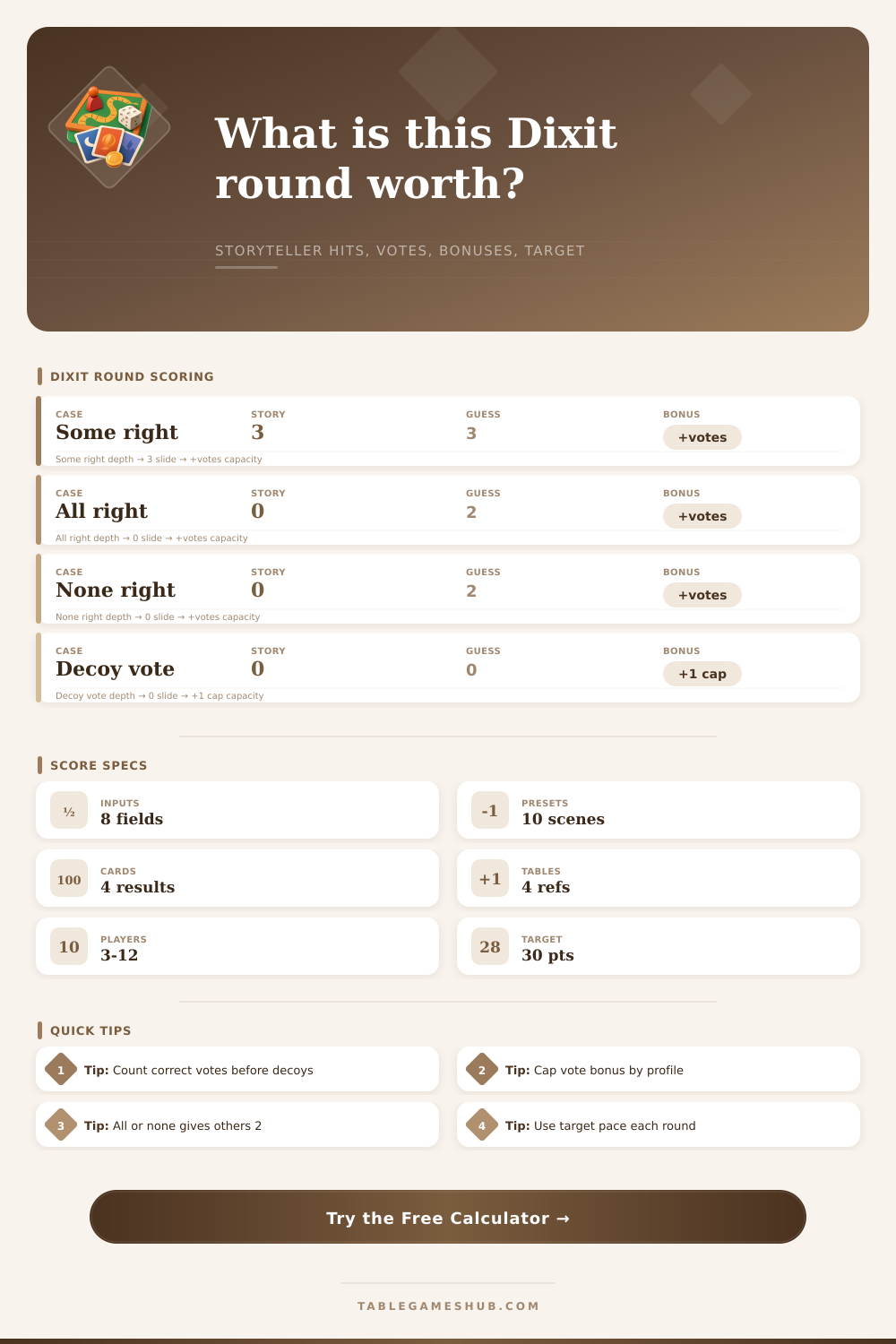
| Reveal case | Storyteller | Correct guessers | Other players |
|---|---|---|---|
| Some, not all correct | 3 points | 3 each | Vote bonus only |
| All guess correctly | 0 points | 2 each | 2 each |
| No one guesses correctly | 0 points | 0 correct | 2 each |
| Decoy image receives votes | No bonus | Still scores correct | Owner gains vote bonus |
Bonus profile table
| Profile | Vote value | Cap | Best use |
|---|---|---|---|
| Classic vote cap 3 | +1 per vote | 3 | Standard table |
| Open table uncapped | +1 per vote | None | House variant |
| Gentle table cap 2 | +1 per vote | 2 | Short track |
| No decoy vote bonus | 0 | 0 | Teaching round |
| Odyssey large-table cap 3 | +1 per vote | 3 | 7-12 players |
Player count and vote checks
| Players | Voters | Images shown | Accounted votes |
|---|---|---|---|
| 3 players | 2 | 3 | correct + wrong = 2 |
| 4 players | 3 | 4 | correct + wrong = 3 |
| 5 players | 4 | 5 | correct + wrong = 4 |
| 6 players | 5 | 6 | correct + wrong = 5 |
| 7-12 players | 6-11 | 7-12 | use larger-table edition |
There is the kind of challenge in Dixit where people knows what you are thinking all too well. You work hard to come up with a clue regarding a lonely lighthouse keeper, only for everyone to recognize your picture right away. Your clear description earns you no points at all. Clarity is punished just as much as mystery. It’s a system designed to keep players guessing.
That’s why understanding the rule alters gameplay. Stray away from obscure poetry and embrace accessible ambiguity.
How to Win at Dixit
Once the voters has entered their count, the calculator does math for them. It spares you the need to keep track of who owes what as you scramble through a mad reveal. Knowing the score is only half the battle. The trick is figuring out where the collective imagination might go. You’re shooting arrows at a moving target made off other people’s brains. How well did you hit?
To quantify that, enter how many players guessed correctly. Too few? You lost. Too many? You still lost. Ideally, you ended up somewhere in between: some got it but not all.
This is tricky territory for a lot of players to grasp initialy. They assume “no one will ever guess my number” means “I’m safe.” Guess again. Zero exposure are a trap. Keep decoy votes in mind. Though it may not be the right answer for the round, that doesn’t mean it won’t get some vote. These bonuses count towards your score and is capped by your house rules (the calculator handles this).
This gives each turn a two-pronged delivery: Are you the storyteller, or are you illustrating the feeling? When you’re not the storyteller and other players thinks your picture captures the spirit of what you’re describing, you’ll pick up some bonus points. Bonus points is frequently enough to make the game competitive through final rounds. Smart players will start stacking ‘em at first round while most will forget about them until they fall behind by ten.
That changes with player count. Fewer players means every vote count a lot. There’s less room for error on any given clue. One wrong read and everything turn on its head. More players? Six or greater? The noise gets louder. A mess of many votes scatters across the board, making that sweet spot of half-right difficult to nail down.
Adjusting for table size is what this does. It helps you understand where you are relative to overall rhythm of the game. Is it early? Are you way off target? Maybe it’s time to take a risk and go big on some wild clues. Is it late? Everyone’s within shouting distance? Accuracy becomes most important. Precision beat style.
Check out the reference tables on the page, too. That’ll help give you an idea of how various scenarios work out mathematically. Comparing points for “none correct” and “all correct” side-by-side shows just how hard it is to find a balance. Creativity alone isn’t enough. You have to be mindful of social awareness. Who are your friends? Are they more likely to interpret things in a literal sense or more often see images metaphorically? Do you tend to overthink simpler prompt? The numbers don’t lie… But neither do they paint a complete picture.
Exceptional players of Dixit knows how to read both their cards and the room. They weave clues that allows for multiple interpretations. Enough string left to let some pull while allowing others to get lost in unrelated imagery. So in short, be specific enough that players can’t eliminate you, but general enough that they don’t know for sure.
The calculator will give you an idea of where you sit, but do not forget; there’s no substitute for knowing how your opponent think. That happens over time. Watch their faces as you present clues. Pay attention to what seems to catch them off guard early on. See what pictures jump out at them if they aren’t the correct answer. Use those insights when making future clue. If the game is a reflection of common imagination, then doing well is about reflecting just enough of what others see while avoiding showing them precisely where you’re stashing the loot. Learn that rhythm and rest assured the points will follow. You should of seen it coming.