Spelling Bee Score Calculator
Total a hive score from 4-letter words, 5+ word lengths, pangrams, perfect pangrams, center-letter validation, found-word count, max possible score, and rank threshold.
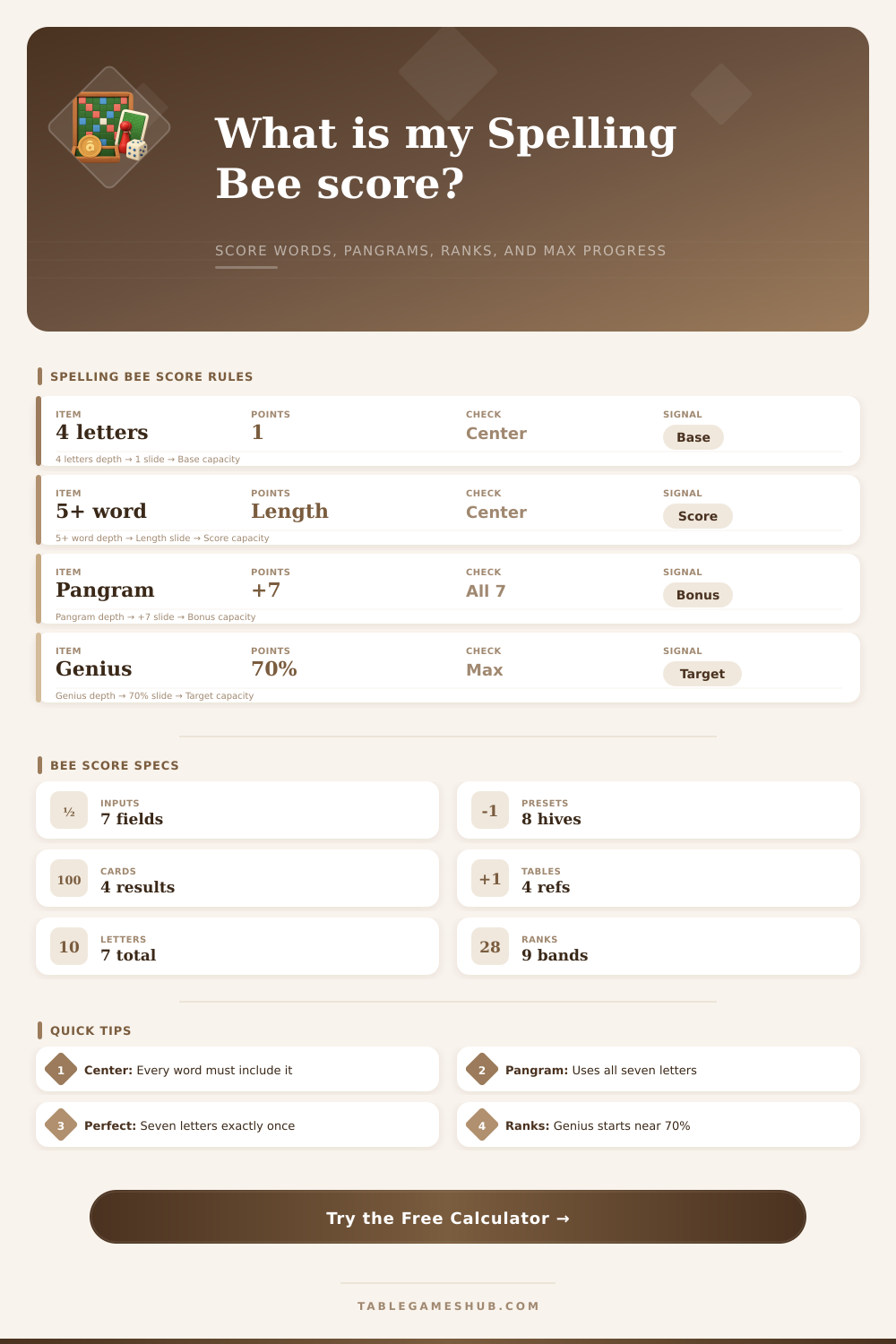
| Word type | Base points | Bonus | Calculator handling |
|---|---|---|---|
| 4-letter valid word | 1 point | None | Counted from valid 4-letter entries or manual count |
| 5-letter valid word | 5 points | None | Length value is added directly |
| 6+ letter valid word | Word length | None | Each listed length scores that many points |
| Pangram | Word length | +7 points | Detected from all seven letters or manual pangram input |
| Rank | Typical threshold | Score formula | Use in calculator |
|---|---|---|---|
| Good Start | 2% | Ceiling of max score x 0.02 | First visible progress check |
| Nice to Amazing | 5% to 50% | Scaled from max score | Mid-rank threshold ladder |
| Genius | 70% | Ceiling of max score x 0.70 | Main daily target for most solvers |
| Queen Bee | 100% | Max possible score | All valid puzzle words found |
| Validation check | Pass condition | Common miss | Result effect |
|---|---|---|---|
| Center letter | Word includes required center | Good-looking word omits center | Invalid word excluded |
| Hive letters | Only seven hive letters used | Extra consonant slips in | Invalid word excluded |
| Word length | At least four letters | Three-letter fragments | Invalid word excluded |
| Duplicate entry | Unique word appears once | Repeated words in notes | Duplicate ignored |
| Preset name | Hive pattern | Scoring focus | Best use |
|---|---|---|---|
| Genius Morning Hive | Balanced vowels | Rank target | Quick progress estimate |
| Queen Bee Push | High max score | Remaining points | Endgame gap checking |
| Pangram Hunt Check | One clear pangram | Bonus audit | Confirm pangram lift |
| Word List Audit | Raw list validation | Center filter | Clean copied word lists |
Seven jumbled-up letters appear on-screen when you open it, one letter in the middle and the rest surrounding it. It’s an easy task on paper, you simply have to identify all the words you can create using those letters that aren’t against the rules. But simplicity is deceptive. An hour later, you’re searching through strange nouns and complex verb. Your score sheet is a tangle of possible contenders. Did you catch them all? Or did you miss any key long word that would of moved you into the genius category? And that’s when the arithmetic turns fiddly: How many points does each four-letter word count? How close are you to a hypothetical high score?
You don’t need to keep tally by hand as you tick off answers; the calculator above take care of that grunt work after you plug your results in. There is no more human error or brain strain. And that’s where this puzzle scores different than other puzzles: The longer your word, the more it scores, but you have to be precise. One point for a four-letter word doesn’t seem like much, not at first, until you discover you have several dozen of those tucked away. As you get further along, those longer words starts earning their points as well. Finding a nine-letter word is practically like finding nine little words in a row.
How to Score More Points
And then comes the pangram. There’s no better way to describe that feeling than that: When your brain just snaps right into place. You suddenly understand how all seven letter can come together to make one whole unit. For that, you’ll earn seven bonus points on top of whatever you earned for getting that word in the first place. It’s a huge boost to your overall total … provided it’s a valid word, and it uses every letter you’ve got.
The single largest source of stumbling for most solver isn’t their vocabulary; it’s neglecting the center letter constraint. Looking at list C-H-E-A-R-I-N, you might see the words chain or even rain. Both are fine. But without the required center letter, your points dissapears. If your list contains anything that won’t pass inspection (i.e., wouldn’t qualify during an actual game), the solver will highlight them. No celebrating those words until they’re removed!
It also ensures that there aren’t any repeats. This is another problem we encounter when scribbling stuff onto paper only to remember having written something else earlier. Removing that clutter before calculating results eliminates inflated scores and resulting false-confidence. But even if you’ve got volume, it’s not enough to get you all the way up the ranks. Seventy percent of the maximum number of possible words seems like it would be pretty generous, except then you remember there’s also all these obscure word, too. There may be upwards of a hundred correct answers in any given puzzle, and only needing to miss a few longer words will leave you mired at “great.”
Knowing how dense your hive is can help: Some letters tend to form short words (easy to see, but difficult to use). Others require long constructions (difficult to locate, but valuable for their point value). Adjust your plan accordingly. When you’ve got a hive full of little ones, go for volume. When they’re lacking, focus on length.
The ultimate goal of these sessions is perfect pangrams. These are the ones where every single letter are used exactly once. The calculator tracks them as a subset of total pangrams found. But knowing when you’ve got one in real time is like a mini lottery win. That means you really know how the letters go together now and can spot connections other people may not be able to. How much more do you want to know about this game? That’s what separates casual solvers from those that truly enjoy the wordplay challenge (because they dig into how words work).
And then the table helps you put things in perspective… What’s your standing compared to the overall potential? How are you doing so far? Are you crushing it? Or do you have quite a way to go yet? It lets you know how far off the mark you are. This tells you when to stop with your head held high and when to keep digging around for one more word. It turns the single puzzle into a way to measure yourself and track your progress.
It all comes down to attention to detail and patience. Once you’ve fixed the letters, you may discover that, given some time and effort, they look much differnt. You may believe you’ve reached the end of the road only to stumble upon a nifty compound word within five minutes. And that’s where folks go awry, there’s nothing emptier than the puzzle itself until you’re certain you’ve checked each combo. Let the numbers tell you how confident you should feel, keep validating, and keep hunting.