Disc Golf Player Rating Calculator for Round Strength
Estimate your round rating from throws, OBs, putting, and layout pressure.
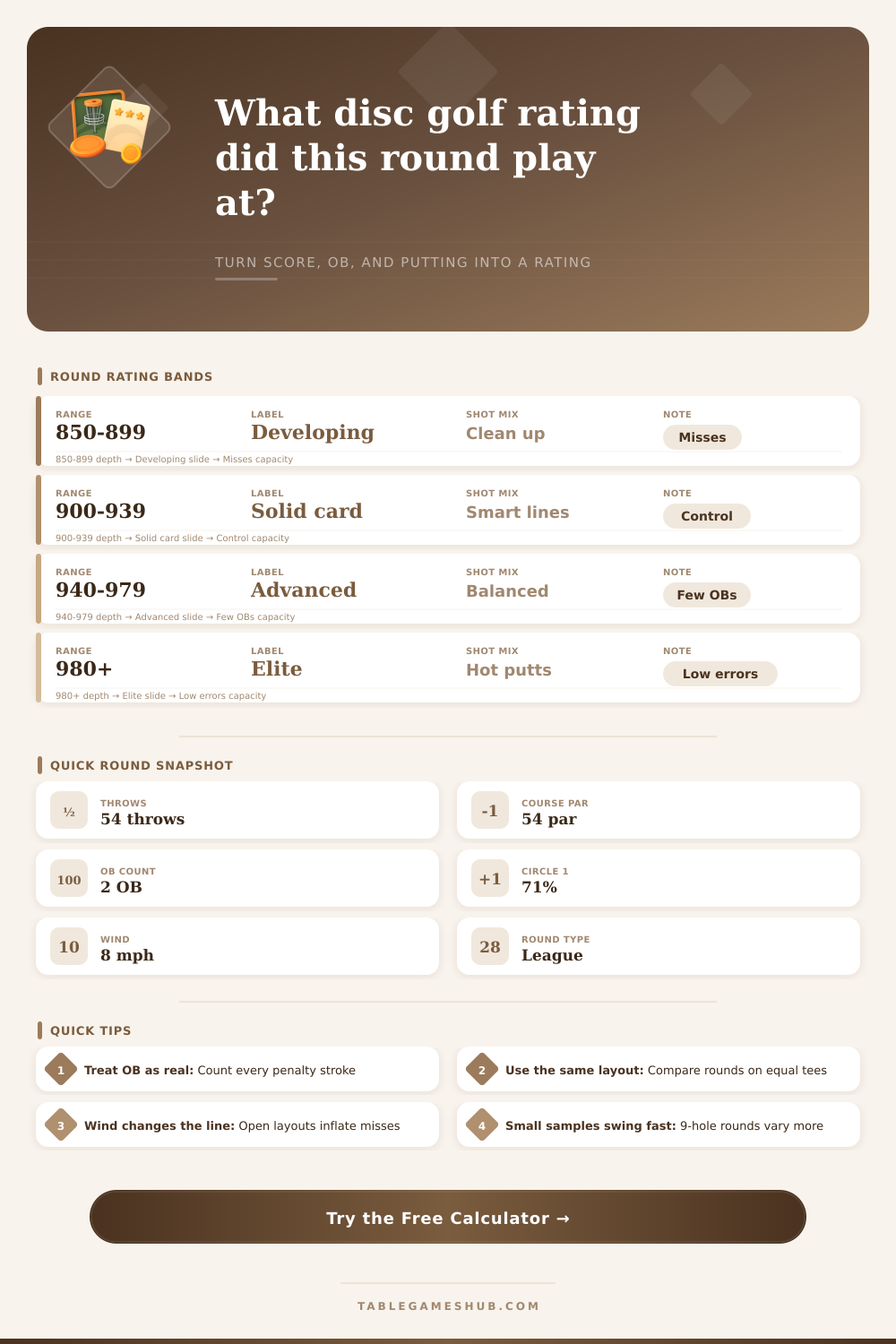
| Rating Band | Label | Round Shape | Short Note |
|---|---|---|---|
| 850-899 | Developing | Misses | Leakier lines |
| 900-939 | Solid card | Clean | Fewer stalls |
| 940-979 | Advanced | Balanced | Few errors |
| 980+ | Elite | Hot putts | Low drag |
| Layout Type | Terrain Tilt | Wind Penalty | What It Means |
|---|---|---|---|
| Wooded | 1.08 | 0.04 | Gap control |
| Mixed | 1.00 | 0.07 | Balanced mix |
| Open | 0.96 | 0.09 | Wind bites |
| Windy | 0.98 | 0.12 | Big swings |
| Holes | Scale | Use Case | Why |
|---|---|---|---|
| 9 | 2.00 | Quick card | Fast swing |
| 12 | 1.50 | Mid-card | Partial day |
| 18 | 1.00 | Full card | Baseline |
| 36 | 0.50 | Two loops | Blend scores |
| Penalty Type | Counted As | Typical Weight | Comment |
|---|---|---|---|
| OB | +1 throw | 1.00 | Full cost |
| Wind | +0.1/ mph | Layout-based | Open hits |
| Fairway miss | Small bonus loss | 0.12 | Drive shape |
| C1 miss | Small bonus loss | 0.14 | Putt finish |
Disc golf rounds reveal more than a raw score. This calculator turns throws, penalties, and layout pressure into a player rating, a target line, and a practical benchmark.
Disc golf ratings indicate the skill level of an individual player. Raw scores shows the total number of throws that an individual takes to complete a disc golf course. However, raw scores do not account for environmental factor or the difficulty of the course.
Environmental factors, such as wind speed and course layout, can impact the raw score that are calculated for an individual player. Disc golf ratings adjust raw scores to provide a accurately measurement of a players skill in disc golf. A player’s rating can be calculated by looking at several components of their score.
How Disc Golf Ratings Work
The number of throws that a player take to complete a course is the first component. However, it is not the only component to consider. Penalty can be given to a player for tasks like throwing a disc out of bounds.
Such penalties will impact the raw score of the player. The second component is the players fairway accuracy. This component calculate the number of times that a player hits the intended line through a fairway.
The third component is the player’s putting performance. This component measures the number of putts that a player make while within the circle. This component has the most impact on a player’s rating.
Finally, the layout of the course that is played and the difficulty of that course can also impact a player’s rating. Some courses include wooded layouts where players must hit their discs through trees that limit the space in which they can land their discs. Other courses may be open layouts where players can hit their discs more farther but are more vulnerable to the impact of the wind.
Wind can impact the path of a disc and the number of penalties that a player records. A player might score 54 on a challenging disc golf course. However, their rating might be higher then players who scores 54 on an easy disc golf course.
Disc golf ratings allow a person to compare their rounds of disc golf, even if those rounds are played on different courses. For instance, a person may play one round of 9 holes of disc golf, while another person plays one round of 18 holes of disc golf. Because the round of 9 holes is shorter than the round of 18 holes, the 9-hole disc golf round can be scaled to that of an 18-hole disc golf round.
This prevents the person who played the shorter round of disc golf from having an inflated rating due to the shorter length of the course that they played on. Additionally, a person can use the disc golf rating system to recognize weaknesses in their game. For instance, if a person tracks their fairway accuracy and putting performance in disc golf, they will be able to recognize which component of their game is cause their low disc golf rating.
Within the game of disc golf, there are different skill band within the ratings system. For instance, people consider ratings of 900 or below to be developing disc golf ratings. Developing disc golf ratings indicate that the player make errors in their disc golf game.
Disc golf ratings between 900 and 939 is considered to be solid disc golf ratings. Solid disc golf ratings indicate that the player completes each round of disc golf with few errors. Disc golf ratings between 940 and 979 is considered to be advanced disc golf ratings.
Advanced disc golf ratings indicate that the player has high level of control over their discs with few penalties during each round of disc golf. Finally, people consider disc golf ratings of 980 or higher to be elite disc golf ratings. Elite disc golf ratings indicate that the player has high accuracy with their discs and few error during each round of disc golf.
A player should use these ratings to set goal for their future rounds of disc golf. For instance, rather than focusing solely on their raw score within disc golf, a player should focus on meeting goals like their fairway hit percentage or their putting percentages. For instance, if a player reduces the number of times that their disc flies off of the course (out-of-bounds), they will see an increase in their disc golf rating.
Additionally, if they increase their accuracy with their putting discs that land within the target circle, they will also see an increase in their disc golf rating. Therefore, by focusing on these goals, a player can use the disc golf rating system to track their progress with the game of disc golf over time. Youll find that it works well based off of how much you practice.
It would of helped if I knew this sooner.