Pepper Card Game Calculator
Score a Pepper hand, compare common rule profiles, track set markers, and estimate whether a bid is worth the risk before the next deal.
Calculation breakdown
| Profile | Typical target | Made numeric bid | Failed numeric bid | Pepper treatment |
|---|---|---|---|---|
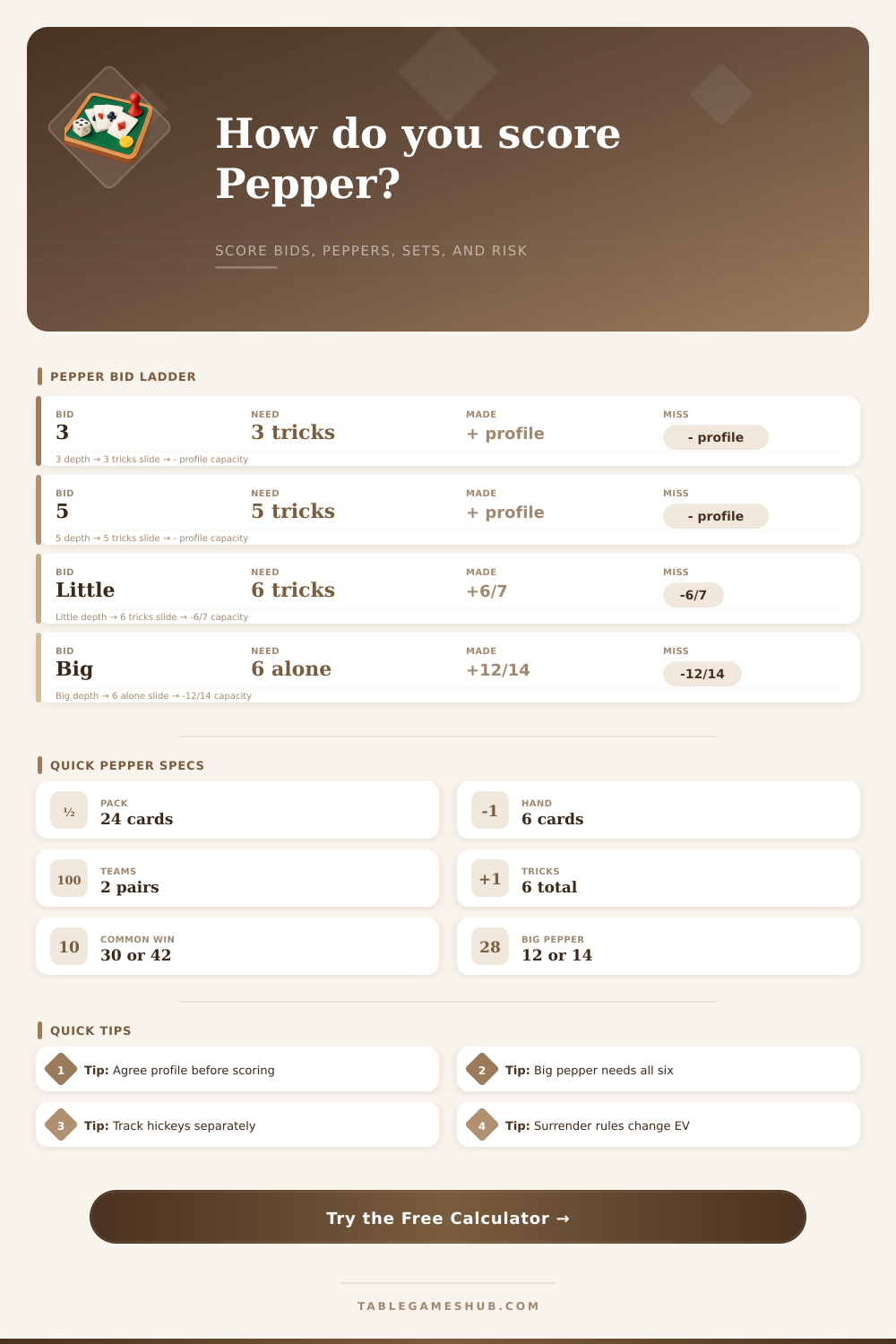
| Iowa / Pagat-style | 42 | Bid value | Minus bid value | Little +/-7, big +/-14 |
| Bicycle-style | 30 | Tricks won | Minus 6 | Big pepper +/-12 |
| Hasenpfeffer | 10 | Tricks won | Minus tricks won | Big doubles the stakes |
| Pfeffer hickey | 42 | Tricks won | Set marker and penalty | Big set counts double |
| Contract | Tricks needed | Partner mode | Risk note |
|---|---|---|---|
| Bid 3 | 3 of 6 | Partner or pass-card | Low exposure, common opener |
| Bid 4 | 4 of 6 | Partner or exchange | Dealer-stick tables often force this |
| Bid 5 | 5 of 6 | Partner or exchange | One lost trick still succeeds |
| Little pepper | 6 of 6 | Usually with help or exchange | Higher swing than a plain six |
| Big pepper | 6 of 6 | Solo bidder | Largest single-hand swing |
| Pack / rank item | Count | Use in calculator | Scoring impact |
|---|---|---|---|
| Standard Pepper pack | 24 cards | 9 through ace in four suits | Six cards per player |
| Hasenpfeffer pack | 25 cards | Same pack plus joker | Widow pickup profile |
| Trump bowers | 2 jacks | Right and left bower rank high | Raises sweep chance |
| No-trump call | 0 trumps | All suits use plain rank | Lower bower leverage |
| Hand outcome | Input pattern | Score effect | Watch item |
|---|---|---|---|
| Made numeric bid | Tricks meet bid | Profile awards bid or tricks | Defender trick points may still apply |
| Set numeric bid | Tricks below bid | Bidder loses profile penalty | Hickey profiles add marker |
| Opponents surrender | Action is surrender | Bid succeeds automatically | Defenders usually score zero |
| Both reach target | New scores meet target | Tie rule decides message | Confirm house rule first |
When the dealer slaps down a bid for six tricks, the table falls silent. It is a moment of suspended animation and everybody knows that they are no longer playing for fun but competing to win. Scoring in pepper, a popular card game that’s played in clubs and basements throughout Iowa and beyond, are never straightforward. There is regional variants and house rules that change often. There is also the tension of trying to set someone up without getting swept out yourself. Doing the math isn’t as important than having a calculator on hand to resolve disagreements before they spoil the night.
That’s when the fighting typically begins: “I thought we were using standard rules.” “Nope! A missed bid is worth twice as much!” “Okay, okay, but your big pepper is worth twelve points? That’s not even a real pepper.” Enter the calculator. Before deck goes in for another hand, this thing makes you pick your scoring profile and live with it; no arguing until after cards have been dealt. Pick an appropriate profile (the Bicycle version maxes out at 30; the Iowa style runs to 42). Then everybody knows what they’re shooting for which is the same thing. Subjective confusion becomes objective data.
How to Use a Calculator for Pepper Games
So what about bidding numerically? A bid of three tricks is a safe bet, not much reward but not much penalty if you don’t get there. Big pepper and little pepper is gambles, will you execute perfectly? How likely do you think you’ll be able to make the contract? The calculator allows you to enter the percentage likelihood that you will succeed with your bid, which visually illustrates the payoff of a risky move versus a safer one. Does that aggressive bid pay off more often then not? Is it worth the effort in the long run? It takes the emotion out of equation and presents the numbers.
Until you’re ten points down and scrambling to catch up most people overlook it. These numbers also shift as partnerships do. Going it alone when attempting a big pepper makes those odds far different than playing with someone who will trade cards. The tool accounts for these modes and will adjust its risk assessment to match whether you are playing alone or with a partner. That’s important because failing without a partner to soften the blow stings more then if they traded their pass card and saved the day strategically.
By understanding the details of this, you’ll not only be able to make smarter bids but you don’t need to bid louder, either. And then there’s the matter of set markers and hickeys which vary by region but act as penalties in some variants. They are not simply changes to your score; they represent extra pressure that has teams either playing recklessly or conservatively based off their own temperaments. To keep things honest and avoid any confusion come time for the final tally, we track them separately from your overall score. The calculator breaks it all out so you can get the whole picture of how one hand affect the larger match.
That’s not to say that knowing all of the variant rules means you’ll be playing well… It doesn’t… But it does mean that you know what rules apply at your table. These common variants are laid out neatly on the reference tables provided with the tool so the next time there’s an awkward silence as nobody can remember if big pepper is worth twelve or fourteen points, you won’t have to worry about it. It is small stuff, but it keeps things moving smoothly and keeps friendships together.
In sum: In pepper, sometimes you hold good cards; in other cases, you’re just managing risk. Pepper works the same way. You use the calculator to run the numbers. However, reading your partner’s hesitation during an exchange or bluffing a defender into surrendering take intuition and experience. That part comes with time. The tool offers clarity around scoring results and agreed-upon rules. This builds a solid base that removes friction over math so you can concentrate instead on the social dynamics and strategy that make the game fun in the first place.
Take a few seconds before dealing the cards to get your target score and set up your profile. Tell all players what victory will look like for this round. Once those cards hit the table, things move pretty quickley. There’s no need for any surprises except which player winds up taking the final trick, let alone how much that trick is worth. You should of saved your headaches until later by being clear at the beginning.