✏ Telestrations Score Calculator
Total a Telestrations player score from correct final guesses, favorite drawing votes, favorite guess votes, booklet pages completed, scoring mode, rounds, players, and bonus votes.
Choose a preset or enter table totals to score the reveal.
Live score projection ladder
| Round point | Projected score | Favorite votes | Reveal note |
|---|---|---|---|
| 3 rounds | 0 points | 0 votes | Ready |
Scoring mode point weights
| Mode | Correct final guess | Favorite drawing | Favorite guess and bonus |
|---|---|---|---|
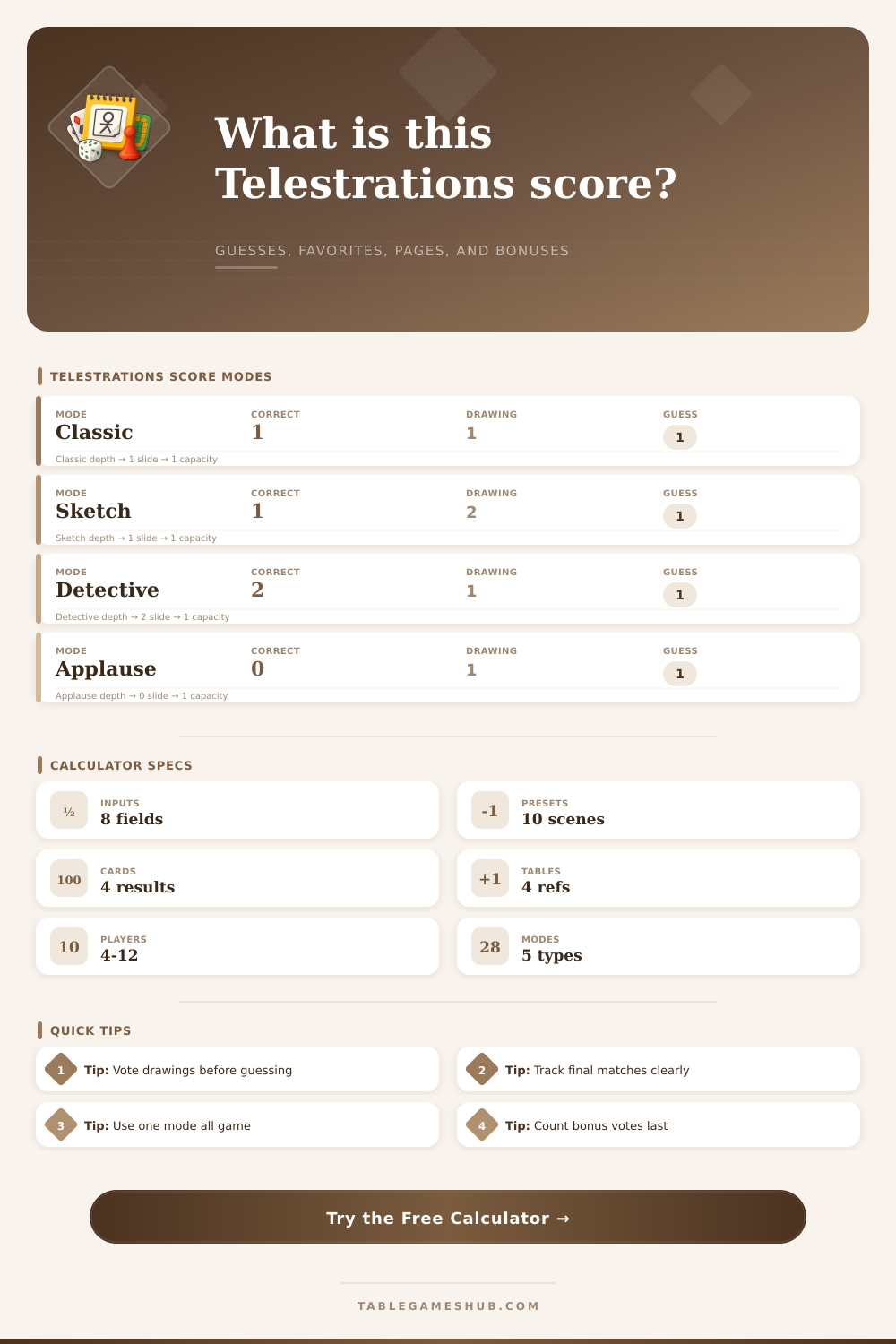
| Classic table | 1 point for a prompt match | 1 point per drawing vote | 1 per guess vote and 1 per bonus vote |
| Sketch spotlight | 1 point for a prompt match | 2 points per drawing vote | 1 per guess vote and 1 per bonus vote |
| Detective finish | 2 points for a prompt match | 1 point per drawing vote | 1 per guess vote and 1 per bonus vote |
| Applause only | No correct-match points | 1 point per drawing vote | 1 per guess vote and 1 per bonus vote |
| Team reveal | 1 point for a prompt match | 1 point per drawing vote | 2 per guess vote and 2 per bonus vote |
Booklet page expectations by player count
| Players | Pages in one booklet | Player pages per round | Scoring use |
|---|---|---|---|
| 4 players | 4 pages plus prompt | 4 filled pages | Short chains make every match visible |
| 6 players | 6 pages plus prompt | 6 filled pages | Balanced drawing and guessing pace |
| 8 players | 8 pages plus prompt | 8 filled pages | Great for favorite-vote scoring |
| 10 players | 10 pages plus prompt | 10 filled pages | Use a larger vote pool estimate |
| 12 players | 12 pages plus prompt | 12 filled pages | Best scored by favorites and bonuses |
Reveal result interpretation
| Signal | Low range | Strong range | Table meaning |
|---|---|---|---|
| Match rate | 0% to 20% | 50% or more | High rate means the chain stayed close to the prompt |
| Favorite capture | Under 10% | 25% or more | High capture means the table kept choosing this player's pages |
| Page pace | Under 80% | 100% | Completion points depend on finished sketch and guess pages |
| Points per round | Under 2 | 5 or more | Large totals usually come from favorites plus bonuses |
The back-and-forth nature of the booklet returning to its owner always lead to confusing endings for Telestrations games. The dragon you drew turned into a potato wearing a hat. And then there’s the laughter, the accusations, and the tally marks that inevitable lead to messy hand counts determining who won.
Enter the Telestrations score calculator. It takes out the noise of tallying by hand, bringing a mathematical framework to what can be a very subjective game experience. Was your performance dominant? Did you miss any votes? With this calculator, you’ll know. The tool handles math instead of your fingers, leaving you more time to play.
How to Score Your Game
So it tracks multiple levels of success/failure. For most players it’s simply “did I get it right in the end”. They believe there’s only one way to be successful: match the prompt exactly. That is not true and it overlooks social nature of game. In bigger groups sometimes what wins are making people laugh, or getting the gist of someone’s bad drawing.
The calculator allows you to enter favorite guess/vote and favorite drawing vote separately. Because that’s usually how most player do things. There were zero accurate matches, but there was lots of fun wrong stuff with good drawings.
The Scoring Mode determines strategy In Classic, accuracy counts as much as popularity. Detective: Double points for a guess if it’s right! This mode favors those tracing back the chain to its beginning. In Sketch spotlight, you get double voting points on drawings. If you are artistic, good luck beating that group in precision. Point values shifts with the modes as shown in the reference table above. Select one at the start of play so there are no disputes later.
The number of players also matter a lot. This determines how many pages is drawn and how long the chain gets. Four players is pretty tight and you can expect a fair amount of predictability. There are fewer opportunities for the drawing to go off the prompt, which leads to higher match rates. Twelve players get you a very long booklet that looks nothing like the original concept.
The calculator uses this number to change what it expects. It will tell you what vote pool and page completion rate it expects. In big games (12 players or more) a 100% match rate is statistically improbable. The tool helps put into context how you are doing based off the constraints of the game’s length.
That’s where bonus votes come into play. They’re doled out for things like best artistic effort, funniest recovery, even if it wasn’t accurate. Without them, the score would of just about landing on the right point. It recognizes how everyone contributed to the fun. Bonus votes is tallied last by the calculator. That way, they can serve as tie-breakers instead of skewing the main points.
It is a small thing. But a big difference between a sterile spreadsheet and something reflecting real deal. Keep Score: It doesn’t require an accountant to keep score, but it does require something that’s charming and accurate. It spits out your page pace, your match rate and a total score, a full picture of your play. It is a way to know if you drew well, guessed right, were delightful to play with and dominated the game. The numbers will show you.
When you get your totals, set the booklet aside and pull up a glass. The true prize is never the points; it’s the story of what you made come to life, a confused potato, a dragon.