Wavelength Score Calculator
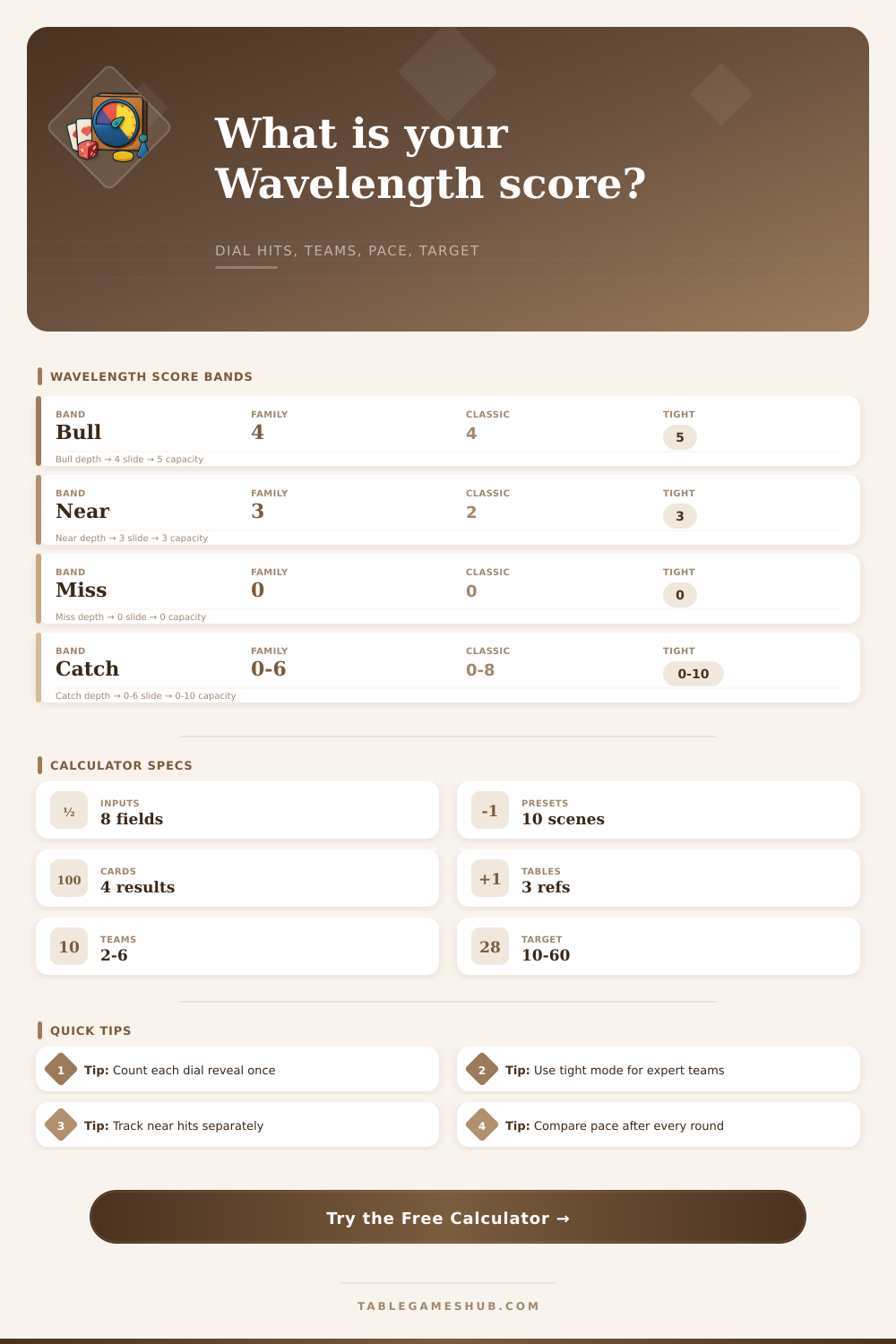
Score bullseye, near-zone, and miss reveals, apply a table catch-up rule, and check whether each team is on target pace.
Each preset fills a real scoring scene with team count, round plan, hit pattern, catch-up style, and target score.
Score breakdown
4
Scoring bands
2-6
Team range
10-60
Target scores
3
Reference tables
| Scoring table | Bullseye points | Near-zone points | Miss points | Best use |
|---|---|---|---|---|
| Classic dial | 4 | 2 | 0 | Standard two-team scoring |
| Family dial | 4 | 3 | 0 | Friendlier table with more near-zone rewards |
| Expert tight dial | 5 | 3 | 0 | Harder clue groups and tournament heats |
| Forgiving table | 3 | 2 | 1 | Teaching games where every reveal should move |
| Catch-up rule | Adjustment used | Best table state | Score impact |
|---|---|---|---|
| No catch-up points | +0 | Close games or official-style play | Keeps raw dial accuracy intact |
| Near boost | +1 per near, capped by half the rounds | Trailing teams that are consistently close | Rewards playable clues without flipping the table |
| Bull chase | +2 per bullseye, capped by team count | Late games with a double-digit gap | Creates a short comeback window |
| Miss floor | +1 per miss, capped by team count | Teaching rounds with new clue givers | Keeps early turns from stalling |
| Target race | Expected teams | Typical rounds | Average needed | Pace signal |
|---|---|---|---|---|
| Quick target 10 | 2 | 3-4 | 2.5 to 3.4 | Great for a warmup game |
| Standard target 20 | 2-3 | 6-8 | 2.5 to 3.4 | Balanced for mixed clue skills |
| Long target 30 | 3-4 | 8-12 | 2.5 to 3.8 | Best when everyone gives clues |
| Heat target 40 | 4-6 | 10-14 | 2.8 to 4.0 | Use tighter scoring to separate teams |
And that’s what makes the tension of playing a Wavelength game: Will my partner guess right? Where will they land the dial? Will I give them a clue that fits how they think about what I mean, or will I leave some points on table? Each moment is less about math and more about catching small details of a connection.
How do you know how you’re doing? When those moments happen, having a reliable way to track that progress can turn your vague feelings into something concrete. Classic scoring use a 2-4 point system with bullseyes getting four points and near misses getting two points. That’s fine for a casual round of Wavelength, but it fails to take into account how some teams is just inherently better at reading one another then others.
How to Score Better in Wavelength
If your team always lands in the near zone, the default penalty system can feel too severe since they’re basically being punished for coming close, which can kill momentum and make what should of been an enjoyable night into a slog. The calculator lets you change between different scoring tables on-the-fly so you can adjust to match. Go with the family dial if this is your first time playing together. Go with the tight expert dial if you’d like to split the truly psychic players from those who only makes wild guesses. Changing the coefficients will completely change the game.
In competitive environments like this, catch-up rules makes a big difference. A blowout gets boring quickly. When one side is racking up their bullseyes early, the other might check out. With bonus points for near-misses if a team is behind, the rules incentivizes consistent effort without cheating person who’s already leading. You reward both effort and luck (with that first handful of cards), instead of only luck. Best of all, the tool lets you adjust those rules as you go, keeping the game close till the end reveal. That’s particularly handy with bigger groups where there’s less attention span and more feeling like something big is at stake.
Without a target in sight, games can go on forever (or end suddenly with little feeling of accomplishment). This is another place where folks can stumble as they may not keep up good pace. A goal score provides an idea of how to complete the game; everyone visualizes finish line. It also keeps forcing teams to measure themselves as they go along, round by round. Halfway done with your rounds? But you are lacking half the points you thought you would need. Something isn’t right. Are your clues too obscure? Or do your guesser get hung up trying to find some deeper meaning behind a simple association? With the breakdown from the calculator you’ll know precisely how far off course you are, and what to work on to play better, instead of whether you’re winning or losing.
In Wavelength matches, the quality of clues is a silent killer, missing a bullseye on a brilliant clue is frustrating for all, whereas getting a perfect guess on a terribel clue feels hollow. The scoring system tries to weigh these differently, but only if you record them correctly. There’s a big difference between a miss and a near hit that just barely slips outside the zone. Only by counting each reveal accurately can you know whether your final score represent actual skill or just noise. It forces you to care about the process, not just the outcome. That kind of attention to detail makes all the difference between a good party and a great one; it provides a clear story of how everyone did.
Numbers aren’t everything. The point isn’t hitting a certain target. It’s knowing whether your team communicate effectively when the chips are down. If you’re doing this for fun, great! Or maybe you treat it like a real mental sport. Either way, the numbers helps organize the confusion of human interpretation. Try out some different scenarios and use the presets to see what happens as you change the rules. Tinker with them until you get the sweet spot where everyone stay involved. You can run the math quickly but the insight into team dynamics is so much more valuable. Let the numbers do their thing, look at where the pointer stops, and let the numbers speak for themselves.