🎲 Backgammon Match Equity Calculator
Compare match score, away scores, Crawford status, cube value, gammons, win probability, and take point using neutral match-equity analysis.
| Line | Match equity | Score impact | Formula detail |
|---|
| Away score | Baseline leader equity | Cube sensitivity | Common read |
|---|---|---|---|
| 1-away, 1-away | 50% | Cube irrelevant | Double match point; game win decides match. |
| 1-away, 2-away | 67% | Crawford often active | Leader is close but opponent still has play equity. |
| 2-away, 2-away | 50% | Very high | A live cube can make one game decide the match. |
| 2-away, 4-away | 67% | High | Leader benefits from single wins; trailer values gammons. |
| 3-away, 5-away | 62% | Medium | Score pressure is real but not overwhelming. |
| 4-away, 7-away | 64% | Medium | Cube action still depends heavily on position volatility. |
| State | Cube access | Equity effect | Calculator handling |
|---|---|---|---|
| Normal centered cube | Either player may turn cube | Pass line is available to cube side | Compares no-double, pass, and take lines. |
| Live cube owned by cube side | Cube side may redouble | Opponent receives future cube after take | Adds recube credit to take-line evaluation. |
| Opponent owns cube | Cube side cannot cube now | No immediate pass decision | Reports no-double equity as primary line. |
| Crawford game | Cube unavailable | Only game result distribution matters | Turns cube action off and uses current cube value 1. |
| Post-Crawford | Cube live again | Trailer often cubes early | Highlights score pressure in action note. |
| Outcome | Points at cube 1 | Points at cube 2 | Match-equity use |
|---|---|---|---|
| Single win | 1 | 2 | Baseline game-win result. |
| Gammon win | 2 | 4 | Weighted by conditional gammon-win percentage. |
| Backgammon win | 3 | 6 | Rare but included for high-contact positions. |
| Single loss | -1 | -2 | Uses opponent score advance in the equity formula. |
| Gammon loss | -2 | -4 | Important for gammon-save scores. |
| Backgammon loss | -3 | -6 | Modeled as triple cube value against the cube side. |
| Band | Typical signal | Useful input to inspect | Neutral interpretation |
|---|---|---|---|
| No-double | Take line does not beat no-double | Win probability and volatility | Position may be too early or too stable for cube pressure. |
| Optional double | Double adds small equity | Equity swing below 2% | Result is close; score context matters. |
| Double-take | Take line beats pass line for opponent | Taker point versus opponent win chance | Cube is live but opponent has enough continuation equity. |
| Double-pass | Pass line exceeds take line | Game win chance and gammon threat | Current score and gammons make continuing too weak for taker. |
| Crawford off | Cube unavailable | Crawford selector and away score | Only game outcome distribution is compared. |
Score Tip
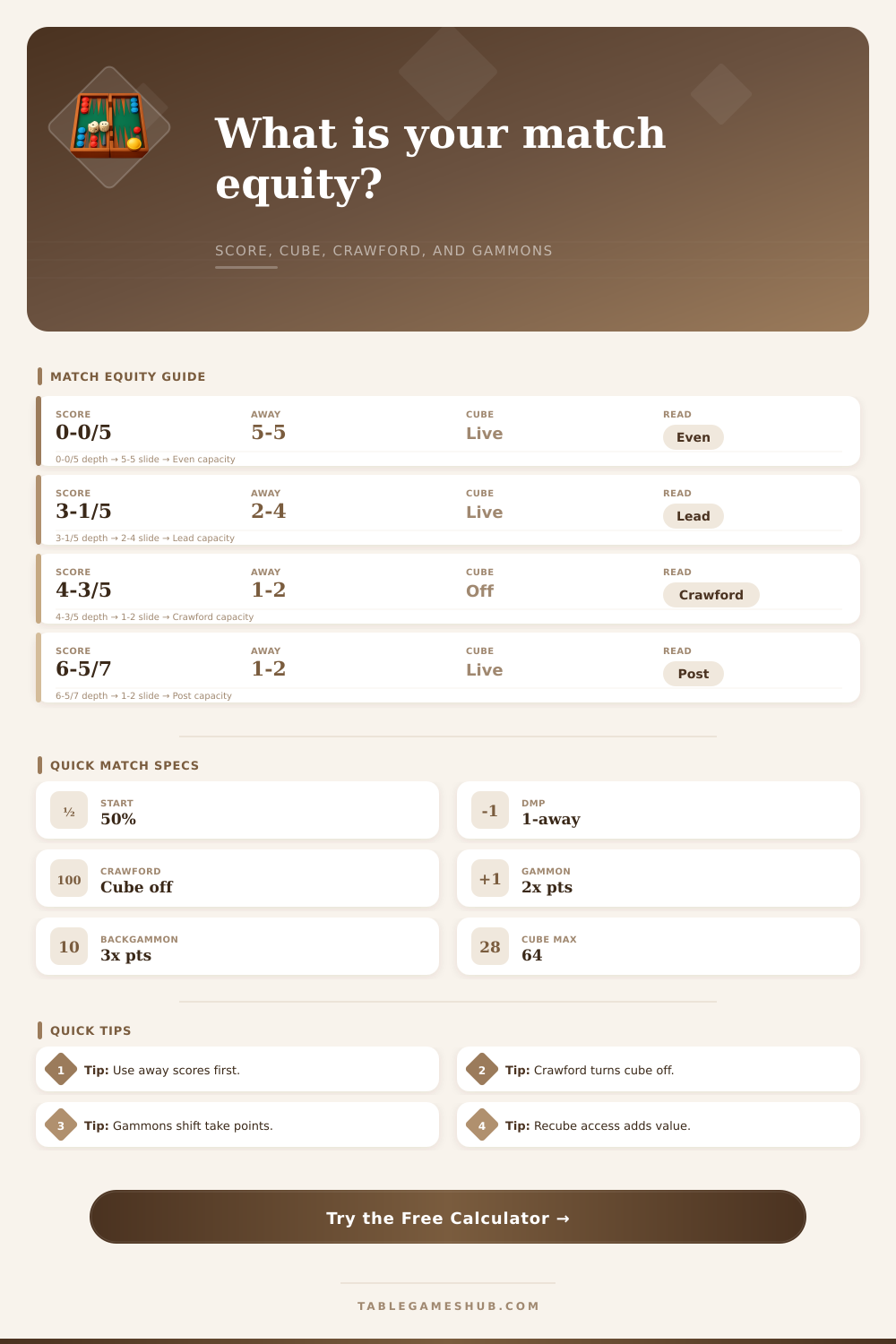
Convert the score to away points before reading any match-equity result. A 4-2 lead in a 7-point match is 3-away 5-away, and that is the useful equity state.
Cube Tip
When Crawford is active, cube comparisons should be ignored. The calculator keeps the game-result distribution but marks cube action as unavailable.
Match equity is a measurement of the value of a single game based off the score of the match. Match equity is important because the value of a single game within a match change based upon how many point each player needs to win the match. If the score is even, the value of winning a single game is relatively small.
However, if a player is close to winning the match, the value of winning a single game is very highly. Thus, match equity changes the way that player makes decisions regarding the cube and there actions within the match. The importance of match equity become readily visible when comparing the opening game of a seven point match with a game where one player is four points ahead of their opponent.
What Match Equity Is and How to Use the Calculator
In the opening game of a seven point match, the game is worth approximately half the match. However, when one player is four points ahead in a match that is otherwise seven points in length, the game is worth almost all of the match remaining. Match equity, therefore, determine if a player should double early in the match, how much they should fight for a gammon, and if they can afford to lose a marginal position.
If a player ignore match equity, they may either overvalue their position if they are behind in the match, or they may undervalue their position if they are ahead in the match with respect to points needed to win. Match equity calculations provides three specific values for a player to use to determine if a player’s proposed doubling is correct or incorrect. These three values is the current match equity, the best neutral action, and the take point that the opponent must have in order to continue with the match on the current position.
In addition to calculating match equity, the calculator include a state selector for the Crawford rule. The Crawford rule states that when a player is one point away from winning a match, the player cannot use the match cube for that one game. Many players will often forget this rule during a long match.
Thus, by including this selector, the calculator will remove those lines that represents games where the player cannot use the cube. Additionally, the calculator also accounts for the instance where the player is on double match point such that the first match to win a game is the winner of the match. Gammon rates is another factor that can influence match equity calculations.
For instance, if a player is three points away from winning a match, they must win two games for the opponent to win three games for the match. However, if a player wins a gammon, they only have to win two games for the opponent to win four games for the match. Thus, gammon win and loss percentage can be accounted for so that match equity calculations is more accurate to the potential outcome of the match.
For instance, a quiet holding position will contain fewer gammons than one that is aggressive in their plays, such as a blitz or backgame. The position family dropdown menu allow for players to account for different type of positions. For instance, positions that involve racing to the 15 point line will have fewer gammons and lower volatility than positions where players are pitting one player against the other’s prime.
The calculator accounts for this by providing a different value for the recube of a player’s position. While the percentage of the match equity gained by this adjustment is small, it can be the difference between taking a borderline position or passing. Away scores are provided for players to quickly read the output of the match equity calculator.
Away scores convert the current score of a match to the number of points that each player need to win the match. Thus, converting the score to away points allow the player to more easily remember the value of the match equity number. For instance, a lead of 4-2 in a seven point match can be represented as a score of 3-away and 5-away.
Additionally, the reference table on the page include several common away scores and their interpretations. While the calculator can determine match equity for a given position, there are other factors that is beyond the calculations of the calculator. Factors such as fatigue, opponent tendencies, and the emotional connection of a player to the match can affect a player’s decisions outside of the calculator.
For instance, a player who has lost three games in a row may take actions that is opposite of those that they would take in a winning streak. Thus, while the calculator can assist a player with their decisions, they is also required to use the calculator as a baseline from which to take action with these additional factors in mind. A common mistake by players is to believe that every game have the same value.
Match equity, however, allows for a player to understand that each game does not have the same value within the same match. For instance, a trailer who understand match equity may dare to double early in the match, even if they do not have an edge in the game. Additionally, the leader may use match equity to determine that they should not double until they have a larger advantage.
The same logic can be used for decisions regarding gammons. For instance, at some match scores, winning a gammon is not as valuable than in other matches. The calculator allows players to understand the equity of winning a gammon, and that can assist a player in understanding if the risk of the position is justified by the equity that can be provided by winning the gammon.
While using the match equity calculator may seem like a complicated task, it can become an automatic habit for a player. Instead of think about match equity in the middle of a game, players can learn to incorporate this extra step in their minds to consider how each score impact match equity calculations. This will allow players to avoid expensive mistake, and to leave their mental energy for the play of the game.