♞ ELO Performance Rating Calculator
Calculate tournament performance rating, expected score, and ELO rating change from your game results
Enter your results (up to 10 games):
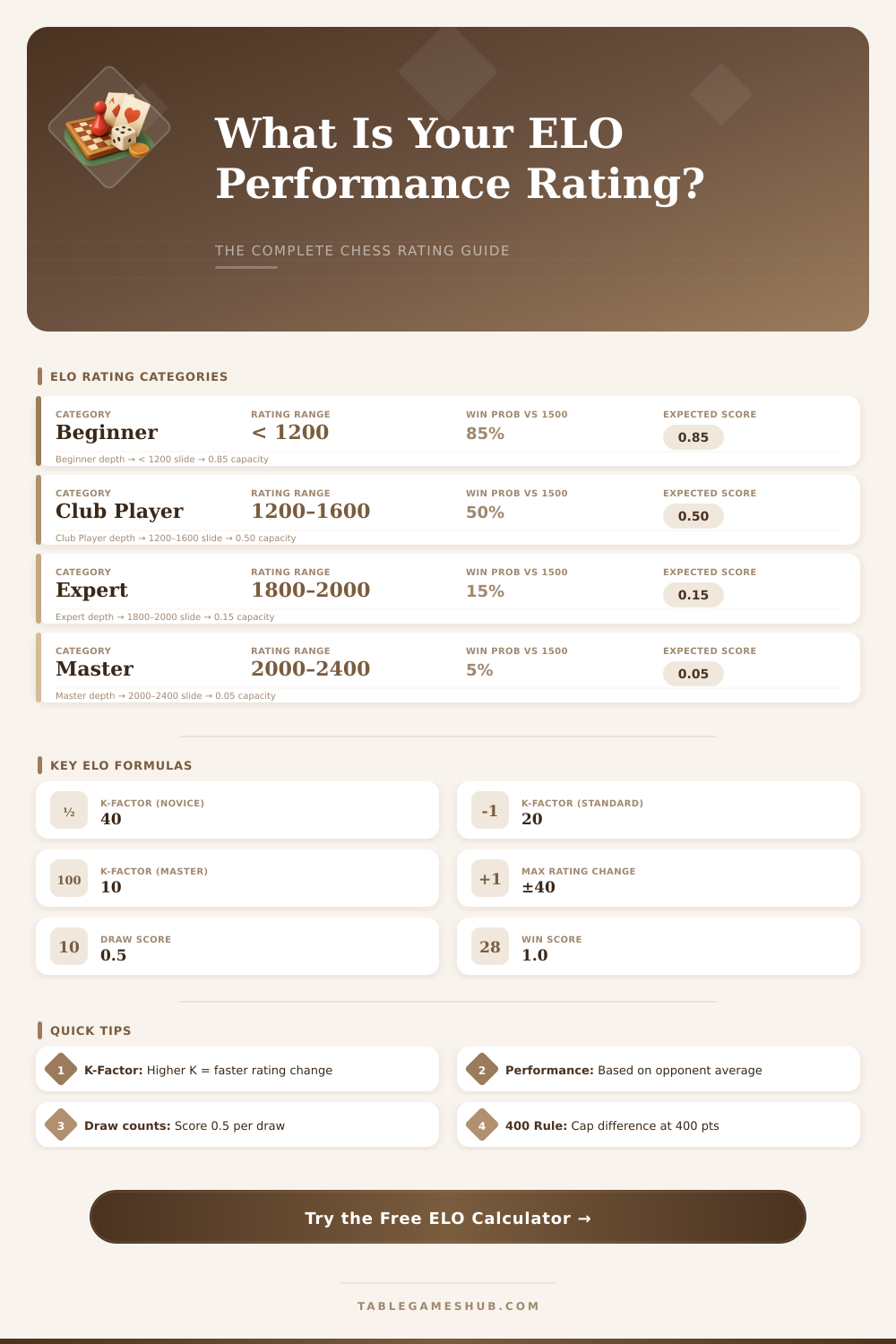
| Category | FIDE Rating Range | Win Prob vs 1500 | Expected Score | K-Factor |
|---|---|---|---|---|
| Beginner | Below 1200 | 15% | 0.15 | 40 |
| Novice | 1200 – 1399 | 24–36% | 0.24–0.36 | 40 |
| Club Player | 1400 – 1599 | 36–50% | 0.36–0.50 | 20 |
| Intermediate | 1600 – 1799 | 50–64% | 0.50–0.64 | 20 |
| Advanced | 1800 – 1999 | 64–76% | 0.64–0.76 | 20 |
| Candidate Master | 2000 – 2199 | 76–85% | 0.76–0.85 | 20 |
| FIDE Master | 2200 – 2299 | 85–89% | 0.85–0.89 | 20 |
| International Master | 2300 – 2499 | 89–95% | 0.89–0.95 | 10 |
| Grandmaster | 2500 – 2699 | 95–98% | 0.95–0.98 | 10 |
| Super Grandmaster | 2700+ | 98%+ | 0.98+ | 10 |
| Score % | Score (5 games) | Score (9 games) | Rating Diff | Performance vs 1500 |
|---|---|---|---|---|
| 100% | 5.0 | 9.0 | +800 | 2300 |
| 90% | 4.5 | 8.1 | +366 | 1866 |
| 80% | 4.0 | 7.2 | +240 | 1740 |
| 70% | 3.5 | 6.3 | +149 | 1649 |
| 60% | 3.0 | 5.4 | +72 | 1572 |
| 50% | 2.5 | 4.5 | 0 | 1500 |
| 40% | 2.0 | 3.6 | -72 | 1428 |
| 30% | 1.5 | 2.7 | -149 | 1351 |
| 20% | 1.0 | 1.8 | -240 | 1260 |
| 10% | 0.5 | 0.9 | -366 | 1134 |
| 0% | 0.0 | 0.0 | -800 | 700 |
| Formula | Expression | Variables | Notes |
|---|---|---|---|
| Expected Score | E = 1 / (1 + 10^((Ro–Ra)/400)) | Ra=your rating, Ro=opp | Core FIDE formula |
| Rating Change | ΔR = K × (W – E) | K=factor, W=actual, E=expected | Applied per game |
| New Rating | Rn = Ra + ΔR | Ra=current, ΔR=change | Final calculation |
| Performance Rating | Rp = Ro_avg + D(W%) | D from score% table | FIDE method |
| Score Percentage | W% = (W + 0.5×D) / N | W=wins, D=draws, N=games | Actual score |
| 400-pt Cap | min/max diff = 400 | Applies to each game | Anti-inflation rule |
The ELO Rating system is a way to measure the relative skill of a player or team in a game. It was created by Hungarian-American physicist called Arpad Elo at the end of the 1950s. Originally it was used for chess, but later it was adapted to sports ties, video games rankings for machine learning, and similar platforms for education.
The basic idea of the system is that the result of every player in every game is a random variable that follows normal distribution. Although some players can play much better or worse from one match to the next, the usual level of game for any player changes only slowly over time. Simply, the method assumes that the winner of any match is the one that played the best in it, and it gradually improves the ELO Rating of every player based on real results.
How ELO Ratings Work
The scales of ratings range from around 1000 for total beginners up to 2800 or more for the strongest players ever. Beating an opponent with a higher rating gives more points than beating one with a lower rating. When a player with a higher rating beats one with a lower rating, he gets fewer points because one expects that he wins anyway.
If two players have exactly the same rating, none receives points.
The performance rating is an important part of this system. It shows how well someone played during a certain event. The basic formula takes the total of all ratings of opponents, adds 400 times the difference between wins and losses, and then divides by the number of games.
An eaiser version says that your performance against one match estimates the rating of your opponent plus 400 if you won and minus 400 if you lost. Even so, truly precise performance rating becomes hard to calculate if someone wins every game, because players of various skill levels could reach a perfect result against weak enemies.
One weakness is that the ratings are based on past results. The ELO Rating of a player is never fully precise, because it mixes older and fresh results. The K-factor, which controls the speed of rating change, also creates problems.
Changing it affects both the historical and the short-term tracking of performance, without being able to separate won from the other.
The system was also used outside chess, in games like Warhammer 40,000 and on platforms like Tabula Game Arena. Some games even dropped it, because very high players avoided small events to protect their rating. ELO Rating can even apply to games with several players with enough math, that computers do easily today.
At its base, therating intends to estimate the chance of victory between two players, even if they never met each other before.