🎲 Warhammer 40K Damage Calculator
10th Edition — Calculate expected hits, wounds, failed saves & damage output
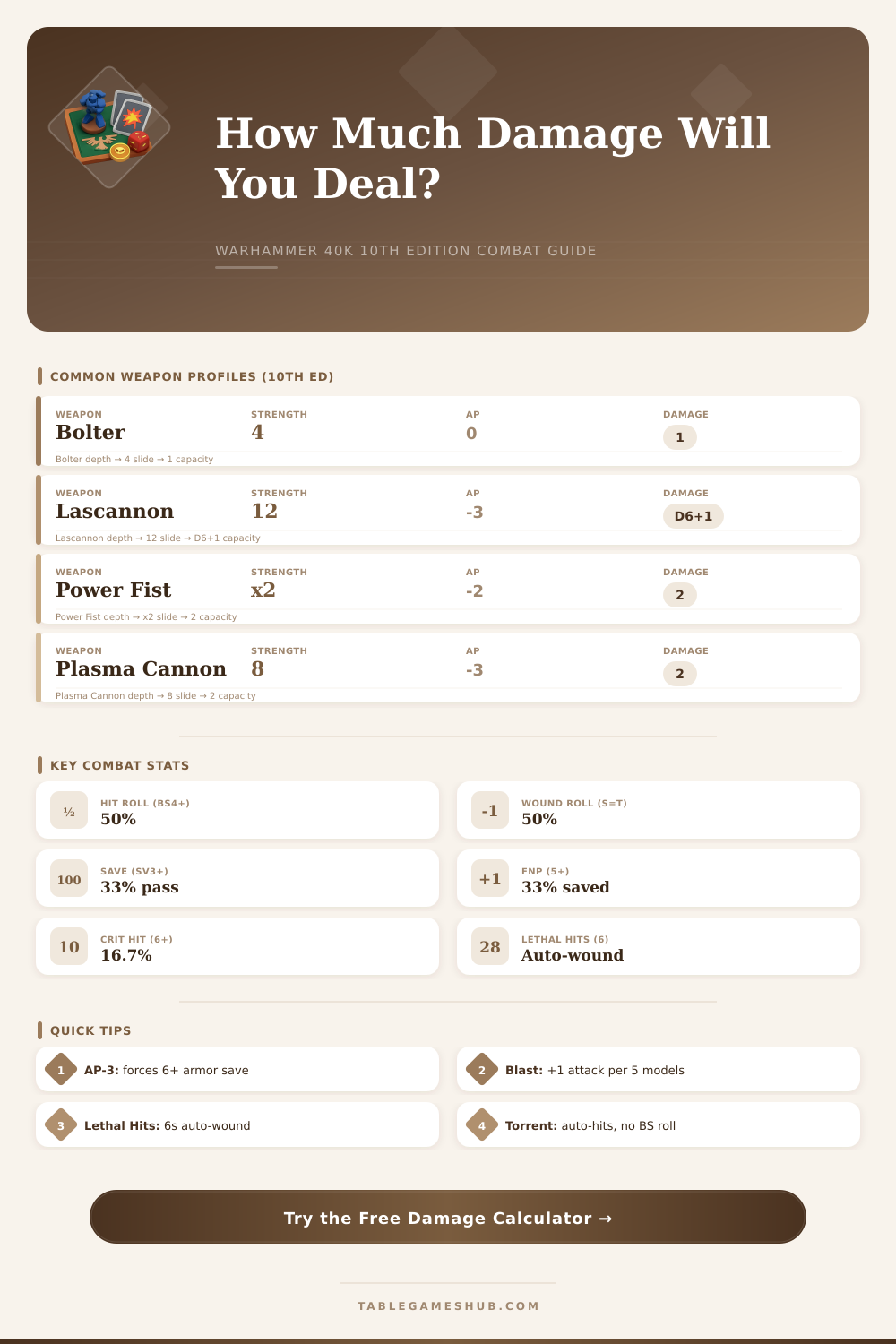
| Weapon | Range | A | S | AP | D | Keywords |
|---|---|---|---|---|---|---|
| Bolter | 24" | 2 | 4 | 0 | 1 | Rapid Fire 1 |
| Heavy Bolter | 36" | 3 | 5 | -1 | 2 | Heavy, Sustained Hits 1 |
| Meltagun | 12" | 1 | 9 | -4 | D6+2 | Melta 2 |
| Lascannon | 48" | 1 | 12 | -3 | D6+1 | Heavy |
| Plasma Cannon | 36" | D3 | 8 | -3 | 2 | Blast, Overcharge option |
| Flamer | 12" | D6 | 4 | 0 | 1 | Torrent, Ignores Cover |
| Autocannon | 48" | 2 | 9 | -1 | D3 | Heavy |
| Krak Missile | 48" | 1 | 9 | -2 | D6+1 | — |
| Frag Missile | 48" | D6 | 4 | 0 | 1 | Blast |
| Power Fist | Melee | 3 | x2 | -2 | 2 | — |
| Power Sword | Melee | 4 | +1 | -2 | 1 | — |
| Sniper Rifle | 36" | 1 | 4 | -2 | 2 | Heavy, Precision |
| Unit Type | T | Sv | W | Example |
|---|---|---|---|---|
| GEQ (Guard Equivalent) | 3 | 5+ | 1 | Guardsman |
| MEQ (Marine Equivalent) | 4 | 3+ | 2 | Space Marine |
| TEQ (Terminator Equiv) | 5 | 2+/4++ | 3 | Terminator |
| Light Vehicle | 6 | 3+ | 8–10 | Rhino |
| Medium Vehicle | 8 | 3+ | 12–14 | Predator |
| Heavy Vehicle / Tank | 10 | 2+ | 14–18 | Land Raider |
| Super-Heavy | 12+ | 2+ | 22+ | Baneblade |
| Monster / Creature | 8 | 3+ | 10–14 | Carnifex |
| Roll Target | Success % | Fail % | Avg Success (6 dice) |
|---|---|---|---|
| 2+ | 83.3% | 16.7% | 5.0 |
| 3+ | 66.7% | 33.3% | 4.0 |
| 4+ | 50.0% | 50.0% | 3.0 |
| 5+ | 33.3% | 66.7% | 2.0 |
| 6+ | 16.7% | 83.3% | 1.0 |
Understand how damage works in Warhammer 40k commonly confuses new players. Counting damage after attacks is not that simple, as if one only would take the force of the weapon minus the value of the defence of the target. Behind everything this is a whole process, and getting it right is truly key during the game.
Every weapon in Warhammer 40k has its own values. For example, some weapon maybe has damage of 3. That value applies for one shot, not for the whole set of shots together.
How Damage Works in Warhammer 40k
So, if a weapon shoots 7 times and every shot does D6 of damage, then each separate shot rolls its own D6 for damage. A weapon with 20 shots and damage of 1 means that each uncovered wound from those 20 shots causes 1 of damage each.
Wounds in 40k work like health points. They show how much damage a model can take before it dies. When damage reaches a unit, one must apply it in order, from one model to the next.
One takes all wounds on one model before moving to the next. If a model already has a wound, one chooses it first. This way damage does not spread freely, as a player would want.
Here is where everything gets tricky. If a weapon causes more damage then the model has wounds, the extra part simply goes away. It does not pass to the next model.
That is a truly important rule. It shows that weapons with high damage can waste a lot of their force on weak enemies.
Consider bolters as a sample. They cause 1 of damage per wound. If a unit receives 5 uncovered wounds from bolters, the first 3 could kill one model with 3 wounds, and the remaining 2 go to the next model.
Everything nice and clear.
This explains why choosing the right target matters so seriously. One of the biggest mistakes of players is aiming too much firepower at one single target. If a unit has only two wounds, shooting a whole group of strong weapons against it wastes resources.
Many calculators help to figure out the minimum firepower needed to destroy a target with around 80 percent reliability. Free online tools match with the 10th Edition of rules and use dice odds to simulate shots and close fights.
Here also can happen conflict between math calculations and real simulations. That difference commonly comes from the fact that calculations do not always consider damage that gets wasted when a high damage shot hits a target that already almost dies. The one-by-one mode of rolling dice causes more damage thrown away than the pure numbers would predict.
Armour also matters. If a roll falls to zero ormore below than the armour, then no damage applies at all.