🎲 13th Age Point Buy Calculator
Spend a 28-point ability pool, add abstract race and class bonuses, total modifiers, and check tier readiness.
Build Summary
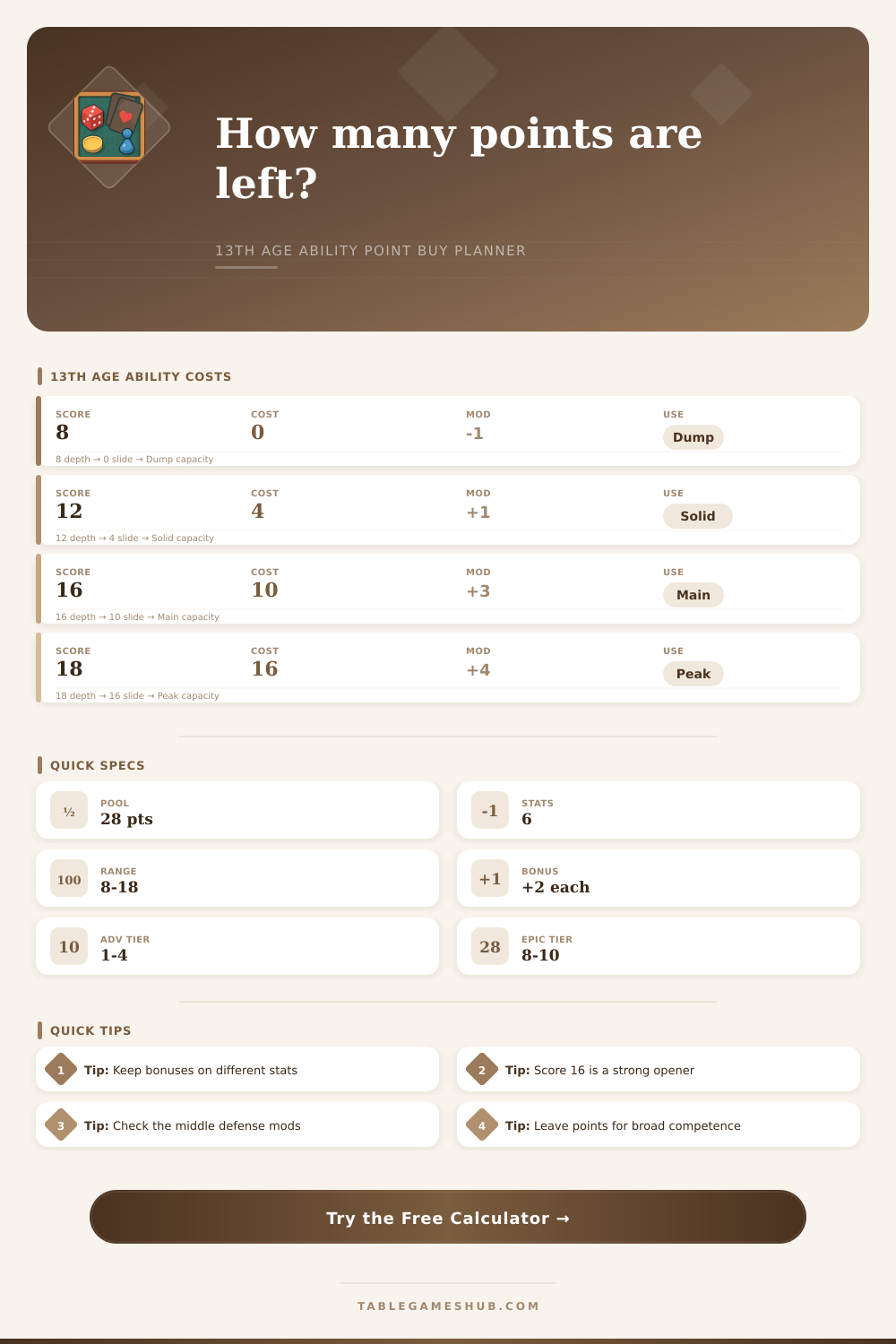
| Purchased Score | Point Cost | Modifier Before Bonus | Planning Note |
|---|---|---|---|
| 8 | 0 | -1 | Free low score; use only when the character can live with it. |
| 9 | 1 | -1 | Usually less efficient than buying 8 or 10. |
| 10 | 2 | +0 | Neutral baseline for a less-used ability. |
| 11 | 3 | +0 | Odd score that may become useful with a later increase. |
| 12 | 4 | +1 | Good secondary stat with modest cost. |
| 13 | 5 | +1 | Useful if a bonus or level increase will make it even. |
| 14 | 6 | +2 | Efficient target for defense and support abilities. |
| 15 | 8 | +2 | Costs extra before the modifier improves. |
| 16 | 10 | +3 | Strong primary score before a +2 bonus. |
| 17 | 13 | +3 | Expensive unless your table values odd-score setup. |
| 18 | 16 | +4 | Maximum purchased score; leaves fewer broad stats. |
| Preset | Base Array | Bonus Pair | Point Cost |
|---|---|---|---|
| Barbarian Striker | 16,14,14,12,10,8 | Str + Con | 28 |
| Bard Leader | 10,12,14,12,12,16 | Cha + Dex | 28 |
| Cleric Healer | 12,14,10,10,16,12 | Wis + Con | 28 |
| Fighter Defender | 16,16,12,8,12,8 | Str + Con | 28 |
| Paladin Champion | 16,14,10,8,12,14 | Str + Cha | 28 |
| Ranger Archer | 12,14,16,10,12,8 | Dex + Con | 28 |
| Rogue Skirmisher | 10,14,16,14,10,10 | Dex + Int | 28 |
| Sorcerer Caster | 8,14,14,10,12,16 | Cha + Con | 28 |
| Wizard Controller | 8,14,14,16,12,10 | Int + Con | 28 |
| Balanced Hero | 14,14,14,12,12,10 | Any two | 28 |
| Derived Check | Uses These Modifiers | Calculator Output | Why It Matters |
|---|---|---|---|
| Armor Class basis | Con, Dex, Wis | +1 middle | Helps spot fragile spreads before play. |
| Physical Defense basis | Str, Con, Dex | +2 middle | Shows whether physical defenses are supported. |
| Mental Defense basis | Int, Wis, Cha | +1 middle | Flags weak mental-side ability coverage. |
| Initiative basis | Dex modifier | +1 | Useful for characters who rely on acting early. |
| Tier | Levels | Suggested Primary Final | Calculator Readiness Logic |
|---|---|---|---|
| Adventurer | 1-4 | 16+ | Valid pool, legal bonus setup, and primary score at least 16. |
| Champion | 5-7 | 18+ | Valid pool, legal bonus setup, and primary score at least 18. |
| Epic | 8-10 | 20+ | Valid pool, legal bonus setup, and primary score at least 20. |
| Custom | Any | GM choice | Adjust the point pool or stacking rule for your table. |
In teh game 13th Age, character building is a process that involves the management of a fixed number of points. Because characters require that players make trade-offs between attributes, characters cant allocate their points to one attribute rather than another; any points that are spent on one attribute prevent the character from spending points on another attribute. The character begins with a set number of points, and the player can distribute those points among different attributes for the character.
By choosing to assign a high value to one attribute, a character will use up all of its points for that one attribute, and it will have no remaining points to allocate to others. In order to create a well-rounded character, players must find a balance between specializing in a few attributes and ignoring others (which can make the character a liability) versus creating a character that has relatively even attribute scores. Characters is required to identify at least one primary focus among its attributes; this attribute will allow the character’s class features to function.
How to Build and Balance a 13th Age Character
Characters must ensure that they spends their points mostly on their primary focus and that they provide their other attributes with enough points to be usable within the game. Beyond the character’s ability scores, there is also race and class bonuses that can be applied to those attributes. For instance, players may spend their points to purchase an attribute of 16, but the character may have a plus-two bonus from its race for that same attribute.
Thus, its attribute will be 18. This system for applying race and class bonus points is an efficient means of increasing the attribute scores of a character. Furthermore, how the player applies the bonuses will determine the maximum potential of each of the character’s ability scores.
In addition to attribute points, there are also defense attributes for characters, such as Armor Class, Physical Defense, and Mental Defense. These defenses are based off the middle modifiers of the attribute scores rather than the highest score. Thus, if a character has a high value for one attribute, but others is very low for that character, those defenses will be low.
For instance, if a character has a low Physical Defense attribute, it can die easy in combat. Therefore, players must allocate attribute points such that the character has good defenses and dont ignore the importance of the middle attribute scores. Many players tend to forget about the middle attribute scores when building a character, but these attributes is what will keep the character alive in combat with other enemies.
The requirements for attribute scores change as the character moves through the different tiers of the game. For instance, early game characters with relatively low attribute scores is likely to succeed. However, as the game develops and the enemies become more challenging to defeat, characters require higher attribute scores to be effective at fighting those enemies.
Thus, characters can use a tier readiness check for their attribute scores to determine if they are high enough for their level and experience within the game. If the character do not meet the minimum requirement for attribute scores relative to there level, the character will struggle to beat the enemies in that tier. Another aspect of character building is the consideration of dump stats for a character.
Dump stats are attributes that players choose to make low for that character. The benefit of creating dump stats for a character is that the character can recover some of its points, which can be used to increase its primary attribute scores. For instance, a caster may want to make its Charisma score relatively low in order to allocate points toward an Intelligence attribute score.
However, these stats can make it more difficult for the character to complete certain tasks. Thus, players should of consider carefully which attributes to make a dump stat for their character. Character building in 13th Age, therefore, is a process of managing the priorities of the player and the character.
Character building involves players making sure that they provides their most important attributes with the points needed to provide good powers for the character. Furthermore, they must ensure that they dont ignore their less important attributes, since each attribute score has a role within the game. Once the character’s points are spent and race and class bonuses are applied to the character’s attributes, the attribute scores will provide a mathematical foundation for the character’s abilities.
Thus, players must remember their mathematical attribute scores and point budget when building their character to ensure that they is effective in the game.