Cornhole Board Height Calculator
Set the front edge, rear edge, board pitch, leg pivot geometry, floor slope correction, and shim stack for a playable board setup.
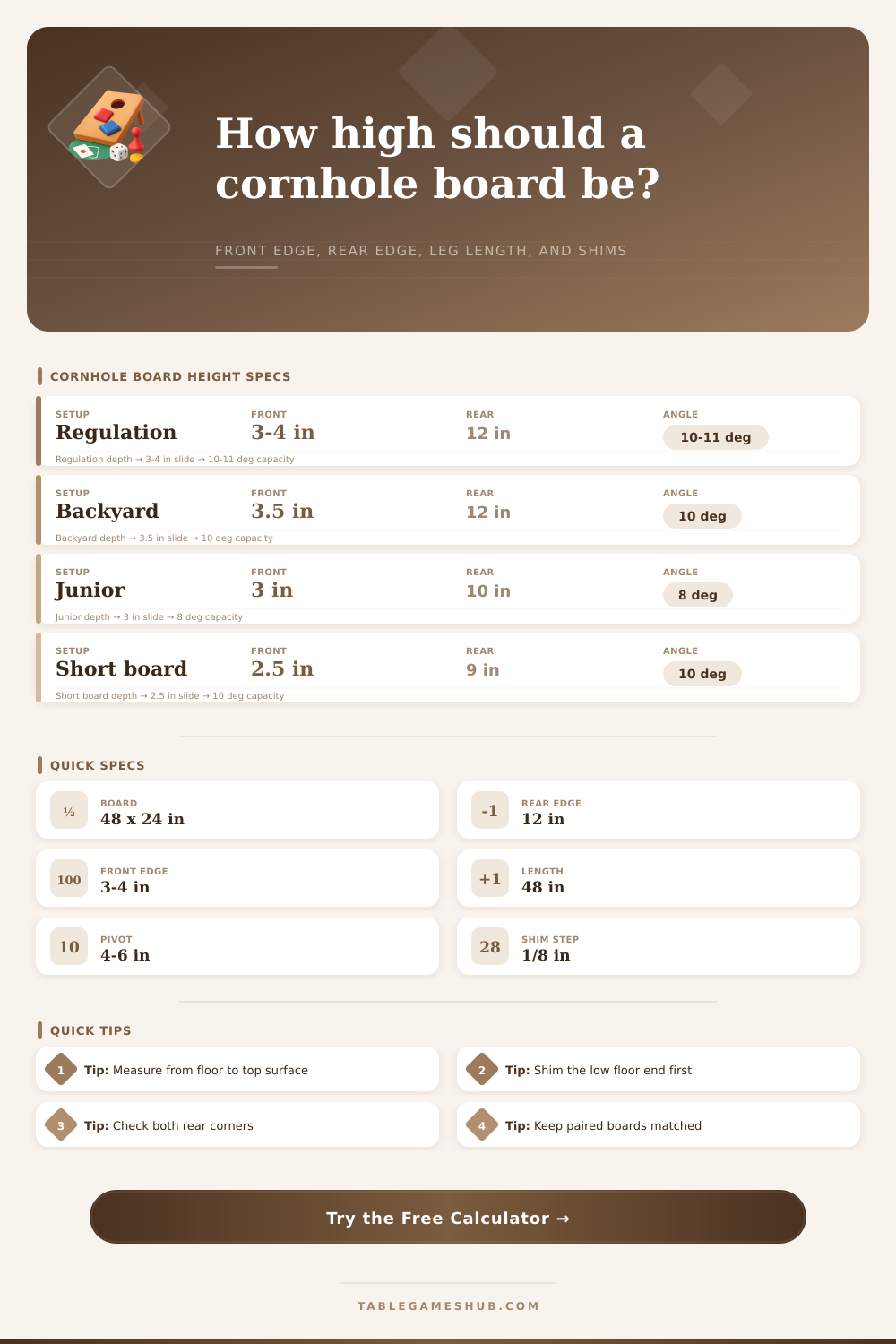
| Board setup | Front edge height | Rear edge height | Use case |
|---|---|---|---|
| Regulation target | 3 to 4 in | 12 in | Adult boards and formal checks |
| Backyard target | 3.5 in | 12 in | Portable folding-leg boards |
| Junior practice | 3 in | 9 to 10 in | Younger players or short throws |
| Tailgate short board | 2.5 to 3 in | 8.5 to 10 in | Compact boards under 48 in long |
| Pivot layout | Pivot from rear | Foot setback | Setup note |
|---|---|---|---|
| Tight folding leg | 3 to 4 in | 7 to 9 in | Compact, steeper leg stance |
| Common hinge leg | 4 to 6 in | 9 to 11 in | Stable backyard setup |
| Wide stance leg | 5 to 7 in | 11 to 13 in | Longer diagonal cut |
| Short board leg | 3 to 5 in | 7 to 10 in | Scale with board length |
| Floor slope reading | Meaning | First correction | Check after shimming |
|---|---|---|---|
| 0 in | Level front to rear | Use rear height only | Measure rear corners |
| +1/4 in | Rear floor higher | Raise front edge 1/4 in | Recheck board pitch |
| -1/4 in | Rear floor lower | Raise rear legs 1/4 in | Recheck rear height |
| Over 1/2 in | Noticeable slope | Use a firm riser, not soft pads | Match both boards |
| Shim stack | Approx height | Best placement | Practical use |
|---|---|---|---|
| 1 playing card | About 1/64 in | Fine corner trim | Tiny wobble fix |
| Thin hardboard | 1/16 in | Rear leg foot | Fine height matching |
| Common shim | 1/8 in | Low end or low corner | Most setup checks |
| Wood riser | 1/4 in plus | Full foot support | Sloped patio or garage |
Cornhole board height is one of teh most critical factors in the game of cornhole. The height of the cornhole board will ultimatel determine an angle of the playing surface. The angle of the playing surface will ultimately determine the way the cornhole bag will slide across the cornhole board.
If the rear edge of the cornhole board is too high or if the front edge of the cornhole board is too low, the cornhole bag may bounce off of the cornhole board instead of slide toward the hole. In order to avoid this outcome, the cornhole board must have a consistent pitch to allow for the cornhole bag to slide smooth across the board. The legs of the cornhole board ultimately determine the height to which the cornhole board will rise.
How to Set Cornhole Board Height
The legs of the cornhole boards often use a pivot system where the leg is hinged near the back edge of the cornhole board. The length of the leg of the cornhole board and the distance of the pivot point from the rear edge of the cornhole board will ultimately determine the height to which the cornhole board will rise. The thickness of the plywood top of the cornhole board will also impact the height to which the cornhole board will rise.
For instance, if thick plywood is used to construct the top of the cornhole board, the plywood will contribute to the height of the cornhole board. In contrast, if thin plywood is used to construct the top of the cornhole board, the thin plywood will contribute to the decrease of the height of the cornhole board. In either case, the height of the cornhole board should be measured from the floor to the top face of the cornhole board.
The ground upon which the cornhole board will be constructed may also impact the height of the cornhole board. For instance, many different surfaces may not be flat to the touch. Many concrete patios and garage floors, for instance, may slope in such a way that it drains water away from the structure.
If the ground upon which the cornhole board is to be constructed is sloped, the cornhole board may not achieve the height to which it is constructed. For instance, if the ground slopes in a way that the rear of the cornhole board will be higher then the front of the cornhole board, the cornhole board will be tilted in a manner that does not allow it to achieve the height that was intended to be constructed. In this situation, it may appear that the cornhole board is constructed to a height of twelve inches, but the slope of the ground will cause the cornhole board to have a height of thirteen inches.
Shims can be used to even out the height of the cornhole board. Shims is added to the bottom of each leg of the cornhole board. The shims are added to the bottom of the leg rather than cutting the legs of the cornhole board to an even height.
For example, if the legs of the cornhole board are too high to ensure that it does not wobble when the cornhole bags hit the board, cutting the legs to an even height will cause the cornhole board to be too short if it is moved to a different location. Shims allow for the height of the cornhole board to be adjusted to account for the slope of the ground upon which the cornhole board is constructed. Each cornhole board leg has two critical variables that will impact the height to which it rises: the pivot offset and the foot setback.
The pivot offset of each leg of the cornhole board is the distance from the back edge of the cornhole board to the hinge of the leg. Similarly, the foot setback is the distance that the foot of each leg of the cornhole board extends backward from the back edge of the cornhole board. If the legs of the cornhole board are too vertical to allow for the bag to rise from the cornhole board, the cornhole board may be unstable.
Additionally, if the legs of the cornhole board are too wide to allow for each bag to rise from the cornhole board, the cornhole board may become too top-heavy. Each of these factors must be balanced to create a cornhole board that does not wobble when the bags hit the cornhole board. Consistency between each of the two cornhole boards is required to play a fair game.
Each of the cornhole boards must have the same height and pitch. If one cornhole board is higher than the other, the game will not be consistent for the players of those bags. For children, it may be desirable to lower the height of the cornhole board to make the cornhole board more accessible to the children.
Regardless of the type of players that are using the cornhole board, it is essential to ensure that each of the two cornhole boards are of the same height and pitch to each other. If each of the cornhole boards is constructed in the same manner to each other, each of the cornhole bags will slide smooth off of the cornhole board allowing the game to rely upon the skill of the players rather than luck. Its important to remember that you’re should of checked the boards height before playing.
You’ll find that alot of players dont realize how much the grounds slope can affect the game. Even a small mistake can make the boards performance feel uncomfortably uneven.