Cornhole Board Angle Calculator
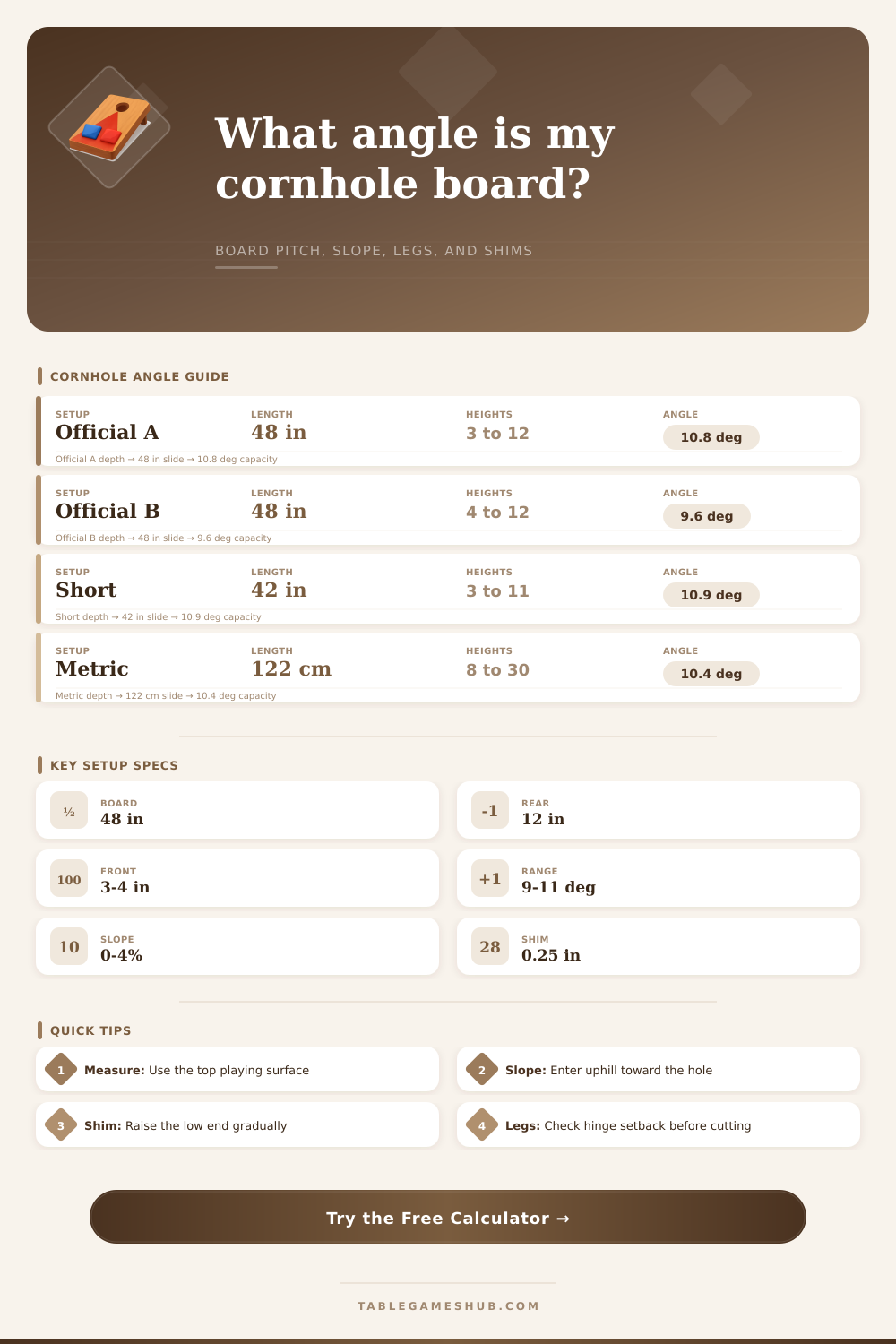
Calculate cornhole board pitch from board length, front height, back height, ground slope, leg length, target angle range, and shim adjustment without using throw distance.
| Board length | Front height | Back height | Height difference | Approx angle |
|---|---|---|---|---|
| 48 in | 3 in | 12 in | 9 in | 10.8 deg |
| 48 in | 3.5 in | 12 in | 8.5 in | 10.2 deg |
| 48 in | 4 in | 12 in | 8 in | 9.6 deg |
| 48 in | 3 in | 11.5 in | 8.5 in | 10.2 deg |
| 42 in | 3 in | 11 in | 8 in | 11.0 deg |
| Style | Target range | 48 in rise range | Typical feel | Adjustment focus |
|---|---|---|---|---|
| Softer board | 8.5-9.5 deg | 7.1-7.9 in | Flatter slide | Lower the rear |
| Standard band | 9-11 deg | 7.5-9.2 in | 10 degree style | Match both boards |
| Steeper board | 10.5-11.5 deg | 8.7-9.6 in | More loft stop | Raise the rear |
| Custom build | Entered range | Calculator output | Measured repeat | Use shim step |
| Ground slope | Rise over 48 in | Uphill to back | Downhill to back | Shim note |
|---|---|---|---|---|
| 0% | 0 in | No correction | No correction | Match measured heights |
| 1% | 0.5 in | Feels 0.6 deg flatter | Feels 0.6 deg steeper | Small pad check |
| 2% | 1.0 in | Feels 1.1 deg flatter | Feels 1.1 deg steeper | Shim rear or front |
| 4% | 1.9 in | Feels 2.3 deg flatter | Feels 2.3 deg steeper | Level area preferred |
| Rear height change | Approx angle change | With 1/4 in shims | Leg length impact | Use case |
|---|---|---|---|---|
| 0.25 in | 0.30 deg | 1 shim | Small trim | Fine matching pair |
| 0.50 in | 0.60 deg | 2 shims | Noticeable | Correct mild slope |
| 0.75 in | 0.90 deg | 3 shims | Recheck fold | Low rear support |
| 1.00 in | 1.20 deg | 4 shims | Adjust leg stop | Major height fix |
Cornhole boards must have the same pitch. The pitch of a cornhole board are the angle of the board to the ground. If one cornhole board has a different pitch than another cornhole board, then the bag will slide different on each board.
The bags may slide toward the hole on one board but may not on the other board. The pitch of the board impact how the bag interacts with the board. The relationship between the friction between the bag and the board and the gravitational force that pull the bag down the board can determine the pitch of the cornhole board.
Make sure both cornhole boards have the same angle
If the cornhole board has a steep pitch to the ground, the bag will travel quick down the board due to gravity, but the steep pitch will cause the bag to stop on the board. If the pitch of the cornhole board is shallow to the ground, the bag will travel a longer distance down the board due to the shallow pitch and the less gravitational force that pulls the bag down the board at a fast rate. Most players prefers a ten-degree pitch to the ground for playing cornhole.
It offers the best experience for players due to the distance the bags will travel down the board. Measuring the pitch of the cornhole board can be challenging. The ground is never level.
The ground may slope up or down from one end of the cornhole board to the other. The slope of the ground will change the effective pitch of the cornhole board. If the ground slope upward toward the hole, the cornhole board will feel flatter than it is.
If the ground slopes downward away from the hole, the cornhole board will feel more steeper than it is. To measure the correct pitch, take accurate measurements of the cornhole board. Measure from the ground to the top of the playing surface of the cornhole board.
Do not measure from the ground to the bottom of the cornhole board. If you take such a measurement, you will ignore the thickness of the cornhole board. Ignoring the thickness of the cornhole board will result in an incorrect measurement of the pitch of the cornhole board.
You can adjust the pitch of the cornhole board by adjusting either the front height of the cornhole board or the back height of the cornhole board. By raising the back height of the cornhole board, the pitch of the cornhole board will increase. An increased pitch of the cornhole board will increase the drag on the cornhole bag.
Players may prefer one angle to the other. Some may prefer a shallow pitch so that the bags slides easily off the cornhole board. Others may want a steep pitch so that the bags do not leave the cornhole board.
To change the pitch of a cornhole board without rebuilding its legs, you can place shims under the rear legs of the cornhole board. Adding a shim under the rear legs of a cornhole board will raise the back of the cornhole board. Raising the back of the cornhole board will increase the pitch of the cornhole board.
Using shims to raise the back of the cornhole board is a way to fine-tune the pitch of the cornhole board without using a saw to cut the legs of the cornhole board. In determining the pitch of the cornhole board, it is essential to consider the hinge setback. The hinge setback is the distance from the edge of the cornhole board to the leg pivot point.
If the hinge setback is not the same for two cornhole boards, then the same length of legs will not produce the same pitch for each cornhole board. A ten-inch leg for one cornhole board may not produce the same pitch as a ten-inch leg for another cornhole board. For cornhole boards to be a matched pair, both cornhole boards must have the same pitch.
A ten-degree pitch on each cornhole board will ensure that the bags will react the same on each side of the cornhole court. If one cornhole board has a nine-degree pitch and the other has an eleven-degree pitch, the bags will not react the same way on each cornhole board. You must calculate the pitch of each cornhole board separately because the boards may slope up or down to the ground.
If both cornhole boards have the same pitch, the bags will react the same on each cornhole board. The players can then focus on there aim for the game.