♟ Chess Endgame Calculator
Analyze endgame positions, calculate win probabilities, pawn promotion paths & drawing zones
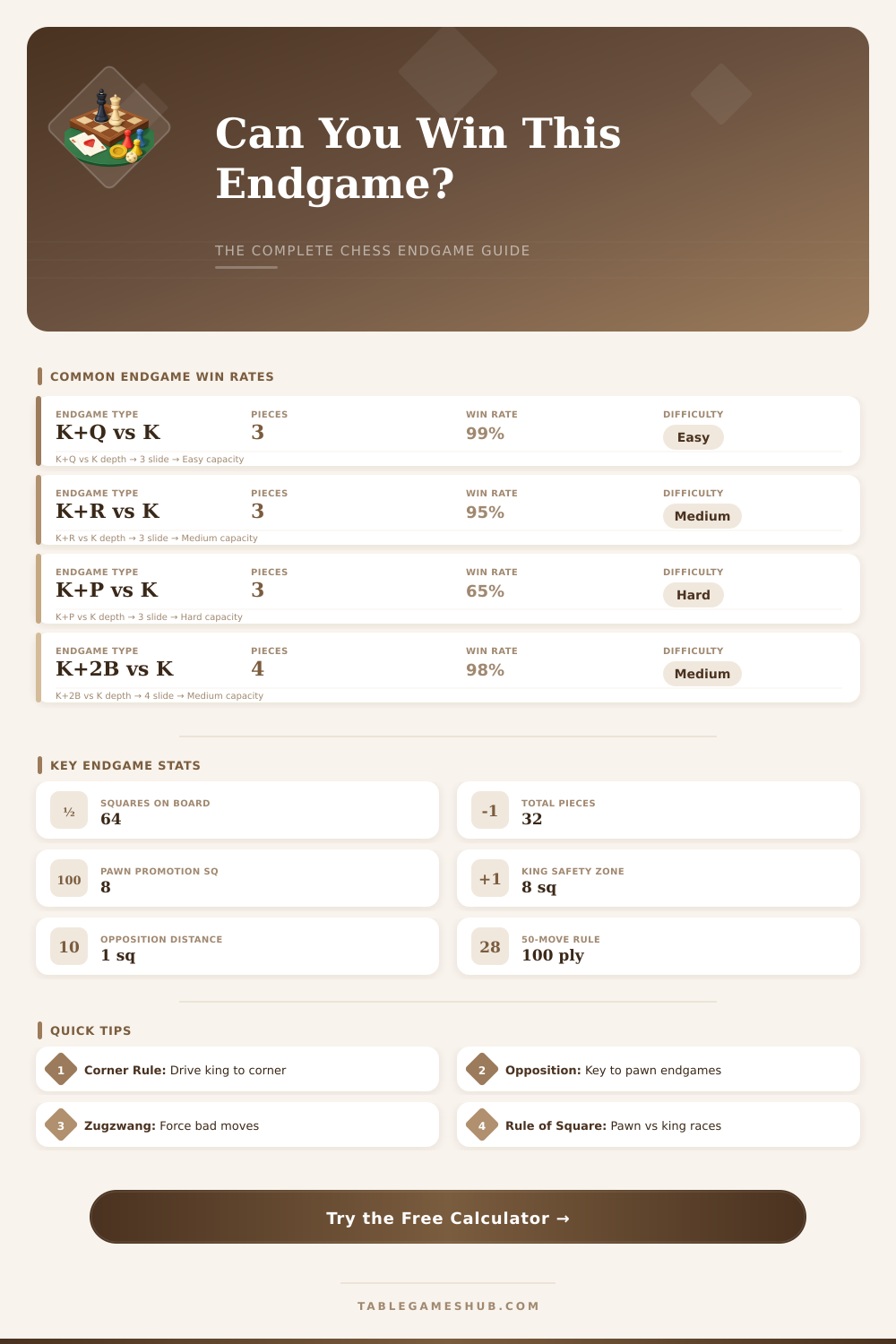
| Endgame Type | Material | Win Rate (Strong Side) | Avg Moves to Mate | Draw Possible? |
|---|---|---|---|---|
| Queen vs King | K+Q vs K | 99% | ~10 | No (forced mate) |
| Rook vs King | K+R vs K | 95% | ~16 | Rare stalemate |
| Two Bishops vs King | K+BB vs K | 98% | ~19 | Only stalemate |
| Bishop + Knight vs King | K+BN vs K | 95% | ~33 | Stalemate risk |
| Pawn Endgame (center) | K+P vs K | 65% | ~20 | Yes (key sq) |
| Pawn Endgame (rook file) | K+aP vs K | 35% | N/A | Yes (frequent) |
| Two Knights vs King | K+NN vs K | 0% | N/A | Yes (no forced) |
| Rook vs Rook | K+R vs K+R | 15% | N/A | Yes (very likely) |
| Queen vs Rook | K+Q vs K+R | 80% | ~35 | Yes (fortress) |
| Opposite Color Bishops | K+B+P vs K+B | 40% | N/A | Yes (common) |
| Pawn Rank | Key Squares (White) | Steps to Promotion | Rule of Square Diagonal | Win/Draw Assessment |
|---|---|---|---|---|
| Rank 2 | c4, d4, e4 | 5 moves | 5x5 | King must reach key sq |
| Rank 3 | c4, d4, e4 | 4 moves | 4x4 | King must reach key sq |
| Rank 4 | c5, d5, e5 | 3 moves | 3x3 | Usually winning |
| Rank 5 | c6, d6, e6 | 2 moves | 2x2 | Usually winning |
| Rank 6 | d7, e7 | 1 move | 1x1 | Promotion imminent |
| Rank 7 | d8 (promo sq) | 0 moves | N/A | Win if queening safe |
| Board Type | Square Size (in) | Board Size (in) | Square Size (cm) | Board Size (cm) |
|---|---|---|---|---|
| FIDE Tournament Standard | 2.20 – 2.36 | 17.6 – 18.9 | 5.5 – 6.0 | 44 – 48 |
| Club Play | 2.00 – 2.50 | 16 – 20 | 5.0 – 6.35 | 40 – 51 |
| Casual / Beginner | 1.50 – 2.00 | 12 – 16 | 3.8 – 5.0 | 30 – 40 |
| Travel / Portable | 0.75 – 1.25 | 6 – 10 | 1.9 – 3.2 | 15 – 26 |
| Giant / Display | 4.00 – 8.00 | 32 – 64 | 10 – 20 | 80 – 160 |
| Piece | Point Value | Endgame Mobility | Mating Potential | Endgame Role |
|---|---|---|---|---|
| Queen (♕) | 9 | 27 max squares | Alone + King | Dominant, fast mate |
| Rook (♖) | 5 | 14 max squares | Alone + King | Cut off enemy king |
| Bishop (♗) | 3 | 13 max squares | Pair or + Knight | Long diagonal control |
| Knight (♘) | 3 | 8 max squares | Pair or + Bishop | Short range, tricky |
| Pawn (♙) | 1 | 1–2 forward | Via promotion | Promotion is key goal |
| King (♔) | Infinite | 8 max squares | Support piece | Active in endgame |
The Endgame is the last stage of a Chess game. It comes after the middle game, when on the board stay only some pieces. The line between the middle game and the Endgame is not always clear.
It can arrive slowly or after sudden change of pieces. There is no single precise definition about what counts as an Endgame. Some think that a position without queens already is an Endgame but others would not agree with that.
What is the Chess Endgame?
Thinking about the Endgame through the role of the king helps a lot. The Endgame starts, when the king no longer needs to hide and becomes an active piece in the game. Because only few pieces stay, the king can safely enter the fight.
It is enough that on the board be only some chosen pieces, and they can be of any kind. Because the king always stays here, the various mixes of the remaining pieces give many types of Endgames.
Endgames require much thinking. With fewer pieces, the position gets simpler, so that players can plan more ahead. That however also makes it sensitive.
Mastering the Chess Endgame is hard, because it depends on precise thinking, deep understanding of ideas and knowledge about basic techniques. Knowing how too push pawns forms a big part of that. Sometimes one must give up certain pieces, to reach a pawn that passed.
Some ideas deserve learning. Ideas like the square of the pawn, opposition, stalemate, pawn push and triangulation appear often in Endgame positions. Other general rules include zugzwang, bring the king to the centre and lay the tower behind passed pawns.
Those ideas relate to special kinds of Endgames.
Traditionally one learns Chess the other way around. So one studies first Endgames, later middle games, later openings. The reason is simple: most games finally arrive to an Endgame, especially at higher skill levels.
At lower levels players often lose pieces or suffer checkmate before the Endgame starts. But when players progress, Endgames become more and more important. Between 1600 and 1800 points, many games reach the Endgame without big mistakes in the middle game from any side.
Studying Endgames one can sort by kind of pieces. It starts with king and pawn Endgames, later moves to knight and pawn Endgames, knight against bishop Endgames, bishop and pawn Endgames, tower and pawn Endgames and queen and pawn Endgames. Playing games with longer time controls, like fast or daily Chess, also helps to improve.
Swapping quick games for focused practice of Endgames with books or puzzles can bring a quick gain of many points. Training apps and Endgame coaches allow players to practice thousands of positions against thecomputer.
Now Chess engines use Endgame tables, which are pre-computed data. They carry every possible position in certain Endgames and the result, whether it is a draw or how many moves stay to win or lose with perfect play. Even so computers are not always perfect, and some positions people understand better than engines.