Vampire The Masquerade Dice Calculator
Model V5 d10 pools with normal dice, hunger dice, difficulty, messy criticals, bestial failures, and willpower reroll estimates.
| Final successes | Exact odds | At least this many | Result band |
|---|
| Difficulty | Base success | After willpower | Messy critical | Bestial failure |
|---|
| Hunger dice | Normal dice held | Success chance | Messy critical | Bestial failure |
|---|
| Reroll cap | Success chance | Gain vs base | Messy critical | Bestial failure |
|---|
| Die result | Normal die | Hunger die | Calculator treatment |
|---|---|---|---|
| 1 | Failure | Possible bestial failure | Tracked as hunger-one risk if the roll fails |
| 2-5 | Failure | Failure | Available normal failures may be rerolled by willpower |
| 6-9 | One success | One success | Counts toward difficulty without critical pairing |
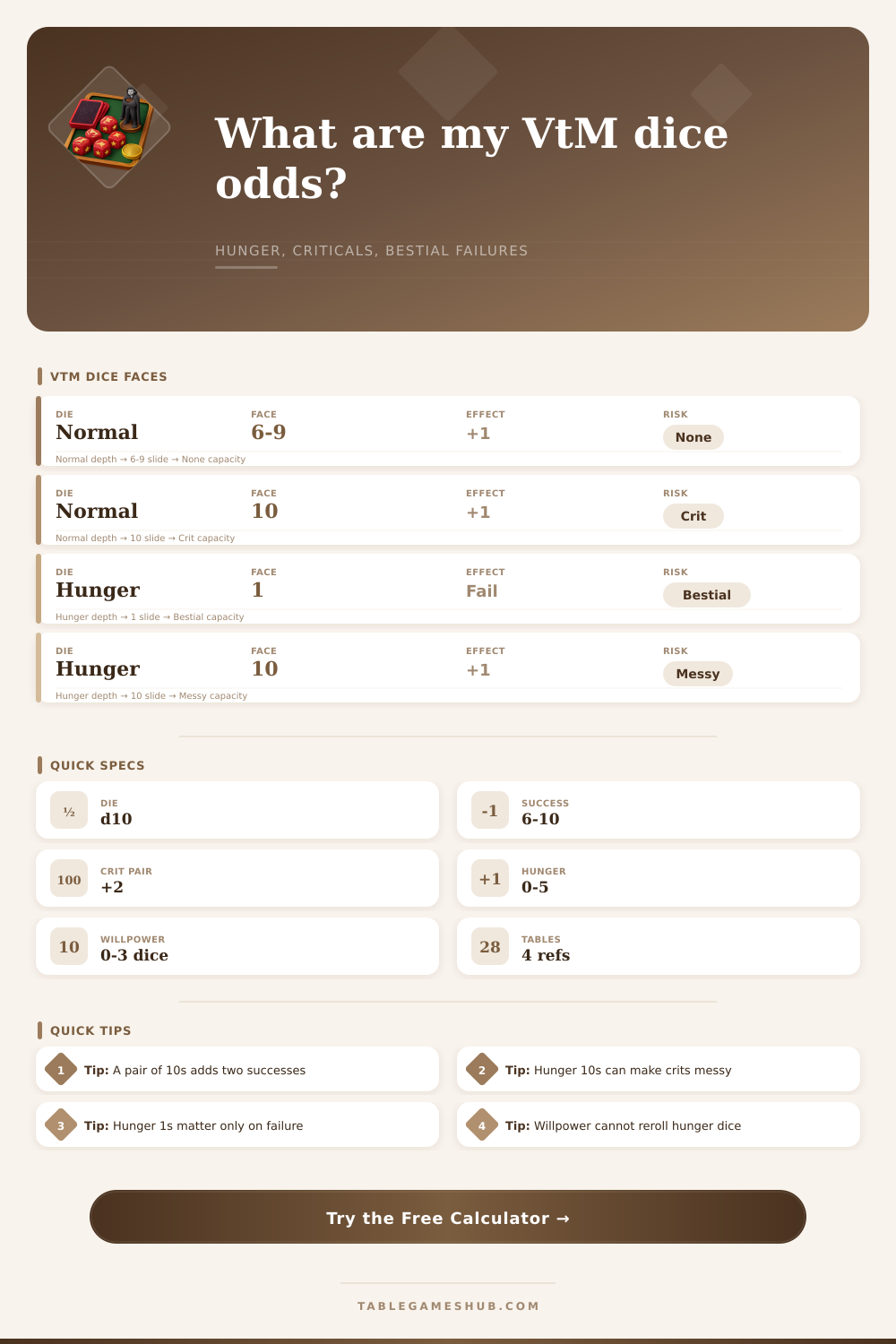
| 10 | One success and critical face | One success and messy face | Every pair of 10s adds two extra successes in V5 mode |
The dice system in Vampire the Masquerade involve the use of differents types of dice to determine the outcome of an action. In using the system, a player use normal dice to represent the character’s skills, but also use hunger dice to represent how close the character is to losing control for there hunger. The hunger dice function similarly to the normal dice in that each die will show successes on number six through ten; however, there are additional consequence to rolling certain number on the hunger dice.
For instance, if a character rolls a ten on a hunger die during a critical success, the result will be messier. Additionally, if the character rolls a one on a hunger die, a failure become a bestial failure. In order to understand the probability of the dice rolls, a player use a calculator.
Vampire the Masquerade Dice, Hunger and Calculator
The calculator ask for the number of normal and hunger dice to be rolled, the difficulty of the character’s task (a value set by the storyteller that represents the difficulty of the world to perform the task), and the margin target for the character (a value that determine if a success is significant or basic). The calculator will display the probability of both a clean win and a messy result. Thus, the calculator allow a player to understand the potential result of any given task.
The inputs for the calculator relate to decisions that the player has already made related to the character. For instance, the number of hunger dice to be rolled relate to the number of meals that the character has consumed and the pressure that the storyteller has applied to the character’s hunger. Willpower is another resource that can be spent to reroll dice; however, willpower cannot be used to reroll hunger dice.
Thus, willpower can only be used to reroll normal dice, and players use the calculator to understand the benefits that willpower will have when hunger dice are present on the table. Since willpower is a limited resource, players must make a decision about when and how often to use willpower during their character’s play. Many player make mistakes when rolling the dice for Vampire the Masquerade.
For instance, many players roll hunger dice as if they were normal dice, even though the presence of hunger dice introduce messy or bestial results. Additionally, some players fail to recognize that hunger dice cannot be rerolled, even if the player decide to spend their character’s willpower. Furthermore, some players also fail to recognize that the difficulty level for an action can change, but the storyteller fail to change the difficulty level in the calculator.
While the calculator does not prevent these mistake, it does allow players to roll the dice and run the numbers multiple times in order to make certain that they understand the potential outcome of a given action. The reference table inside the calculator allow for each player to quickly understand the meaning of each face of the dice. For instance, a ten on a normal die is a success, but a ten on a hunger die will produce a messy success.
Additionally, a one on a normal die is a failure, but a one on a hunger die will result in a bestial failure. These reference tables are helpful in that they display these different value for each type of die to the player, rather than requiring the player to memorize these different types of roll. Furthermore, these tables are also helpful in that they can be used to explain to new players the difference between normal and hunger dice.
Finally, the player can use the calculator to make strategic decisions prior to rolling the dice. For instance, the player can use the calculator to determine the outcome of rolling additional hunger dice. Additionally, the player can determine the outcome of adding normal dice to the pool of dice that are rolled for the character’s action.
These types of calculation help the player to determine if the character is willing to risk a stain on their humanity in order to achieve some specific goal. Thus, the calculator can be used as a helpful tool in making such decision.