Arboretum Garden Scoring Calculator
Score a candidate Arboretum path, test the species hand-control gate, and see whether your run length and card values are actually legal.
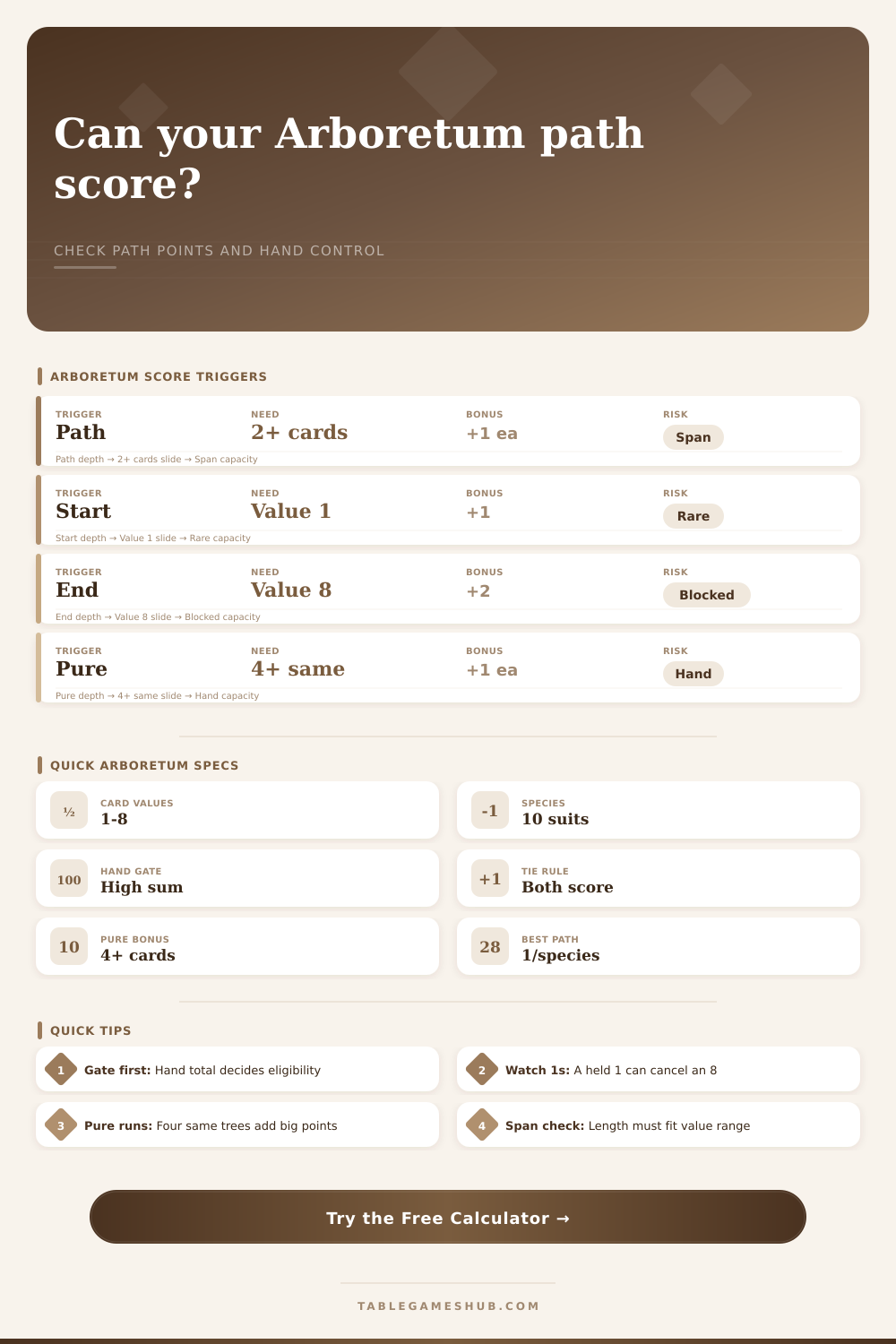
| Scoring part | Requirement | Points added | Calculator field |
|---|---|---|---|
| Card count | Legal ascending path with same-species endpoints | +1 per path card | Cards in chosen ascending path |
| Opening 1 | First card is value 1 and matches species | +1 total | Starting species card value |
| Closing 8 | Last card is value 8 and matches species | +2 total | Ending species card value |
| Pure path | 4+ cards and every card is the scoring species | +1 per path card | Same-species cards inside path |
| Hand state | Who may score | Important exception | Endgame impact |
|---|---|---|---|
| Your adjusted total is higher | You score one best path for that species | None | Path value converts to points |
| Adjusted totals are tied | All tied players may score that species | Ties include 0 totals | Your path remains live |
| Rival adjusted total is higher | Rival controls scoring rights | Your path scores 0 | Keep or reclaim hand values |
| Opponent holds the species 1 | Any held 8 of that species may become 0 | The 1 still counts as 1 | Large hand leads can vanish |
| Value span | Maximum legal cards | Common path shape | Score ceiling before hand gate |
|---|---|---|---|
| 1 to 8 | 8 cards | Perfect full run | 19 if pure |
| 2 to 8 | 7 cards | Strong late finish | 16 if pure |
| 1 to 6 | 6 cards | Early pure garden | 13 if pure |
| 3 to 7 | 5 cards | Compact middle lane | 10 if pure |
| 5 to 8 | 4 cards | Late four-card sprint | 10 if pure |
| Scenario | Path profile | Hand-control lesson | Expected result |
|---|---|---|---|
| Oak 1-to-8 Pure Avenue | 8 cards, all Oak | Small hand lead is enough | 19 points |
| Maple 8 Cancelled by Held 1 | 7-card pure finish | Opponent 1 can erase your 8 | Gate can close |
| Lilac Beautiful Path Denied | 6-card mixed climb | Board work alone is not enough | 0 if denied |
| Poinciana Span Trap Check | Too many cards for value range | Strictly ascending values limit length | Invalid path |
Building the perfect row of trees only to score nothing is heartbreaking for most board gamers. That’s when you lost the hand control race. The numbers says you didn’t own it even though you saw the path and admired its shape.
With this calculator, you won’t have to worry about that. It separates the eligibility checks from the path scoring, forcing you to look at hand requirements before looking at board. Most players is 100% focused on what they’re seeing on the board, because that’s where the visual progress occur. Hand total becomes an afterthought.
How to Use the Calculator
But this tool flips that priority. Before it will consider if your path is legal, it forces you to put down your hand totals first. It’s a small shift in mindset, but it changes how you play endgame.
“Here’s what you need to know: A path only exists if you have the right to score it. You may have an eight-card pure run of Oaks beginning with a one through an eight. Sounds like a nineteen-point powerhouse on paper. This is the theoretical ceiling of a single species.
But what if your rival has two additional Oak cards over yours? Then that avenue is nothing but art. Decoration. The calculator does the math for you but what it also does is shine light on reality of the species hand gate. You input your hand sum and your rival’s and it lets you know whether or not you’re eligible. The door closes; path value doesn’t matter.
And this is where most folks get it wrong. They do the points calculations first, then assume they’ll be eligible, and most times they won’t.”
But after you get through that gate, the tool will help you count up the path points correctly. Enter the number of same-species cards, the starting and ending values, and the length of the run you’re connecting to them. The tool then breaks it down piece by piece for you.
Every card in the path gets a base point. Starting on a one adds another bonus. Ending on an eight adds yet another bigger bonus. Then there’s the kicker. It is a double-boosting bonus called the pure path bonus. This multiplies value of each card in the run by two if they’re all the same species.
The breakdown is spelled out clearly in the reference table on the page. It explains when a shorter pure run can be outscored by a longer path with a mix of different species if the end-point bonuses is high enough. It makes you consider both purity of the species and the length of the path. If the path has lots of species jumbled together but you’ve got those end-point bonuses working for you, you may end up with a higher score than someone who took a shorter path but kept everything pure.
What’s especially nice about the tool is its presets, it lets you learn how the rules interact and what they mean to you as you play: For example, it will let you pretend that your opponent holds a one, which cancels out an eight in your hand. They cancel each other out. Even seasoned players forget about this small rule.
By default, an eight is eight points towards your total hand value. But if you have an eight and your opponent also has a one then your eight doesn’t count. That’s why it’s better to keep control of your hand instead of playing another card to extend the round because with that one card, you could of easily lose a big lead in seconds.
The calculator makes this adjustment for you and illustrates the point: the path length isn’t as critical than the gate. The tension between these two opposing forces is key to playing Arboretum well. On one hand you want to find long pure paths (for the points). But on the other, you also want your hand to contain disjointed cards with a lot of value (for the control).
That’s the trade-off the tool shows. You type in various hand totals and it shows how the eligibility changes accordingly. You try out varying path lengths and it shows how the pure bonus compares. It eliminates any guesswork when it comes time for final tally.
No longer will you hope you got the count right; instead, you’ll know precisely where those points come from. And better yet: You’ll know if you’re even allowed to keep them.
Ultimately though, what matters in the garden is how much you control it. Nice path? That is a bonus. Winning the hand race? That is a victory.
Before you do the discard, run it by the calculator. Check the path; check the gate; and then go for it. There is a difference between a garden that looks good and one that scores.