Troyes Score Calculator
Total your Troyes final score from VP tokens, activity-card citizens, uncountered event presence, cathedral penalties, deniers, influence, dice-color action previews, and all revealed character cards.
1.Scenario Presets
2.VP Tokens and End Scoring
3.Cathedral, Citizens, Cards, and Resources
4.Revealed Character Cards
Select only the character cards revealed in your game. In 2-player games each player begins with 2 secret character cards, but all revealed cards still score both players.
5.Dice Color Action Preview
Total Score
Character VP
End-Game VP
Dice Preview
Score Breakdown
6.Troyes Quick Reference Grid
7.End Scoring Table
| Scoring source | How to count it | Calculator field | Audit note |
|---|---|---|---|
| VP tokens | All tokens earned during play | VP tokens already gained | Hidden VP piles of 10 help recounts |
| Uncountered event presence | 1 VP for each uncountered event with your cube | Uncountered event cards | Marauding can qualify if you have presence |
| Activity-card citizens | Printed VP on occupied tradesman spaces | Activity-card citizen space VP | Citizen on illustration space is worth 0 VP |
| Cathedral penalty | Lose 2 VP for each cathedral level with no cubes | Cathedral cubes by level | Check all three levels separately |
8.Character Card Thresholds
| Character | Mission | 1 VP | 3 VP | 6 VP |
|---|---|---|---|---|
| Chretien de Troyes | Citizens on principal buildings | 3-4 (4-5 in 2P) | 5-6 (6-7 in 2P) | 7+ (8+ in 2P) |
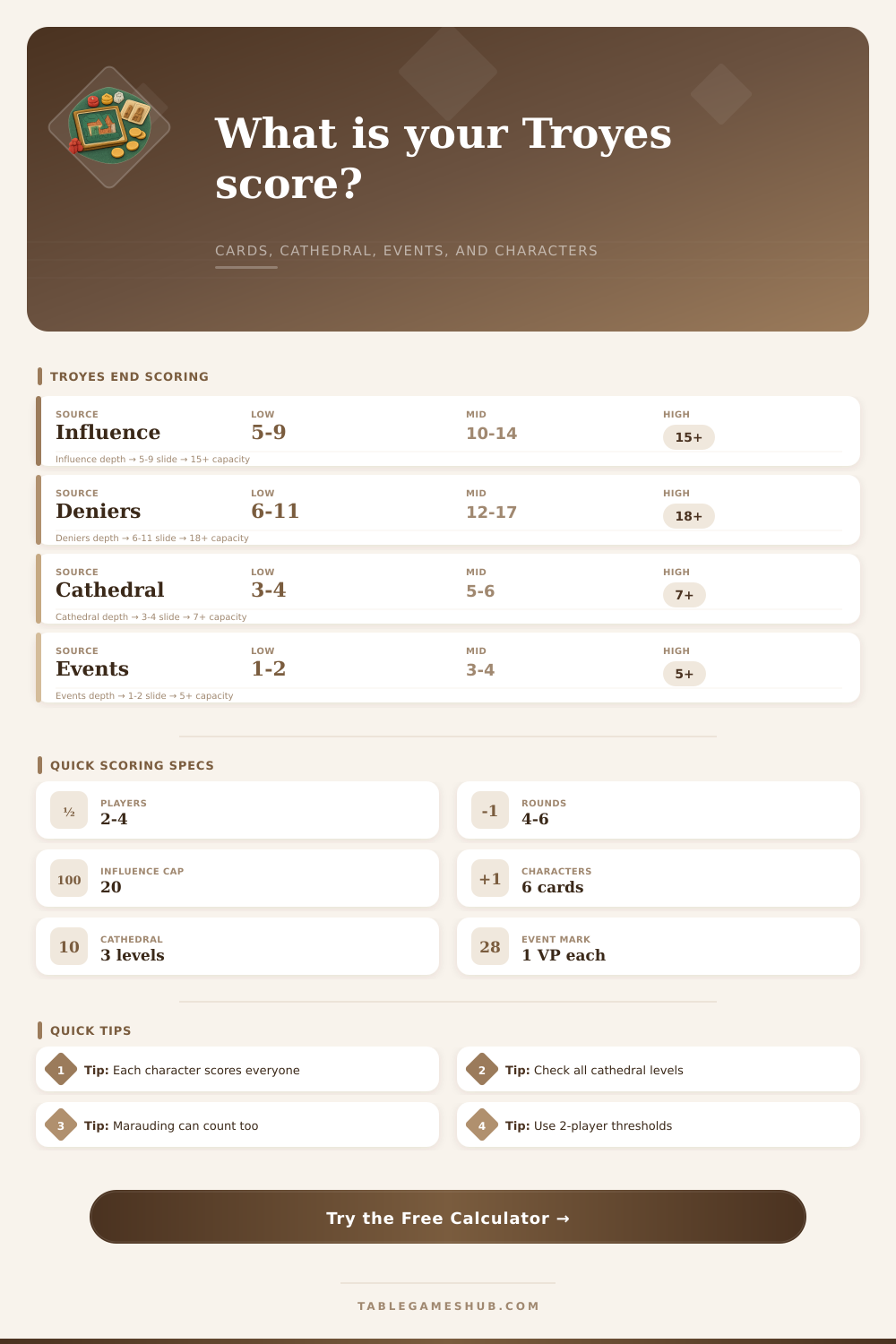
| Hugues de Payns | Influence points | 5-9 | 10-14 | 15+ |
| Urbain IV | Cubes on cathedral | 3-4 (4-5 in 2P) | 5-6 (6-7 in 2P) | 7+ (8+ in 2P) |
| Le Florentin | Tradesmen on activity cards | 2-3 | 4-5 | 6+ |
| Thibaut II | Deniers | 6-11 | 12-17 | 18+ |
| Henry I | Event cards won | 1-2 | 3-4 | 5+ |
9.Dice Colors and Action Checks
| Color | Building link | Common scoring use | Calculator reminder |
|---|---|---|---|
| Red dice | Palace | Military cards, events, Palace citizens | Red dice count double when countering black dice |
| White dice | Bishopric | Cathedral cubes and religious cards | Cathedral cube total feeds Urbain IV |
| Yellow dice | City Hall | Agriculture, civil cards, deniers | Agriculture gains total divided by 2, rounded down |
| Black dice | Events | Threat countering and influence gain | Countered event cards may feed Henry I |
10.Scoring Tips
Scoring and Mechanics
This is about military power. Religious Influence and Scoring The combination makes Troyes a fun game where you try not to screw up in the end game as points is scored. And it all comes down to each player’s final score in the last round. As each character card are turned over, everyone finds out how well they did. It’s nail-biting stuff when you see your opponent has all their deniers and a completed cathedral but didn’t quite make it past Hugues de Payns.
How to Score Points in Troyes
That single point can lose most games, so knowing how many points are needed is half the battle. That said, there’s an easy way to get the math done for you. Meet the Troyes Point Calculator. Get rid of the worry about doing math in your head and let it go so you can concentrate on the game, that is, unless you like doing math.
Before anything else, it’s important to understand that Troyes has asymmetric victory points. Yes, they come as separate packs and need different ingredients. You earn Token VP slowly through events and activity cards. You gain static end of game VP from events with no counter. You also gain it from the number of citizens on your activity cards. These are easy enough. Count what you’ve got.
Where things get spicy is when character card come into play. Each character card has its own requirements. These include a certain number of deniers held, cathedral cubes, influence levels, or citizens on buildings. Those limits change in a two-player game, often making them more difficult to achieve. This provides a level of strategy beyond chance, rewarding players who plan ahead instead of those with lucky dice rolls.
Many people fail to notice the cathedral penalty until it’s too late. You receive a -2 victory point penalty for every cathedral level that has zero cubes on it. This might not seem like much but if you don’t account for bishopric actions, the penalty adds up fast. Again, just a little detail here, but when the margin is slim, it matters hugely.
You might be able to win events, you might be able to build up influence, but a hollow cathedral becomes your anchor, dragging your overall score down. To counteract this, the tool allows you to enter how many cubes there are at each level so the correct penalty is applied without having to remember which levels remained empty.
Compare Countered Event Presence to Won Event Cards. Both involve black dice events, but people confuse them as being interchangeable. If an event is countered and it’s your turn with the most cubes on the card, then you score the event card (which scores toward Henry I’s mission). But if an event goes uncountered and all you’ve got is just a cube there by the end of the game, that gets you a direct victory point. They’re two different streams of income.
One gives you raw points and the other flows into a character threshold. Miscalculation here will cost you games. Knowing the difference will help you decide whether to spend cubes to counter an event or save them for presence.
There’s also careful thought needed when it comes to influence scoring. You get points in the Influence Track, and Hugues de Payns gives you points depending on where you are in it. However, he caps those points. After twenty influence, any additional points don’t apply to his mission. So if you hoard influence past that point with him, it doesn’t help you at all.
It can still block others and help you win events, but it won’t increase your score with Hugues. Knowing his limit helps you better manage your resources. Instead of maxing out his influence, maybe you’ll save deniers for Thibaut II.
Finally there’s the dice preview feature which shows you how activities use their dice. You input the number of dice you have and the divisor they add on top and it’ll tell you roughly how many times you’re going to activate that card. That way you can make an informed decision on if it’s worth it for you to buy additional dice or spend turns doing something else.
It won’t predict the future exactly, but knowing the odds and having a handle on your resources will go a long way towards helping out.
The truth is, scoring Troyes isn’t about maxing out a particular category. It’s about juggling several scores to get the most out of all sources. How many citizens do you have to satisfy Chretien de Troyes? Enough. And how much influence do you need to give Hugues and perhaps a little extra for Thibaut?
There’s no such thing as dominating with a single strategy… Unless you execute it perfectly.
Then again, the calculator gives you the power to turn what could of been a tense recount into an easy audit of your efforts. It provides a clear picture of where you excelled and fell short. This is good not only for this round of play, but for improving your strategy next time around. You walk away from the table knowing exactly why you won or why you didn’t.
That’s mastering Troyes. One calculated score at a time.