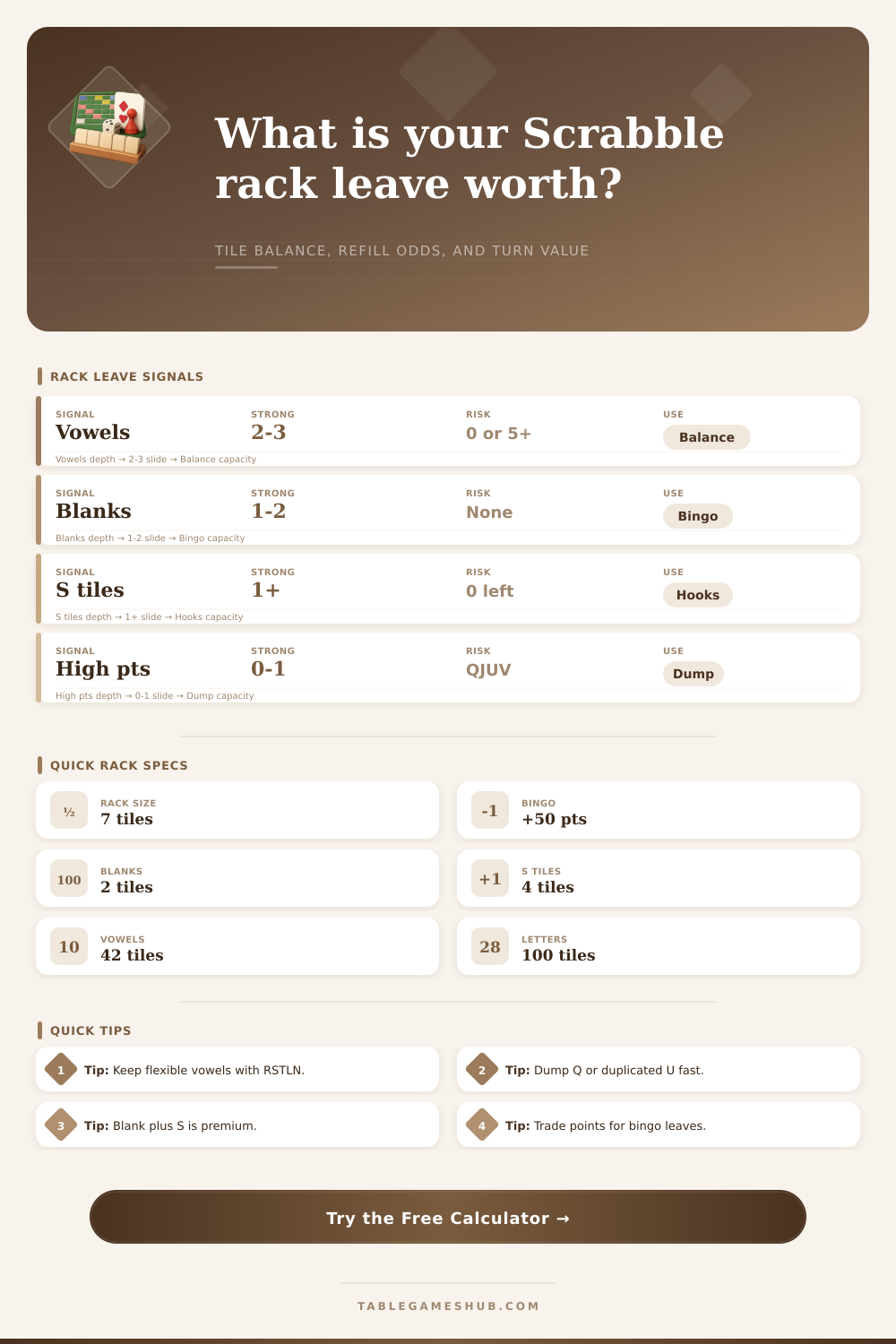
🔠 Scrabble Rack Leave Calculator
Rate the tiles you keep after a play by balance, duplicate drag, point burden, blank and S value, refill odds, bingo readiness, and total turn value.
1Rack Leave Presets
Load a realistic leave pattern, then edit the board, bag, and score fields for the position on your score sheet.
2Leave, Score, and Bag Inputs
3Rack Leave Results
4Four Formula Cards
Rack Leave Equity
tile value + synergy - drag
Letter equity starts the rating, then vowel balance, duplicates, high-point burden, and stem synergy adjust it.
Refill Odds
1 - C(pool-target, draw) / C(pool, draw)
Blank and S odds estimate whether the refill can upgrade a leave without pretending to know the exact draw.
Turn Value
play score + leave equity
This compares a lower-scoring play with a stronger leave against a higher-scoring play with a weaker leave.
Bingo Readiness
balance + stems + lanes + odds
Seven-tile potential rises with blanks, S hooks, common stems, open lanes, and a refill that fixes missing vowels or consonants.
5Scrabble Spec Grid
6Rack Leave Reference Tables
| Band | Equity Range | Typical Leave | Practical Meaning |
|---|---|---|---|
| Premium | +10 or better | ? S plus balanced vowels | Often worth taking fewer points now for a stronger next turn. |
| Strong | +4 to +9.9 | AEIRST, RETIN, AELNS | Good bingo pressure and flexible scoring options. |
| Playable | -2 to +3.9 | One flaw, balanced shape | Acceptable when the play scores enough immediate points. |
| Risky | -8 to -2.1 | Duplicate vowels or heavy consonants | Needs score, board access, or a known helpful bag to justify. |
| Repair Now | Below -8 | Q without U, VVW, IIIUU | Consider dumping tiles or exchanging if score does not compensate. |
| Tile Group | Leave Effect | Why It Matters | Calculator Treatment |
|---|---|---|---|
| Blank | Very strong | Represents any missing letter and raises bingo potential. | Large positive tile equity and bingo boost. |
| S | Strong | Creates hooks, plurals, and extension plays. | High leave equity plus S draw odds tracking. |
| E, A, I, R, T, N | Flexible | Builds common stems and keeps many bingo lanes alive. | Positive equity with synergy bonuses. |
| U, V, W, repeated I or O | Clunky | Harder to combine cleanly, especially in duplicate form. | Balance and duplicate drag increase quickly. |
| Q, J, Z without plan | Volatile | Can score now but may freeze the rack if kept. | Point burden penalty with Q-without-U warning. |
| Shape | Example | Best Board Context | Decision Note |
|---|---|---|---|
| Balanced six-tile stem | AEIRST | Open or normal board | Excellent when drawing one tile into bingo lanes. |
| Blank plus four good letters | ?AERT | Any board with lanes | Usually preserve unless the immediate score gap is large. |
| Vowel-heavy leave | AEEIO | Open consonant-rich bag | Playable only if unseen consonants are plentiful. |
| Consonant-heavy leave | RSTMN | Vowel-rich bag | May become excellent after a vowel draw. |
| High tile stuck | QUV | Premium square access | Score or shed the high tile before it drags multiple turns. |
| Position | Keep | Draw Goal | Likely Choice |
|---|---|---|---|
| Score 24, leave AEIRST | Six strong tiles | Any bingo-friendly tile | Prefer leave over a small extra score. |
| Score 38, leave QI | Two awkward tiles | U or scoring lane | Only accept if score premium is large. |
| Score 12, leave ?AERT | Blank stem | S, L, N, I, or O | Strong fishing turn on open boards. |
| Score 30, leave AEEU | Vowel overload | R, S, T, N, L | Check bag consonants before accepting. |
| Late bag, leave S | One hook tile | Control opponent lanes | Defensive value may exceed raw bingo value. |
7Rack Leave Tips
Compare the whole turn, not the leave alone. A beautiful leave can be wrong if it sacrifices too many immediate points, while an ugly leave can be correct after a large score.
Use the bag to change the verdict. A vowel-heavy leave improves when consonants dominate the unseen pool, and a consonant wall improves when vowels are still plentiful.
Sometimes you’re stuck with a safe three-letter word, so you play it out of desperation… And then you end up holding Q, U, and V. You know that feeling. Bad luck? No. Poor rack leave managment.
What you throw away can be the difference between winning (or losing) high-scoring games over and over again. Most player only care about what’s on the board today. They don’t consider long-term value of tiles sitting in their hands. Once you plug in your specific leave pattern, the calculator do the rest.
Why Rack Management Is Important
Plug in your actualy leave pattern, and let the machine do its work; there is no need to guess if those other five points are worth locking yourself into an unplayable combination for the next couple turn.
The potential energy held by your tiles, that’s called rack equity. When you have a balanced hand such as AEIRST, there are lots of words you can make without having to worry about which partners they’ll work with. And that means you’re able to build bingo pressure: the threat that you’ll use all seven of your tiles to get a fifty-point bonus. Bingo pressure makes others play defensively, and very often makes them make mistakes or choose poor scoring move.
The tool consider how much this flexibility will help (and hurt) your short-term scoring goals. If you’re far behind, then maybe you’ve got to give up some equity in exchange for points. If you’re ahead, then leaving good hands intact is the name of the game. It keeps you in control and stops someone else from catching up if they happen to make one large word.
What’s in the bag? That determines what is in your rack. That’s why context matters. If you hold three vowels but there are only two vowels left in the bag, you are going to draw some consonants that may or may not work for you. This is horrible. But if half of bag is filled with vowels (A, E, I, O, U), then those three vowels are now strong.
It’s all laid out clearly in the reference table on the page, showing you how the number of unseen tiles impacts the value of the tiles you do have. Don’t forget: You’ve got seven letters, yes, but you also need to be looking at entire game state. Limiting your strategic view based off only the rack itself is a mistake.
One silent killer in rack management are duplicate letters. You’ll be less flexible if you hold on to two Es or two Rs, unless you intend to build them into parallel word. Because they restrict your word diversity, the calculator penalizes duplicates in its drag calculations.
It also accounts for blanks and S tiles uniquely because of their different use: An S tile is a hook, you can play off what’s already there with little effort. And a blank is nothing but choice; it can be whatever you need it to be. Often it’s smarter to keep that blank in reserve rather than playing it early just to gain a few points.
Certain tiles scores well, such as Q and Z. That’s great in the moment, but it also means less leave if you can’t play those letters right away. For example, if you are holding Q with no U, it can freeze your rack while you wait to draw another vowel or hope someone finds a rare word containing both. This tool highlights that danger.
When there’s room on the board to clear those tiles quickly, you might accept fewer points today to eliminate them. Otherwise, they’ll drain your value for several more turn.
These rules get flipped on their heads late in the game. As there are only a handful of tiles left in the bag, blocking your opponent becomes more important then leaving tiles for later. You may have control over premium squares or be able to prevent someone else from getting a bingo. In those cases, you may also choose to hold onto inferior letter combinations. That’s why the decision style setting allow you to change things up here, to shift away from finding opportunities and towards taking them away.
So to sum up: Good Scrabble require both short-term gain and long-term potential. Think of it as your letter portfolio. Some assets will appreciate; some will depreciate. Never make a play simply for its value on that single round. Make it so that you close down their options while keeping yours open. Every play is an investment in the next. Hold onto those tiles which leave you with the most freedom, and watch your advantage grow naturaly over time.