🀄 Mahjong Flower Bonus Calculator
Total flower, season, seat-match, animal, cap, and payment bonuses without mixing them into the base hand by mistake.
Set the tiles and table rule to calculate the flower bonus.
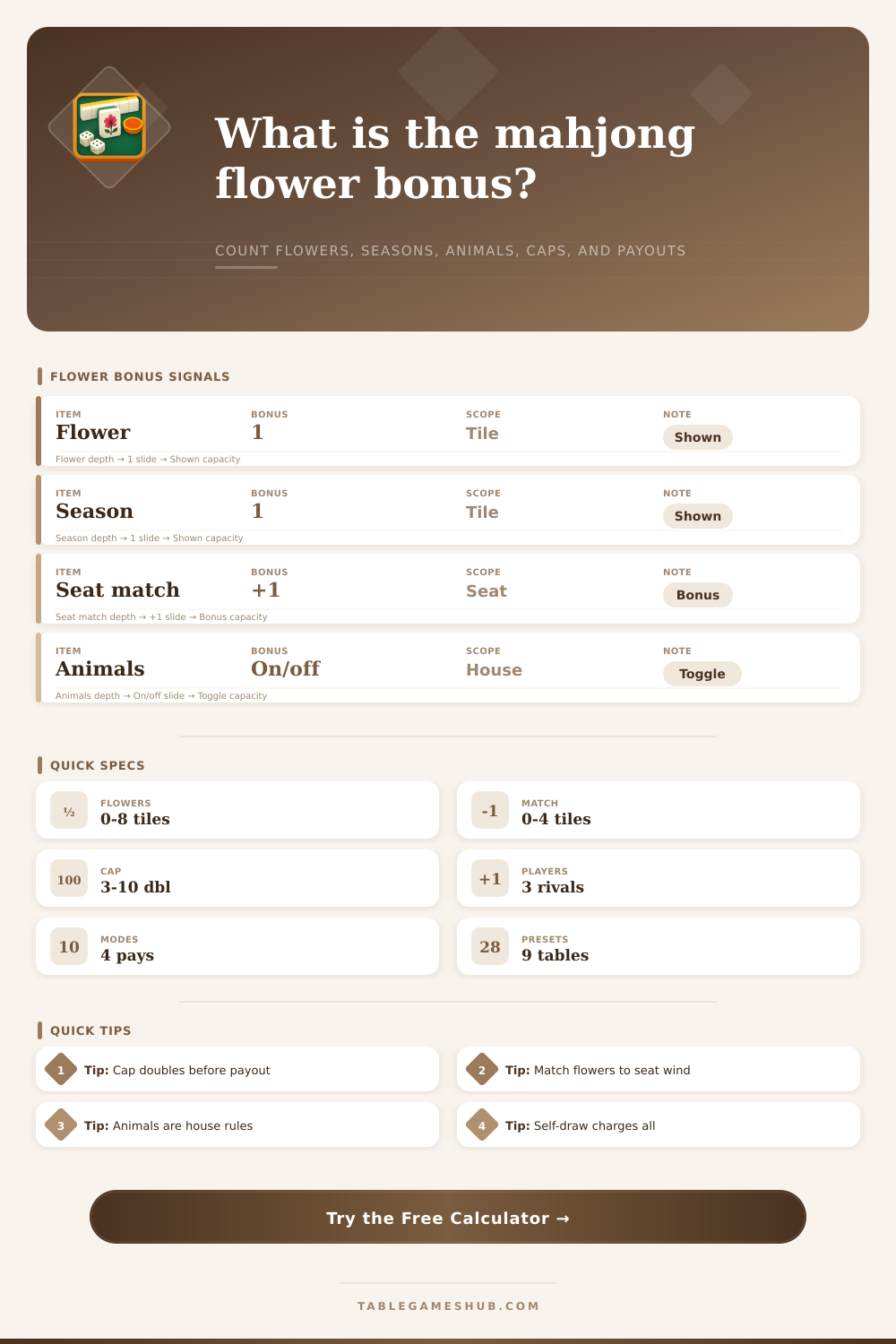
Flower doubles are added to the winning hand, capped, then converted through the selected payment mode.
| Source | Count | Doubles | Payment note |
|---|
Plum, orchid, chrysanthemum, and bamboo commonly map to East, South, West, and North.
Spring, summer, autumn, and winter usually mirror the same seat wind order.
Animals are house-rule bonuses, so this calculator keeps them separate from flower count.
Most four-player settlements convert a capped hand into payments from three opponents.
| Seat wind | Flower match | Season match | Typical note |
|---|---|---|---|
| East | Plum | Spring | Seat 1 pair |
| South | Orchid | Summer | Seat 2 pair |
| West | Chrysanthemum | Autumn | Seat 3 pair |
| North | Bamboo | Winter | Seat 4 pair |
| Table rule | Tile value | Match value | Set value |
|---|---|---|---|
| Casual every flower | 1 each | +1 each | +2 for 4 |
| Seat-only match | 0 each | 1 each | +1 for 4 |
| Set bonus table | 1 each | +1 each | +4 for 4 |
| Bonus-only table | 0 double | 0 double | flat only |
| Payment mode | Who pays | Hand gross | Best use |
|---|---|---|---|
| Discard 2:1 | All, shooter extra | 4 shares | Common splits |
| Discard even | All opponents | 3 shares | Softer tables |
| Shooter pays | Discarder only | 3 shares | Penalty tables |
| Self-draw | All opponents | 3 full chips | Drawn win |
| Counted doubles | Chip multiplier | 2:1 discard | Self-draw |
|---|---|---|---|
| 1 | 2x | 8x base | 6x base |
| 3 | 8x | 32x base | 24x base |
| 5 | 32x | 128x base | 96x base |
| 8 | 256x | 1024x base | 768x base |
Separate tile bonus from hand base
Count the winning hand first, then add flower, season, seat-match, and animal bonuses before applying the limit cap.
Confirm animals before settlement
Animal tiles vary by set and table, so keep the toggle off unless your group explicitly pays them as doubles or bite bonuses.
Even a small hand can change the odds depending on how many flower there are. Four flowers are enough to give you plain hand that holds only one chow, but it’s a winning hand!
You should of take advantage of flowers since they double point value rather than just adding a flat amount. Exponential growth is something many casual player underrate, which is why they makes this mistake. Multiple doublings add up to a much higher amount then a low starting score.
How Flower and Animal Tiles Change Your Score
Know the math of how your table add these bonuses before you play. House rules vary so much that calculator allows you to choose the rules you want to follow. Do you consider all flowers to be double points? Do you have to match your seat’s wind direction to your flower (for example, can you only hold plum blossoms while sitting East)? That makes a big difference.
Under tight rules it’s possible your hand may look like nothing but a weak one. If all flowers score, it could actualy be a strong hand. The tool reflect what you really agreed upon at the table, not some theoretical standard.
The second type is animal tiles which tend to be chaotic and not part of standard ruleset. They’re animal-themed (rooster? They are animal-themed, such as a rooster or a horse. Some folks don’t bother with them at all, while other people apply them as flat penalties or bonuses.
Because mixing animal rules with flower rules tends to lead to fights about who’s right, they has their own category in the calculator. Just click the animal switch to turn it on/off and the value will appear only for the animal tiles. That way you’ll always know exactly what those tiles is adding… Nothing else gets confused in there with basic score calculation.
There’s one very important catch, most of these are home game where there is a limit on the number of times a game can double (usually 5-8). After you hit that limit, any more flowers dont add anything to your winnings. That means, when you draw your fifth flower, it is worth exactly as much as drawing winner tile.
To avoid letting payouts get beyond the comfort zone of the table financially, the calculator consider this cap before doing calculations for each player’s payout. So it displays the total payout and then walks through who gets paid how (it could be everyone, or just person who discards).
The second is like flowers, you need to match a certain tile to the wind of your seat. North = winter, West = autumn, south = summer, east = spring. Under many rule sets, this get you an additional bonus of two points on top of whatever the tile might otherwise be. Because players frequently neglect to remember that seasons follow same direction as the compass points, holding an autumn tile when you’re seated with your back to the South can make it worthless in strict rules.
Reference tables is included so you can check which pairs go together without having to learn whole chart. A standard approach works to settle things faster and more equitably. Who really wants to argue about what flower goes where for this or that chair?
Plug in the tiles you recieved. Pick out set of agreed upon rules. Let the tool do the math. It becomes just a transaction, not an argument. Sure, the flowers are lucky in the game, but money they earn will come to them clearly.